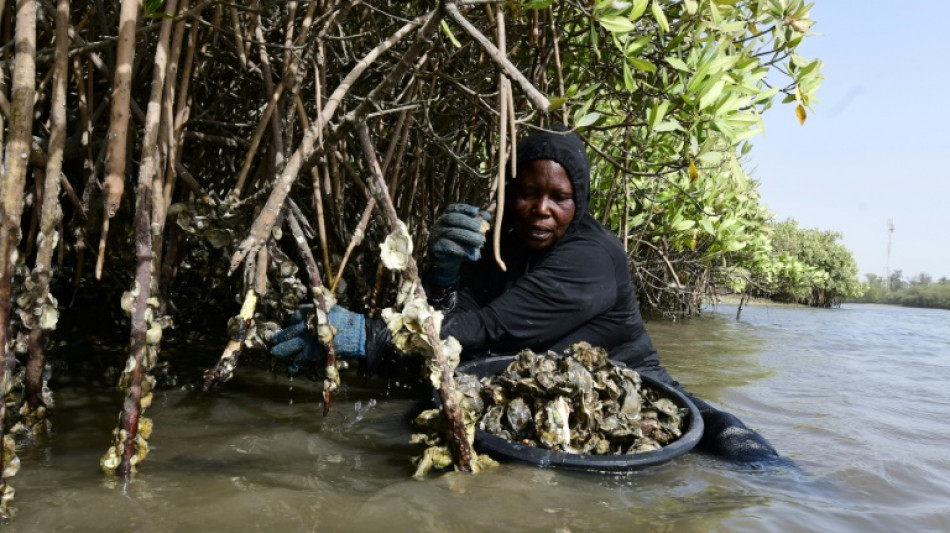
Senegal eyes economic boom in oyster farming / Photo: SEYLLOU - AFP

 Trump's beef policies irk Texas ranchers, testing their loyalty

 Nvidia, OpenAI CEOs to attend Xi dinner at White House

 Anthropic picks Accenture for in-house AI safety evaluation

 Balogun returns as Monaco beat Lens to continue strong Ligue 1 start

 'Pause' on overt repression in Venezuela, but reforms still needed: HRW

 Global stocks mixed as yen falls despite Bank of Japan rate hike

 Cuba hit with seventh major blackout of the year

 Murray out with concussion so Wentz will start for Vikings

 UN chief 'deeply regrets' US visa refusal to Abbas for annual meeting

 England quick Carse to face no charges over alleged nightclub assault

 Mancini brings nine newcomers into the first squad of his Italy comeback

 Czechs level Davis Cup tie against USA as South Korea eye Finals

 New France boss Zidane confirms Mbappe as captain after naming first squad

 California governor signs order to explore AI 'kill switch'

 Head leads run spree as Australia win Zimbabwe ODI series

 In-form Raphinha wants to finish career at Barcelona

 Warren Buffett steps down as Berkshire Hathaway chairman

 Carrick confident Man Utd can 'work through' tough time

 Mbappe ends Nike partnership to join Swiss brand On

 Liverpool boss Iraola puts Bournemouth love affair on hold

 'A disaster' if Man City do not win says Maresca after flawless start

 Kerry James Marshall: American 'blackness' painter celebrated in Europe

 Spain coach De la Fuente offers 'full support' to people of Ceuta

 Russia seizes assets of Nestle, French firms over West's Ukraine support

 England can build on World Cup 'spirit', says Tuchel

The mangrove swamp near Joal-Fadiouth, a fishing village in southern Senegal, teems with oysters.
But hunting for shellfish treasure among gnarly tree roots in brackish water is a lot of work.
Thousands of people -- the vast majority of them women -- make a living from oysters in Senegal, usually at a small and informal level.
But experts say the tropical West African state has huge prospects for ramping up oyster output to far greater levels.
"Oyster production is falling short of its potential," said Boubacar Banda Diop, in charge of the oyster sector at Senegal's fisheries ministry.
The possible harvest, in terms of protein and money, could be high, say champions of the oyster.
About 40 percent of Senegal's population of 17 million people live below the poverty line, according to a World Bank metric. In a nation where fish is a traditional staple, the country also suffers from overfishing and food insecurity.
In 2017, farmers plucked about 15,600 tonnes of oysters from Senegal's mangroves, according to the United Nations Food and Agriculture Organization (FAO). They also gathered about 400 tonnes from oyster beds.
By comparison, the world's largest oyster producer China harvests about 3.5 million tonnes per year, according to the French research institute Ifremer.
- 'Enormous' prospects -
Senegal's government has a development plan for the oyster industry, while the FAO and the European Union are putting forward ideas for techniques and breeding programmes to enhance production.
A small business in the Somone lagoon south of Dakar has already begun to apply some of the project's recommendations.
"We have doubled our production capacity compared to last year, going from three to six tonnes per year," the head of the business, Khadim Tine, told AFP.
But such successes are rare -- and the hurdles for those who want to make the jump from artisanal to industrial-scale farming are daunting.
Mamadou Bakhoum, the head of an association of villages in southern Senegal, said high water salinity caused by climate change meant there were fewer oysters than before.
But, he said, "if people get serious about it, the potential for developing oyster farming is enormous."
- Environmental factors -
Increasing the productivity of oyster farming while protecting Senegal's mangroves poses another environmental challenge.
The habitat features plants and shrubs growing in shallow semi-salty water, protecting against coastal erosion and nurturing a complex and invaluable ecosystem. Mangroves are already under increasing threat in Senegal, as elsewhere.
Abdou Karim Sall, president of the Joal-Fadiouth Marine Protected Area, aims to help farmers cultivate oysters without spoiling the mangroves.
Wooden trestles are placed in the swamp with wires hanging between supports just above the waterline.
Spats -- strings of oyster larvae that grow into the shellfish -- then begin to develop on the wires.
Sall said the method protects the mangrove but also allows the women farmers to produce more oysters and earn more money.
Local NGOs in Joal-Fadiouth have helped several women oyster farmers to start using the technique.
Selling oysters fresh -- as opposed to cooked, as is usual in Senegal -- could also boost returns for farmers.
Industry figures say that a dozen fresh Senegalese oysters sell for the equivalent of between seven and nine euros ($7.70-8.20).
That's a price that puts fresh oysters way of out of reach for many in the country --- wealthy tourists would be the target market for an expanded industry.
To meet it would problems are cold storage, transport infrastructure and sanitation standards.
Expanding the oyster business to an industrial scale requires systems to monitor water quality, as oyster farms are prone to contamination.
For water quality alone, a budget of about 305,000 euros ($335,000) would be needed for the first decade, according to Diop's ministry -- a big ask in a developing country.
F.Ferraz--PC



