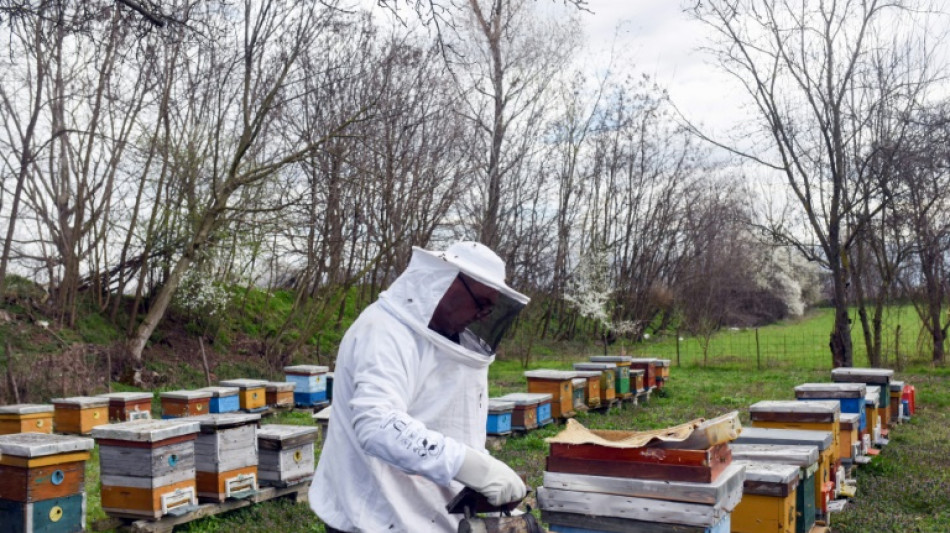
North Macedonia's beekeepers face climate change challenge / Photo: Robert ATANASOVSKI - AFP

 Inter Milan and Italy icon Mazzola dies aged 83

 Saudi capital issues first air raid alert since renewed fighting in Yemen

 Martin edges title rival Marquez for Austrian MotoGP pole

 Indonesia accepts Malaysia's help to tackle wildfires

 Indians living in Japan on stand-by to house Asian Games athletes
 Trump signs bill authorizing sweeping Russia sanctions

 Protesters form human chain at Kennedy Center after Trump threat

 Death toll from attack at police HQ in Pakistan rises to 31

 Trump says Denmark to give US 'permanent control' over Greenland security

 Kennedy Center: future unclear for iconic Washington arts hub

 Trump claims 'infinite' Greenland security deal with Denmark

 Helicopters battle wildfire threatening Ecuador's capital

 Brentford batter Chelsea to undo Alonso's promising start

 Kane hits Bundesliga century as Bayern rout Union

 Trump says CNN, MS NOW, Politico banned from White House

 Hushing and hedging: US companies retreat on climate

 Springboks to face Fiji before 2027 Rugby World Cup

 Nigeria miners struggled to breathe in cell before 37 died: survivors

 McIlroy on the charge at PGA Championship as Reed withdraws

 McIlroy on the charge at PGA Championship

 Crisis-wracked Volkswagen warns of 10-bn-euro hit to profits

 Costa Rica's Grynspan tops third informal poll for UN chief: diplomat

 Stock markets retreat after central bank rate hikes

 Russia labels director of Cannes Grand Prix winner a 'foreign agent'

 Macron warns of Russian 'hybrid' threat after meeting presidential hopefuls

Every day, Magda Miloseska dons a white, protective suit and enters the domain of the honeybees in the backyard of her small weekend house in North Macedonia.
She has been producing honey in this picturesque corner of the country for more than 20 years. But climate change and disease have made what used to be a simple pleasure much harder work, she says.
Stence is a hillside village in the west of the country, surrounded by mountains and at a level of 650 metres (2,130 feet). Temperatures in June already exceed 30 degrees Celsius (86 Fahrenheit), three-degrees higher than usual, according to the state meteorological office.
"In the past, beekeeping was much easier," said 63-year-old Miloseska. "Beekeeping was a treat.
"Now, we simply have to fight both the climate conditions and the diseases that have entered the beekeeping."
Just a hobby for some, but a source of income for others, beekeeping has surged in recent years in all regions of the country.
There were 6,900 beekeepers with 306,000 beehives registered across the country in 2023, according to the Food and Veterinary Agency.
But according to a European Commission study issued in July 2023, 10 percent of bees and butterflies are threatened with extinction in Europe -- largely due to human activities.
- Honey production down -
Miloseska may not have the data at her fingertips, but her everyday experience has made it clear to her something is wrong.
"Older beekeepers say that in the past they could get 30-50 kilograms (44-66 pounds) of honey from one beehive," she said.
"In this period, with these climate conditions, that is substantially decreased."
Today, in ideal conditions, the most you could hope for would be around 30 kilograms over one season, she added -- with average production between 10 and 20 kilos.
That relative scarcity has pushed prices up from to between 15 and 20 euros ($16-22) compared to 10 euros just two or three years ago.
Vladimir Petroski, who for the past 13 years has spent his free time caring for 120 beehives, has noted the same problem.
Whereas in the past they could expect 30-40 kilograms, he said, these days they had to be satisfied with 15 kilos per season.
And he agreed that climate change had fuelled the rise of the parasites and viruses that threaten wild and honey bees.
"Beekeepers need to educate themselves and adapt according to the conditions and the micro-climate where they work."
- Educate and adapt -
In fact, the beekeepers are already trying to find solutions themselves.
Their hive mind is made up of the regional beekeepers' associations, which promote good practice and organise honey festivals.
They agree the main challenges are the warm winters, swift changes of the temperature in spring -- and the long, dry periods that come with summer now stretching into September and October.
Environmental groups have called for government ministries and agencies to coordinate to tackle the problems that climate change pose for bees.
So far however, they say their warnings have gone largely unheeded.
The agriculture ministry is just as concerned about intensive agriculture, pesticides, loss of diversity and pollution.
While acknowledging the threat climate change poses, it has simply recommended closer monitoring of the bees' behaviour.
More data is certainly needed, says Frosina Pandurska Dramikjanin of the Macedonian Ecological Society, part of a project trying to understand the effect of climate change on bees.
But it also needs to be share between the relevant state institutions, she argued.
Without that, she told AFP, "it is harder to issue measures and recommendations".
A recent report from the United Nations Environmental Programme (UNEP) underlined the stakes, highlighting the key role bees play in food production and biodiversity.
Out of the 100 crop species that provide 90 percent of all food consumed worldwide, 71 are pollinated by bees, it reported.
P.Serra--PC



