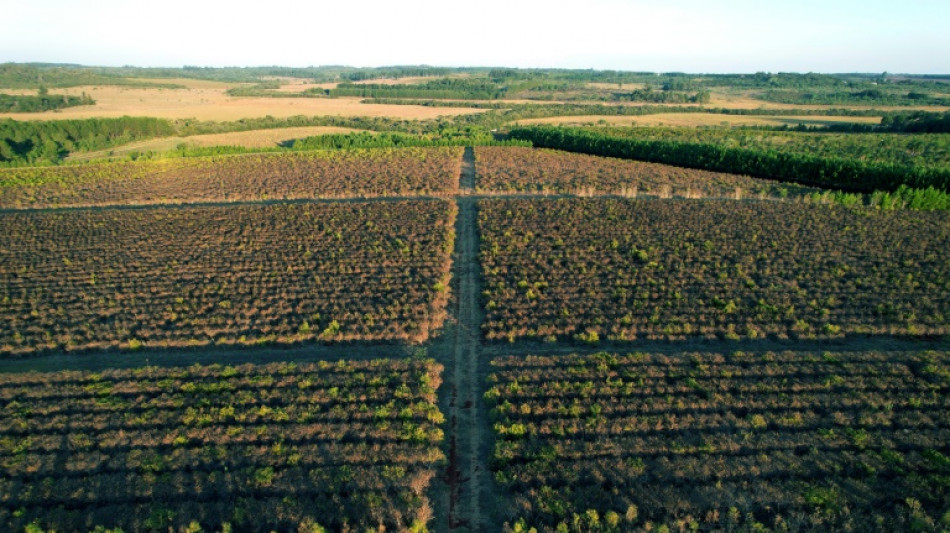
Restoring damaged land key to climate, biodiversity goals / Photo: JUAN MABROMATA - AFP/File

 Trump's beef policies irk Texas ranchers, testing their loyalty

 Nvidia, OpenAI CEOs to attend Xi dinner at White House

 Anthropic picks Accenture for in-house AI safety evaluation

 Balogun returns as Monaco beat Lens to continue strong Ligue 1 start

 'Pause' on overt repression in Venezuela, but reforms still needed: HRW

 Global stocks mixed as yen falls despite Bank of Japan rate hike

 Cuba hit with seventh major blackout of the year

 Murray out with concussion so Wentz will start for Vikings

 UN chief 'deeply regrets' US visa refusal to Abbas for annual meeting

 England quick Carse to face no charges over alleged nightclub assault

 Mancini brings nine newcomers into the first squad of his Italy comeback

 Czechs level Davis Cup tie against USA as South Korea eye Finals

 New France boss Zidane confirms Mbappe as captain after naming first squad

 California governor signs order to explore AI 'kill switch'

 Head leads run spree as Australia win Zimbabwe ODI series

 In-form Raphinha wants to finish career at Barcelona

 Warren Buffett steps down as Berkshire Hathaway chairman

 Carrick confident Man Utd can 'work through' tough time

 Mbappe ends Nike partnership to join Swiss brand On

 Liverpool boss Iraola puts Bournemouth love affair on hold

 'A disaster' if Man City do not win says Maresca after flawless start

 Kerry James Marshall: American 'blackness' painter celebrated in Europe

 Spain coach De la Fuente offers 'full support' to people of Ceuta

 Russia seizes assets of Nestle, French firms over West's Ukraine support

 England can build on World Cup 'spirit', says Tuchel

Unsustainable farming is on track to increase the amount of severely degraded land by an area the size of South America by mid-century, a UN report warned Wednesday, as experts said restoration was a matter of "survival".
Global food systems are responsible for 80 percent of deforestation and 70 percent of freshwater use, said the report.
They are also the single largest driver of species extinction, which is occurring 100 to 1,000 times more rapidly today than when human activity began to radically change the climate and degrade nature.
"The risk of widespread, abrupt or irreversible environmental change will grow," the Global Land Outlook 2 report warns.
The 40 percent of Earth's non-frozen land denatured by chemical-intensive exploitation threatens roughly half of global GDP, some $4 trillion, according to the 250-page peer-reviewed assessment, which called for action "on a crisis footing".
"How we manage and use land resources is threatening the health and continued survival of many species on Earth, including the human species," Ibrahim Thiaw, Executive Secretary of the UN convention charged with reversing land degradation told AFP.
"Business as usual is not a viable pathway for our continued survival and prosperity."
The flagship report of the UN Convention to Combat Desertification (UNCCD) comes two weeks before the treaty's 197 parties meet for the first time in three years, in Abidjan.
Adapting to an increase in drought and transitioning to sustainable agriculture top an agenda more broadly focused on restoring the health of one of Earth's vital resources: land.
- Agriculture's 1% -
At least 70 percent of ice-free land on Earth has been converted to human use, and most of that has been degraded. That means that things do not grow as much or as well as they used to.
"There's not a lot of land left," UNCCD chief scientist Barron Orr told AFP. "And yet, we still see an accelerated rate of land use change taking place."
The report reveals a startling level of concentration in the production of food.
At one extreme, one percent of agribusinesses control 70 percent of the world's agricultural land. At the other extreme, 80 percent of farms comprise only 12 percent of all farmland.
"The solution, at least in the initial phase, is not going to be converting land back to small holders," said Orr.
"It's making sure we move large agriculture into a much more sustainable space."
- Climate and nature -
The UN Paris Agreement's cornerstone climate goal is capping global warming below two degrees Celsius, and the biodiversity convention is aiming later this year to carve out 30 percent of Earth's surface as protected areas.
For the desertification convention, the core goal is "land degradation neutrality" by 2030.
Behind the cumbersome name is a simple concept that can be summed up as "no net loss": to ensure that, by 2030, the amount of degraded land in a given country has not expanded compared to a 2015 baseline.
Previously, the international response has been bogged down in arguments about metrics.
That problem hampered progress on the Great Green Wall, an ambitious, multi-decade scheme to reclaim agricultural land from the desert along the Sahel stretching 7,000 kilometres (more than 4,000 miles) from the Atlantic Ocean to the Red Sea.
Countries could not agree on how to monitor and measure progress. But the new benchmark is far easier to apply, said Orr.
- Competing for land -
The report contrasts different development scenarios out to mid-century.
A "business-as-usual" approach would see an additional 250 billion tonnes of CO2 or its equivalent released into the atmosphere by 2050 -- roughly four times current annual greenhouse gas emissions from all sources.
But a strategy of land restoration and protection could see the opposite: some 300 billion tonnes safely stored in soil and vegetation compared to a 2015 baseline -- equivalent to five years of current emissions.
Competition for land is heating up and there will be increasingly hard choices in the future over whether to carve out land for commodity crops, growing more food, C02-absorbing plantations, or to preserve as biodiversity corridors.
"We have to really think about that much more strategically," said Orr.
The report recommends for the first time scaling up the land rights of indigenous peoples as a climate solution and to ensure the success of projects to restore nature.
But indigenous groups, often shunted aside or pushed off their traditional homelands in the past, remain wary.
"We welcome new allies to this battle, including economic actors who are increasingly interested in avoiding climate risk, but we must make clear that we will not be used for greenwashing," said Jose Gregorio Diaz Mirabal, representing 511 indigenous groups in the Amazon basin.
"Partnering with Indigenous peoples requires embracing transformative change."
Ferreira--PC



