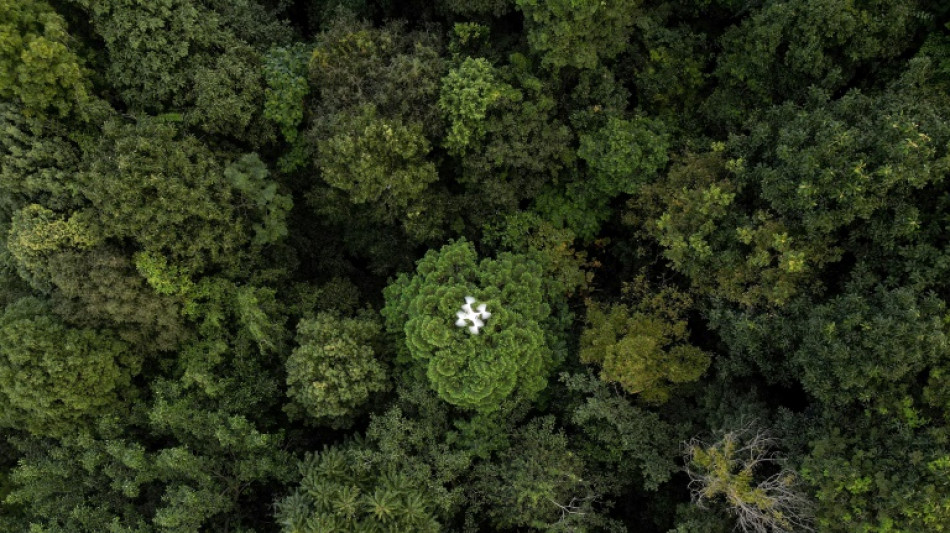
'Not the end of the world', says data scientist on the big issues / Photo: MANAN VATSYAYANA - AFP

 Inter Milan and Italy icon Mazzola dies aged 83

 Saudi capital issues first air raid alert since renewed fighting in Yemen

 Martin edges title rival Marquez for Austrian MotoGP pole

 Indonesia accepts Malaysia's help to tackle wildfires

 Indians living in Japan on stand-by to house Asian Games athletes

 Trump signs bill authorizing sweeping Russia sanctions

 Protesters form human chain at Kennedy Center after Trump threat

 Death toll from attack at police HQ in Pakistan rises to 31

 Trump says Denmark to give US 'permanent control' over Greenland security

 Kennedy Center: future unclear for iconic Washington arts hub

 Trump claims 'infinite' Greenland security deal with Denmark

 Helicopters battle wildfire threatening Ecuador's capital

 Brentford batter Chelsea to undo Alonso's promising start

 Kane hits Bundesliga century as Bayern rout Union

 Trump says CNN, MS NOW, Politico banned from White House

 Hushing and hedging: US companies retreat on climate

 Springboks to face Fiji before 2027 Rugby World Cup

 Nigeria miners struggled to breathe in cell before 37 died: survivors

 McIlroy on the charge at PGA Championship as Reed withdraws

 McIlroy on the charge at PGA Championship

 Crisis-wracked Volkswagen warns of 10-bn-euro hit to profits

 Costa Rica's Grynspan tops third informal poll for UN chief: diplomat

 Stock markets retreat after central bank rate hikes

 Russia labels director of Cannes Grand Prix winner a 'foreign agent'

 Macron warns of Russian 'hybrid' threat after meeting presidential hopefuls

Humanity has made great strides in recent decades: air is cleaner; poverty, deforestation and childhood mortality have fallen; gasoline cars -- and maybe coal -- are on the way out.
This optimistic take on the state of affairs may be startling to some, but not Hannah Ritchie, a Scottish data scientist whose first book lets the facts speak for themselves.
"We just are unaware of how bad the past was," Ritchie told AFP from Edinburgh.
"People are just unaware that at least half of kids died, that diseases were rife, that most people lived in poverty, that most of the world were hungry."
Her book, "Not the End of the World", presents an evidence-rich counterpoint to the view that everything is going in the wrong direction, and offers possible approaches to the burning challenges of our time.
That also means climate change, a problem that Ritchie -- who is lead researcher at the Our World in Data website based out of Oxford University -- is careful not to understate.
"If you skew too far in one direction, I don't actually think you're telling the true story. We need to be clear-eyed about the problem in front of us," she said.
"That's actually not useful -- to deny it, or downplay it, or not be serious about it. But at the same time, you also need to focus on solutions, so we actually drive progress forward."
Those solutions are not always obvious, Ritchie said, and focus can be misguided when it comes to choosing what personal action to take in aid of the planet.
Ritchie pointed to the tendency in rich countries to hype behaviours that have little real impact -- such as recycling or ensuring televisions are not left on stand-by mode -- while continuing to drive, fly and eat meat.
Assuming everything 'natural' is automatically good can also mask some inconvenient realities, she added.
Huddling around a campfire can produce a sense of closeness to nature, but burning wood belches out smoke harmful to humans and the planet.
"What looks sustainable is the natural cow in a green field eating grass. But actually, when you do the numbers on this, the meat substitute burger is vastly, vastly better on almost any environmental metric compared to the cows," she said.
An advocate of lab-grown meat, nuclear power and GMO, Ritchie does not relish being contrarian on tackling environmental problems.
"I don't take delight in being provocative. I just care about the truth," she said.
- Plastic and palm oil -
Ritchie's data-driven conclusions can run counter to the conventional wisdom about how to save the planet.
But they can be illuminating, identifying areas where resources might be better spent elsewhere.
For example, reducing the amount of plastic bags or bottles consumed in Europe might seem a good idea on paper.
But hardly any of the plastic in the sea originates from Europe, with most flowing from Asia, which does not have the same rigorous waste management schemes in place.
"If everyone in Europe stopped using plastics tomorrow the world's oceans would hardly notice the difference," Ritchie wrote in her book.
Palm oil -- the sworn enemy of environmental defenders -- is "an insanely productive plant" that generates far more oil per hectare of land than alternatives like soybean and coconut, she added.
"If we were to boycott palm oil and replace it with one of these alternatives, we would need far more farmland."
Synthetic fertilisers -- another target of environmental movements -- were essential to grow the food that sustains half the world's population.
"The reality is that the world cannot go organic. Too many of us rely on fertilisers to survive," Ritchie wrote, adding that many countries could still reduce the amount of fertiliser they use.
- 'Zombie statistics' -
Ritchie said "zombie statistics" -- bogus facts or figures that get regurgitated over and over -- have a lot to answer for.
Claims that the world's soils would be depleted after 60 more harvests had been repeated time and time again over the past decade despite lacking any reliable source, she said.
Her book returns often to food, not surprising when considering that what we eat, and how it is grown and transported, has a major impact on warming the planet.
Energy, which accounts for more than three-quarters of total greenhouse gas emissions, is in transition: electric cars, heat pumps, and solar energy are changing the game.
But the food system, which represents about a quarter, is far from igniting its own revolution and poses its own unique obstacles.
"For people, food is very identity-driven. It's very personal... And I think it's just much harder and much slower to change that," Ritchie said.
"I'm not that convinced that people move away from meat consumption to traditional plant based products. If you're looking for the large scale, rapid change that you need, people are not going to move to lentils and tofu."
O.Gaspar--PC



