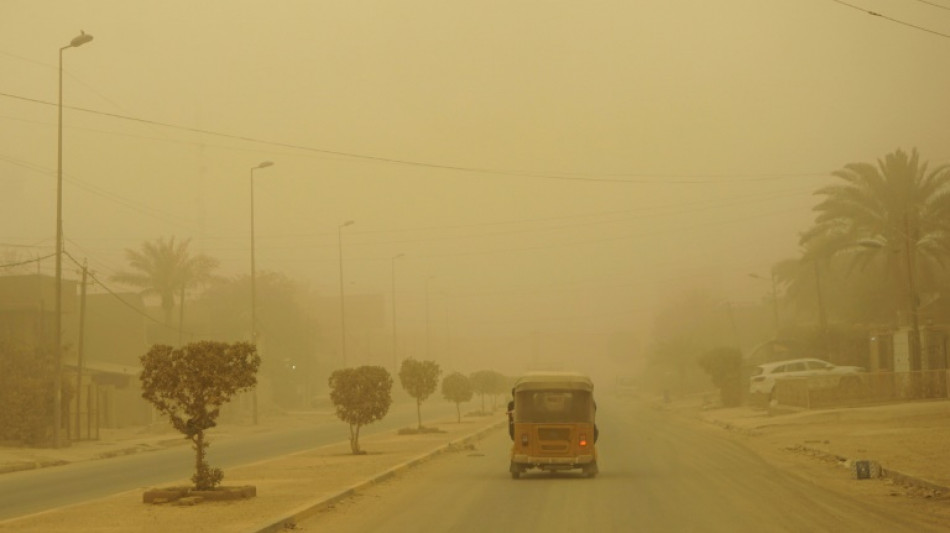
Thousands sick as latest severe sandstorm sweeps across Iraq / Photo: Sabah ARAR - AFP

 Trump's beef policies irk Texas ranchers, testing their loyalty

 Nvidia, OpenAI CEOs to attend Xi dinner at White House

 Anthropic picks Accenture for in-house AI safety evaluation

 Balogun returns as Monaco beat Lens to continue strong Ligue 1 start

 'Pause' on overt repression in Venezuela, but reforms still needed: HRW

 Global stocks mixed as yen falls despite Bank of Japan rate hike

 Cuba hit with seventh major blackout of the year

 Murray out with concussion so Wentz will start for Vikings

 UN chief 'deeply regrets' US visa refusal to Abbas for annual meeting

 England quick Carse to face no charges over alleged nightclub assault

 Mancini brings nine newcomers into the first squad of his Italy comeback

 Czechs level Davis Cup tie against USA as South Korea eye Finals

 New France boss Zidane confirms Mbappe as captain after naming first squad

 California governor signs order to explore AI 'kill switch'

 Head leads run spree as Australia win Zimbabwe ODI series

 In-form Raphinha wants to finish career at Barcelona

 Warren Buffett steps down as Berkshire Hathaway chairman

 Carrick confident Man Utd can 'work through' tough time

 Mbappe ends Nike partnership to join Swiss brand On

 Liverpool boss Iraola puts Bournemouth love affair on hold

 'A disaster' if Man City do not win says Maresca after flawless start

 Kerry James Marshall: American 'blackness' painter celebrated in Europe

 Spain coach De la Fuente offers 'full support' to people of Ceuta

 Russia seizes assets of Nestle, French firms over West's Ukraine support

 England can build on World Cup 'spirit', says Tuchel

One person died in Iraq and more than 5,000 were treated in hospitals Thursday for respiratory ailments due to a sandstorm, the seventh in a month, the health ministry said.
Duststorms have increased dramatically in frequency in Iraq in recent years, driven by soil degradation and intense droughts made worse by climate change, with rising average temperatures and sharply lower rainfall.
Residents of six of Iraq's 18 provinces, including Baghdad and the vast western region of Al-Anbar, awoke once again to a thick cloud of dust blanketing the sky.
As the storm swept across Iraq, it shrouded the capital Baghdad and the holy city of Najaf in ghostly orange clouds of choking dust.
"One death has been recorded in Baghdad" and hospitals "have received no less than 5,000 cases so far," health ministry spokesman Seif al-Badr said in a statement.
Those hit hardest are people suffering from "chronic respiratory diseases such as asthma", and the elderly who suffer in particular from heart ailments, he said.
Badr added that the majority had since been discharged and most cases were of "medium or low intensity".
Dust and sandstorms have always occurred in the Middle East but grown more frequent and intense in recent years, a trend that has been associated with overuse of river water, more dams, overgrazing and deforestation.
The fine dust particles can cause health problems such as asthma and cardiovascular ailments, and also spread bacteria and viruses as well as pesticides and other toxins.
Authorities in Al-Anbar and Kirkuk provinces, north of the capital, urged people "not to leave their homes", said the official INA news agency.
The storms are expected to grow more intense with worsening climate change because higher temperatures and more irregular rainfalls dry out land faster and accelerate desertification.
Sandstorms also cause economic damage by reducing visibility, sometimes to near zero, shuttering airports and highways and causing damage to buildings, vegetation and solar panels.
- '272 days of dust' -
Hospitals in Al-Anbar province had received more than 700 patients with breathing difficulties, said Anas Qais, a health official cited by INA.
The central province of Salaheddin reported more than 300 cases, while Diwaniya and the province of Najaf, south of Baghdad, each recorded about 100 cases, the news agency added.
Oil-rich Iraq, despite its mighty Tigris and Euphrates rivers, is classified as one of the world's five countries most vulnerable to climate change and desertification.
Scientists say climate change amplifies droughts and that their intensity and frequency in turn threaten food security. Experts have said these factors threaten to bring social and economic disaster in the war-scarred country.
In November, the World Bank warned Iraq -- a country of 41 million people -- could suffer a 20-percent drop in water resources by 2050 due to climate change.
The United Nations says about one-third of Iraq's population now lives in poverty.
The effects of low rainfall have been exacerbated as the levels of the Tigris and Euphrates drop because of upstream dams in neighbouring Iran and Turkey.
The environment ministry said the weather phenomenon could be addressed by "increasing vegetation cover and creating forests that act as windbreaks".
E.Paulino--PC



