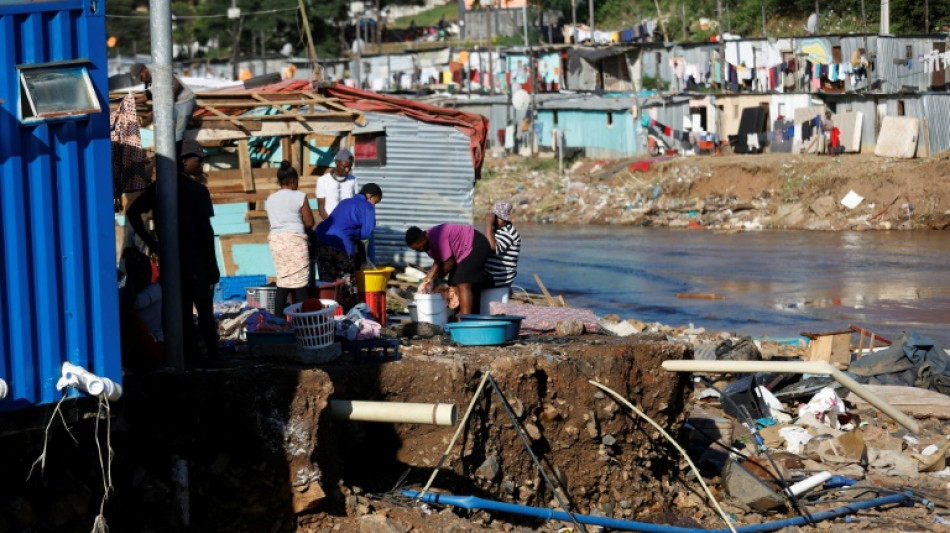
Climate change made deadly S. Africa rains twice as likely / Photo: Phill Magakoe - AFP/File

 Trump's beef policies irk Texas ranchers, testing their loyalty

 Nvidia, OpenAI CEOs to attend Xi dinner at White House

 Anthropic picks Accenture for in-house AI safety evaluation

 Balogun returns as Monaco beat Lens to continue strong Ligue 1 start

 'Pause' on overt repression in Venezuela, but reforms still needed: HRW

 Global stocks mixed as yen falls despite Bank of Japan rate hike

 Cuba hit with seventh major blackout of the year

 Murray out with concussion so Wentz will start for Vikings

 UN chief 'deeply regrets' US visa refusal to Abbas for annual meeting

 England quick Carse to face no charges over alleged nightclub assault

 Mancini brings nine newcomers into the first squad of his Italy comeback

 Czechs level Davis Cup tie against USA as South Korea eye Finals

 New France boss Zidane confirms Mbappe as captain after naming first squad

 California governor signs order to explore AI 'kill switch'

 Head leads run spree as Australia win Zimbabwe ODI series

 In-form Raphinha wants to finish career at Barcelona

 Warren Buffett steps down as Berkshire Hathaway chairman

 Carrick confident Man Utd can 'work through' tough time

 Mbappe ends Nike partnership to join Swiss brand On

 Liverpool boss Iraola puts Bournemouth love affair on hold

 'A disaster' if Man City do not win says Maresca after flawless start

 Kerry James Marshall: American 'blackness' painter celebrated in Europe

 Spain coach De la Fuente offers 'full support' to people of Ceuta

 Russia seizes assets of Nestle, French firms over West's Ukraine support

 England can build on World Cup 'spirit', says Tuchel

Rainfall that caused catastrophic floods and landslides last month in and around Durban, South Africa, was made twice as likely by global warming, scientists said Friday.
An exceptional downpour -- more than 35 centimetres (14 inches) over two days -- on April 11-12 claimed hundreds of lives and caused $1.5 billion in damage across the provinces KwaZulu-Natal and Eastern Cape.
Without climate change, rain of this intensity would happen roughly once every 40 years, according to a report from the World Weather Attribution consortium, a global network of scientists that quantify the impact of a warming world on individual extreme weather events.
But an increase in Earth's average surface temperature of nearly 1.2 degrees Celsius since the late-19th century has shortened that interval to about 20 years.
"The probability of an event such as the rainfall that resulted in this disaster has approximately doubled due to human-induced climate change," the scientists said in a statement.
As the planet continues to hot up in coming decades, so too will the frequency and intensity of devastating floods caused by these downpours, they warned.
The same is true for heatwaves, droughts, tropical cyclones -- also known as hurricanes or typhoons -- and wildfires.
Most of the world's nations have embraced a target of capping global warming at 1.5C, but current greenhouse gas reduction commitments would see temperatures rise far higher.
- Basic physics -
Scientists have long predicted such impacts. In the case of heavy rains, it's basic physics: every extra degree of global warming increases the amount of water in the atmosphere by about seven percent.
But only recently has an accumulation of climate data and more sophisticated tools made it possible to answer the most obvious of questions: To what extent is a particular weather disaster caused by global warming?
The heatwave, for example, that gripped western North America last June -- sending temperatures in Canada to a record 49.6C (121F) -- would have been "virtually impossible" without human-induced climate change, the WWA determined.
And record-setting rainfall and flooding last July in Germany and Belgium that left more than 200 dead up was made up to nine times more likely.
Friederike Otto, lead author of the South Africa assessment, said the destruction was a result not just rainfall intensity, but the exposure of human populations.
"Most people who died in the floods lived in informal settlements," said Otto, a scientist at Imperial College London's Grantham Institute and a pioneer in the burgeoning field of event attribution studies.
"So, again, we are seeing how climate change disproportionately impacts the most vulnerable people."
Early warning systems and urban infrastructure such sewage systems and flood controls are also critical factors.
The WWA is currently assessing the unprecedented heatwave that scorched large swathes of India and Pakistan during March and April.
F.Cardoso--PC



