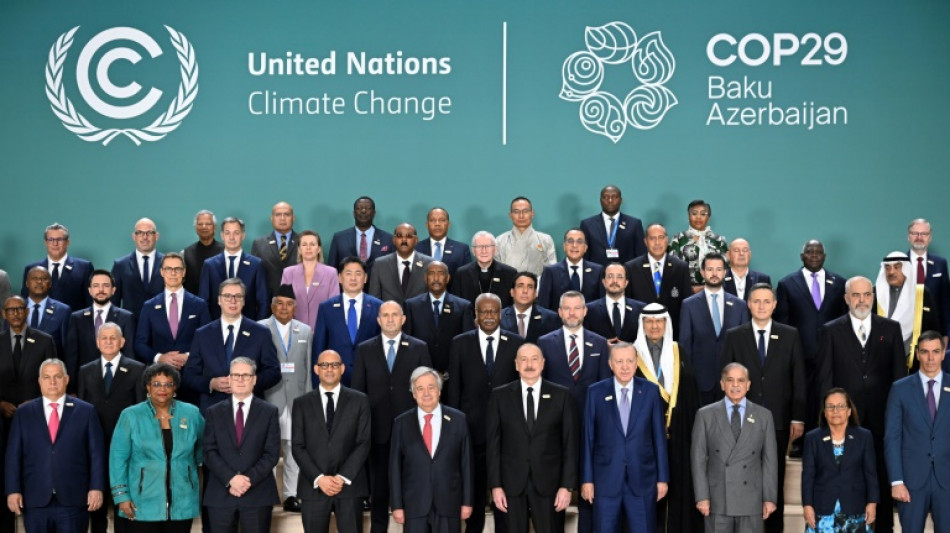
Climate finance: who is being asked to pay what at COP29? / Photo: Alexander NEMENOV - AFP

 Indonesia accepts Malaysia's help to tackle wildfires
 Indians living in Japan on stand-by to house Asian Games athletes
 Trump signs bill authorizing sweeping Russia sanctions

 Protesters form human chain at Kennedy Center after Trump threat

 Death toll from attack at police HQ in Pakistan rises to 31

 Trump says Denmark to give US 'permanent control' over Greenland security

 Kennedy Center: future unclear for iconic Washington arts hub

 Trump claims 'infinite' Greenland security deal with Denmark

 Helicopters battle wildfire threatening Ecuador's capital

 Brentford batter Chelsea to undo Alonso's promising start

 Kane hits Bundesliga century as Bayern rout Union

 Trump says CNN, MS NOW, Politico banned from White House

 Hushing and hedging: US companies retreat on climate

 Springboks to face Fiji before 2027 Rugby World Cup

 Nigeria miners struggled to breathe in cell before 37 died: survivors

 McIlroy on the charge at PGA Championship as Reed withdraws

 McIlroy on the charge at PGA Championship

 Crisis-wracked Volkswagen warns of 10-bn-euro hit to profits

 Costa Rica's Grynspan tops third informal poll for UN chief: diplomat

 Stock markets retreat after central bank rate hikes

 Russia labels director of Cannes Grand Prix winner a 'foreign agent'

 Macron warns of Russian 'hybrid' threat after meeting presidential hopefuls

 UN holds third informal poll for new chief

 Kulusevski return can spark Spurs: De Zerbi

 Shakira to cap off world tour with Madrid 12-gig run

"You owe us!" screamed a protest banner at the COP29 summit in Azerbaijan, where negotiations over how much rich nations most responsible for climate change should pay poorer ones are getting heated.
Striking a deal to provide the $1 trillion annually that experts say is needed by 2030 for developing countries is the top priority at COP29, but getting there will be a slog.
Countries are deeply divided: who should pay what, and how much, are just two of many obstacles standing in the way of an agreement being reached by November 22.
Here's a look at what developing countries need, and who is helping them foot the bill.
- How much is needed? -
A group of leading economists commissioned by the United Nations estimates that developing countries, excluding China, need $2.4 trillion a year in climate finance by 2030.
In a report published Thursday, these experts said two-thirds of this money was required to transition developing economies away from fossil fuels to cleaner forms of energy.
The rest should be divided between adaptation measures to cope with climate change, recovery funds when disaster hits, and conservation of nature.
Of the $2.4 trillion, an estimated $1.4 trillion will need to come from developing countries themselves.
But outside help will be required to cover the remaining $1 trillion.
That could be met by grants or zero-interest loans from foreign governments, private investment flows, or money raised from global taxes, according to the report.
- What should governments pay? -
How much comes directly from governments is the crux of the question for many at COP29, who feel wealthy donors like the United States and European Union are not doing enough.
Amar Bhattacharya, who co-authored the expert climate finance report, said that figure "would be somewhere in the kind of $300 to $400 billion range".
That is at least three times the current commitment -- a tall order for donors facing economic and political crises at home, and the prospect of Donald Trump withdrawing from global climate cooperation.
The cost keeps growing, too.
Developing countries are the least responsible for global warming, but the most exposed to climate shocks, which are accelerating as the planet warms.
By 2035, foreign donors will need to foot $1.3 billion a year to cover developing country needs, the report said.
- How much has been raised? -
Rich nations raised $116 billion in 2022 in climate finance, according to the latest available data from the OECD.
But is money used to make hotels more sustainable, in one stark example, really helping poorer countries adapt to climate change?
What about loans that add to national debt?
Developing countries and campaign groups have called for greater scrutiny of the money that's raised, and efforts have been made to quantify how much each nation gives.
One study done by British think tank ODI ranks progress toward each country's "fair share" based on its carbon footprint, population size and gross national income.
Based on this criteria, Norway led the pack in 2022, followed by France.
The United States -- the world's largest historic emitter -- ranked second to last among 23 nations assessed.
P.Queiroz--PC



