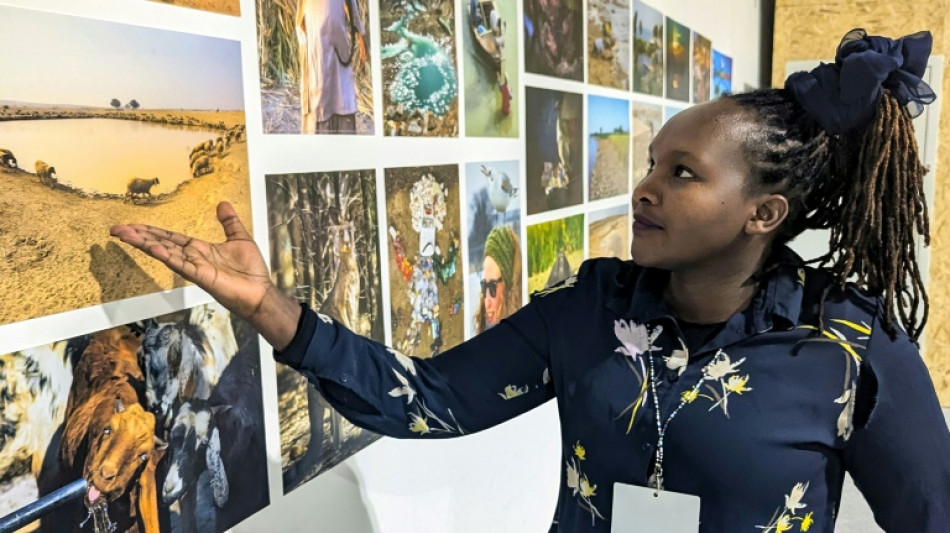
World not listening to us, laments Kenyan climate scientist at COP29 / Photo: Nick Perry - AFP

 Indonesia accepts Malaysia's help to tackle wildfires
 Indians living in Japan on stand-by to house Asian Games athletes
 Trump signs bill authorizing sweeping Russia sanctions

 Protesters form human chain at Kennedy Center after Trump threat

 Death toll from attack at police HQ in Pakistan rises to 31

 Trump says Denmark to give US 'permanent control' over Greenland security

 Kennedy Center: future unclear for iconic Washington arts hub

 Trump claims 'infinite' Greenland security deal with Denmark

 Helicopters battle wildfire threatening Ecuador's capital

 Brentford batter Chelsea to undo Alonso's promising start

 Kane hits Bundesliga century as Bayern rout Union

 Trump says CNN, MS NOW, Politico banned from White House

 Hushing and hedging: US companies retreat on climate

 Springboks to face Fiji before 2027 Rugby World Cup

 Nigeria miners struggled to breathe in cell before 37 died: survivors

 McIlroy on the charge at PGA Championship as Reed withdraws

 McIlroy on the charge at PGA Championship

 Crisis-wracked Volkswagen warns of 10-bn-euro hit to profits

 Costa Rica's Grynspan tops third informal poll for UN chief: diplomat

 Stock markets retreat after central bank rate hikes

 Russia labels director of Cannes Grand Prix winner a 'foreign agent'

 Macron warns of Russian 'hybrid' threat after meeting presidential hopefuls

 UN holds third informal poll for new chief

 Kulusevski return can spark Spurs: De Zerbi

 Shakira to cap off world tour with Madrid 12-gig run

Being an expert on global warming from an African nation prone to disaster can depress Joyce Kimutai during the creaking COP climate summits, where politics often drowns out science.
"If the world was listening to science, maybe we wouldn't be doing these COPs," the 36-year-old Kenyan climate scientist told AFP on the sidelines of this year's UN forum in Azerbaijan.
"We are very slow in how we take our action. We are afraid of taking bold steps. And I do not understand why."
As the conference approaches its second week, the world is no closer to agreeing to increase much-needed assistance for climate-vulnerable countries across Africa, Asia and Latin America.
Without this money, developing countries say they will struggle to move to clean energy, and adapt as climate shocks intensify.
The talks have gone around in circles, with diplomats no closer to consensus, testing those whose communities are at the mercy of ever more erratic and extreme weather.
"It's really frustrating," said Kimutai, who has been a lead author of reports by the UN's expert climate panel, the IPCC.
"I try to be optimistic, but honestly speaking, there are days that I wake up and I am very pessimistic, because you've seen the suffering of these communities of people who are vulnerable."
- Climate frontline -
Kimutai understands the price of climate inaction better than most huddled inside windowless negotiating rooms in a sports stadium in Baku for COP29.
Kimutai is a specialist in attributing humanity's role in warming the planet to extreme weather, and collaborates with a respected global network of scientists advancing this groundbreaking research.
"But I prefer to be based in the continent of Africa, because that is I feel that's where my expertise is required," said Kimutai, who lives in Nairobi.
There, Kimutai is not removed from the data she crunches.
This year, after suffering its worst drought in decades, Kenya was pounded by downpours and floods that killed hundreds of people and destroyed homes and roads in a costly trail of destruction.
Kimutai said in the Rift Valley, a hilly region where high school geography sparked her passion for science, landslides were becoming more frequent, seasons unreliable, and grass and water scarce for cattle.
Climate change was exacting a "terrible" toll in Kenya, she said, but it was no different elsewhere in Africa or other developing regions at the coalface of a warming planet.
"They are not ready for these events," Kimutai said.
Even wealthy countries would not be "spared", she said, pointing to recent deadly floods in Spain that caught a nation off-guard.
- 'Carrying the continent' -
At COP29, Kimutai is advising the Kenyan government as it pushes for a deal that commits wealthy nations most responsible for climate change to better help out poorer nations.
Donors are reluctant to commit large sums of new money and want others like China to chip in, one of numerous sticking points at COP29.
Kimutai said Kenya was "carrying the continent" as head of the Africa Group of Negotiators, which is seeking new finance that doesn't push nations into into debt.
"If you're experiencing three or four disasters in a year, that is four times going to donors... asking for money to respond. And that means you are constantly finding yourself in debt," she said.
Haggling over money to try and fix a problem caused by others was "humiliating" especially when time to act was running out, she said.
But it was important that science helped "inform policy, so that we can make the right decisions to have a better planet," added Kimutai.
X.Matos--PC



