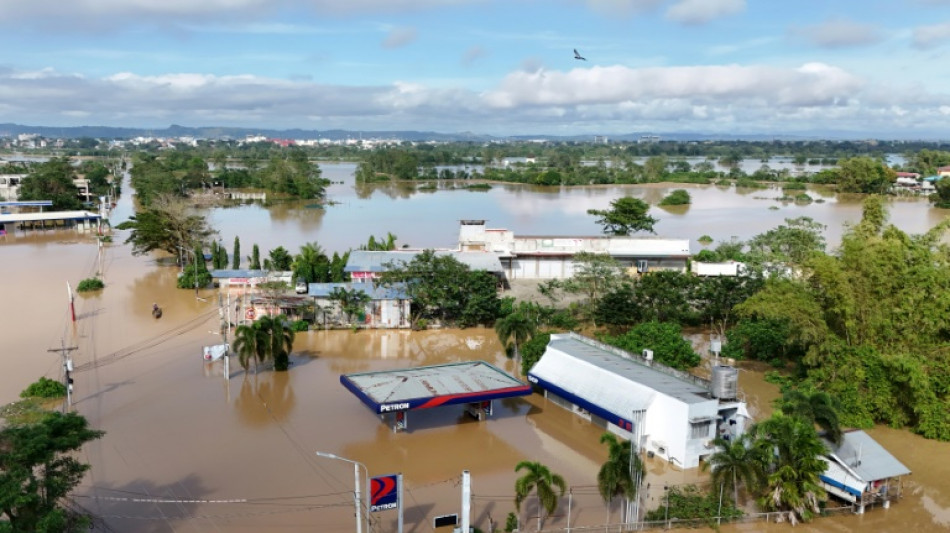
Climate change intensified back-to-back Philippines storms: study / Photo: John Dimain - AFP

 Indians living in Japan on stand-by to house Asian Games athletes

 Trump signs bill authorizing sweeping Russia sanctions

 Protesters form human chain at Kennedy Center after Trump threat

 Death toll from attack at police HQ in Pakistan rises to 31

 Trump says Denmark to give US 'permanent control' over Greenland security

 Kennedy Center: future unclear for iconic Washington arts hub

 Trump claims 'infinite' Greenland security deal with Denmark

 Helicopters battle wildfire threatening Ecuador's capital

 Brentford batter Chelsea to undo Alonso's promising start

 Kane hits Bundesliga century as Bayern rout Union

 Trump says CNN, MS NOW, Politico banned from White House

 Hushing and hedging: US companies retreat on climate

 Springboks to face Fiji before 2027 Rugby World Cup

 Nigeria miners struggled to breathe in cell before 37 died: survivors

 McIlroy on the charge at PGA Championship as Reed withdraws

 McIlroy on the charge at PGA Championship

 Crisis-wracked Volkswagen warns of 10-bn-euro hit to profits

 Costa Rica's Grynspan tops third informal poll for UN chief: diplomat

 Stock markets retreat after central bank rate hikes

 Russia labels director of Cannes Grand Prix winner a 'foreign agent'

 Macron warns of Russian 'hybrid' threat after meeting presidential hopefuls

 UN holds third informal poll for new chief

 Kulusevski return can spark Spurs: De Zerbi

 Shakira to cap off world tour with Madrid 12-gig run

 Isolated Syrian-Druze city blames Damascus for shortages

Human-induced climate change fuelled a rare string of back-to-back typhoons that battered the Philippines this year and boosted the chances of powerful storms making landfall, a new study said on Thursday.
Five typhoons and a tropical storm hit the Philippines in a 23-day period across October and November, killing more than 170 people and causing at least $235 million in damage, according to local authorities.
About 20 big storms and typhoons hit the Southeast Asian nation or its surrounding waters each year, killing scores of people.
However, it is rare for multiple major weather events to hit over such a short period.
To assess the role of climate change in the string of storms, scientists from the World Weather Attribution (WWA) network used modelling to compare weather patterns in today's world against a hypothetical world without human-induced warming.
"Our results show that conditions conducive to the development of consecutive typhoons in this region have been enhanced by global warming," they said in a study published late Thursday.
"The chance of multiple major typhoons making landfall will continue to increase as long as we continue to burn fossil fuels."
The research, which uses a peer-reviewed methodology, found climate change made the conditions that formed and fuelled the typhoons twice as likely.
Globally, the number of tropical cyclones is not increasing significantly.
However, warmer seas are helping fuel an increasing number of strong storms and a warmer atmosphere holds more moisture, which results in storms that drop more rain.
- 'Difficult to recover' -
The study found that the warmer climate makes it 25 percent more likely that at least three Category 3-5 typhoons will make landfall in the Philippines in a year.
"Such consecutive extreme events make it difficult for populations to recover," the scientists warned.
And the world's current warming trajectory puts the Philippines on course for even worse effects, the study said.
Tropical storm Trami, considered by Philippines civil defence officials as the deadliest storm to hit the country this year, submerged hundreds of villages in the northern Philippines and displaced more than half a million residents.
Super Typhoon Man-yi, which brought havoc to Catanduanes province last month, also caused a province-wide power outage that authorities are still struggling to rectify.
"While it is unusual to see so many typhoons hit the Philippines in less than a month, the conditions that gave rise to these storms are increasing as the climate warms," said Ben Clarke, a researcher at Imperial College London's Centre for Environmental Policy.
The study warned that the repeated storms created a "perpetual state of insecurity", with about 13 million people affected by at least three of the extreme weather systems.
The Philippines needs major investment to tackle the challenges it faces from climate change, the scientists said.
"But of course funding adaptation isn't enough to protect the Philippines from climate change," said Friederike Otto, the scientist who leads WWA.
"Unless the world stops burning fossil fuels, typhoons will continue to intensify."
G.Teles--PC



