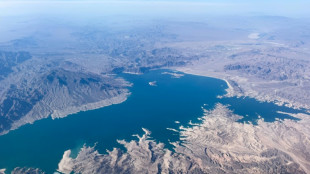
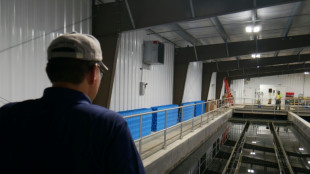
Billionaires promote CO2-removing schemes to protect climate / Photo: Hussein FALEH - AFP

 What scientists know so far about Nepal's deadly floods

 US general visits Colombia to discuss war on drugs

 Meta settlement puts social media industry on notice: 'There will be more'

 NFL owners approve record Seahawks sale

 Nigerian armed groups net nearly $6 mn in ransoms: study

 Savio scores on debut as Spurs advance in League Cup
 Mbappe hits treble as Real Madrid thrash Real Sociedad

 At Dollywood, superfans honor the late singer and local hero

 Stocks mixed as oil drops, US inflation stays high

 Bolivia's Paz appoints new economy minister amid bailout talks

 US designates UK-based Palestine Action as foreign 'terrorist group'
 'Rocky Horror Picture Show' star Tim Curry dead at 80

 American Moll wins women's pole vault at Zurich city event

 As Canada takes on US tariffs, what's behind the David and Goliath fight?

 UEFA 'likely' to drop threat to boycott FIFA tournaments: source

 US disrupts platforms allegedly used by Chinese hackers

 The foreign tourists missing in Nepal's flash floods

 Hundreds missing after Nepal-Tibet flood kills 98
 CIA director was on 'semi-routine' mission in Moscow: Trump

 Aldeguer switches to Rossi's VR46 for next season

 Rent TRON Energy and Reduce USDT Fees : TronBid Expands Marketplace

 Pakistan captain Babar Azam returns against England '90 percent fit'

 Stocks mixed as oil drops, inflation stays high

 Improving standards transform pole vault as spectacle, says Duplantis

 India close in on win despite Sri Lanka fightback in second Test
The boss of NetZero still can't believe his start-up has won a million-dollar prize from Elon Musk to improve ways of sucking climate-heating carbon dioxide (CO2) from the air.
"That'll fund a year of R&D (research and development)... or two-thirds of a factory," Axel Reinaud told AFP.
The XPrize Carbon Removal competition, set up by the billionaire Tesla boss, is a response to the scary conclusion reached by the world's top climate scientists.
However quickly the world slashes man-made greenhouse gas emissions, it will still need to extract CO2 from the air and oceans to avoid climate catastrophe, the UN's Intergovernmental Panel on Climate Change (IPCC) said in April.
Today, CO2 removal is a necessary weapon in the battle to stop global heating accelerating beyond a point of no return.
Technology to do so exists but remains prohibitively expensive. It also needs to be ramped up significantly to make a dent in the 40 billion tonnes of CO2 the world emits each year.
So private-sector giants are stepping in to kick-start research, as they did with vaccines and the first aeroplanes.
The $100-million (93-million-euro) XPrize initiative is a bid to foster low-cost solutions for sucking up huge quantities of CO2 every year and stocking it for ever.
The top prize will be announced in 2025.
NetZero has already scooped up one of the 15 early-stage awards for an astute economic model.
It burns farm waste, which contains CO2, and turns it into "biochar", a kind of "carbon dust" used to enrich the soil.
The heat generated by burning is captured to generate renewable electricity, which is sold to the grid.
In all, NetZero says it can remove a tonne of CO2 for just a few dozen dollars.
In North America, companies like Alphabet, Meta, McKinsey, Shopify and Stripe have agreed to invest $925 million in fostering carbon removal schemes between now and 2030.
The First Movers Coalition, an alliance of some 50 firms from sectors where emissions are hard to reduce such as aviation, shipping and cement, has also committed to financing carbon removal technology.
- Tried and tested method -
Today, research on removing carbon from the atmosphere is conspicuous by its near-absence.
The process is "extremely difficult to manage", French science historian Amy Dahan told AFP. "Musk's idea is to give this field of research a higher profile," she explained.
This is a tried and tested method.
In the 1920s the Orteig prize, which promised $25,000 to the first aviator to fly non-stop from New York to Paris, spurred developments that changed the history of aviation.
More recently, Microsoft founder Bill Gates's promise of finance has done much to accelerate vaccine research since 2010.
But the $100 million for R&D into carbon capture and storage "is in another league altogether", Dahan said.
The US-based Climate Foundation has also received a significant boost from the XPrize.
It uses seaweed to absorb carbon from surface ocean waters. When the algae decompose, they sink to the ocean depths, taking the trapped carbon with them.
The prize money will help it grow its first hectare of seaweed platform, founder Brian Von Herzen told AFP.
He is conscious, though, that such philanthropic incentives are a drop in the ocean.
"Such prizes, including carbon purchases made by Stripe and Microsoft, are important but insufficient first steps to building out a robust carbon removal ecosystem," he said.
"We have to start scaling up these solutions right now. In fact, we're already late," NetZero's Reinaud added.
"We should have started 20 years ago. We're behind on all climate issues."
- A drop in the ocean -
The vital goal is to remove billions of tonnes of CO2 every year -- before 2050 -- to prevent the average temperature of the planet rising more than 1.5 degrees Celsius.
This is critical to avoid large and irreversible changes to the climate.
At present, the world is only removing "microscopic" quantities of CO2, Reinaud said.
Instead, we need to build "something as huge as the oil industry in just 30 years", which requires investments equivalent to "several percentage points of GDP" rather than the current "peanuts".
Dahan agreed. Billionaires would do better to stop greenwashing and change their carbon-spewing business models, she said.
"Of course, we need them to take part in this effort," she said, but what we really need are binding government policies and international agreements.
Despite the $3.5 billion the US government has pledged to invest in carbon removal, "governments aren't grabbing this problem by the horns", she said.
H.Portela--PC