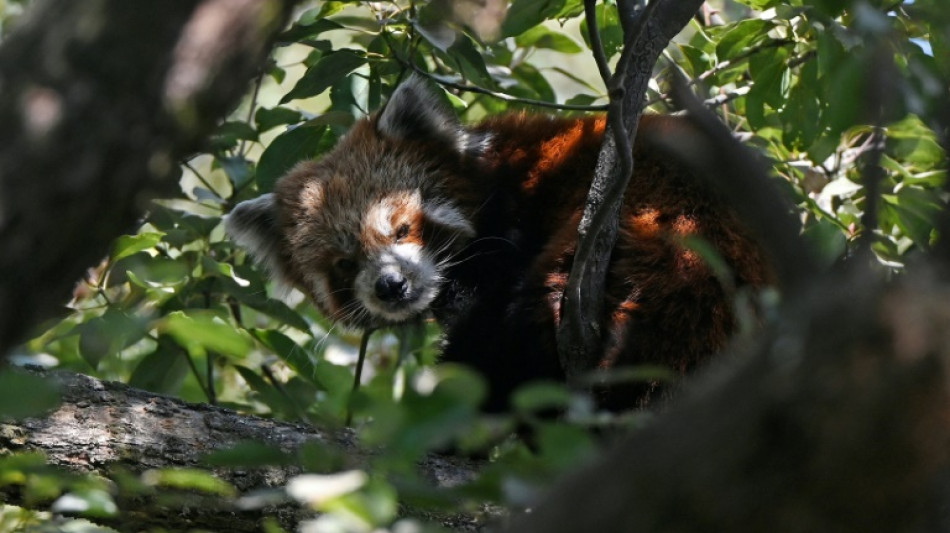
Nepal community efforts revive red panda population / Photo: PRAKASH MATHEMA - AFP

 Indians living in Japan on stand-by to house Asian Games athletes

 Trump signs bill authorizing sweeping Russia sanctions

 Protesters form human chain at Kennedy Center after Trump threat

 Death toll from attack at police HQ in Pakistan rises to 31

 Trump says Denmark to give US 'permanent control' over Greenland security

 Kennedy Center: future unclear for iconic Washington arts hub

 Trump claims 'infinite' Greenland security deal with Denmark

 Helicopters battle wildfire threatening Ecuador's capital

 Brentford batter Chelsea to undo Alonso's promising start

 Kane hits Bundesliga century as Bayern rout Union

 Trump says CNN, MS NOW, Politico banned from White House

 Hushing and hedging: US companies retreat on climate

 Springboks to face Fiji before 2027 Rugby World Cup

 Nigeria miners struggled to breathe in cell before 37 died: survivors

 McIlroy on the charge at PGA Championship as Reed withdraws

 McIlroy on the charge at PGA Championship

 Crisis-wracked Volkswagen warns of 10-bn-euro hit to profits

 Costa Rica's Grynspan tops third informal poll for UN chief: diplomat

 Stock markets retreat after central bank rate hikes

 Russia labels director of Cannes Grand Prix winner a 'foreign agent'

 Macron warns of Russian 'hybrid' threat after meeting presidential hopefuls

 UN holds third informal poll for new chief

 Kulusevski return can spark Spurs: De Zerbi

 Shakira to cap off world tour with Madrid 12-gig run

 Isolated Syrian-Druze city blames Damascus for shortages

Nepali police officer Jiwan Subba still feels pangs of regret decades after he bludgeoned a strange creature he found wandering in his barn, not realising it was an endangered red panda.
Red pandas may share a similar name to giant pandas -- due to their bamboo diet -- but the copper-hued mammals with raccoon-like features are much smaller, typically the size of a house cat.
"I was 17 and had no idea what it was. Nobody in our village even knew," Subba, now 48, told AFP.
Today, he is not only aware of the red panda's vulnerability but is actively involved in its protection -- reflecting a broader shift in attitudes spurred by Nepal's extensive community awareness programmes.
"I once took a life out of ignorance, but now I work to prevent others from making the same mistake," he said.
"People now understand that red pandas are a protected species."
Officials say that Nepal's pioneering community-based conservation work has helped arrest the decline of the cute but skittish bamboo-eaters, which number fewer than 10,000 globally.
Red Panda Network, an organisation leading global efforts to conserve the animal, estimates between 500 and 1,000 of the species live in Nepal.
That is an almost certain increase from an estimated population of somewhere between 300 and 600 by the Himalayan republic's wildlife department in 2011.
"Now, villagers say they can see three or four red pandas on the same day," Red Panda Network's Ang Phuri Sherpa told AFP.
- 'Undisturbed' -
Conservationists say that educational outreach combined with sustainable livelihood programmes has helped improve the effectiveness of Nepal's conservation efforts.
In eastern Nepal, Indigenous inhabitants of the Kanchenjunga Conservation Area switched from raising livestock to cultivating nettle plants to minimise disturbances to red panda habitats.
"We have stopped foraging in the forest so red pandas remain undisturbed," said Chandra Kumari Limbu, a local working on conservation efforts.
Instead, the rhythmic clap of looms now fills the village from women weaving nettle fabric into school bags, wallets and clothing.
"This has empowered women here who did not have an income before. And at the same time we are letting red pandas thrive," Limbu told AFP.
Nepal last year also declared a new conservation zone in the country's east to protect red pandas.
The Puwamajhuwa Community Red Panda Conservation Area, spanning 116 hectares (287 acres), has dedicated anti-poaching and smuggling control committees with local involvement.
- Poaching and infrastructure -
Nepali authorities have confiscated 33 red panda hides from smugglers in the past five years, a drop from 70 hides from 2011-15.
"The number of red panda hides being smuggled has significantly come down, mainly due to weaker smuggling networks and lower profits," police spokesperson Dinesh Kumar Acharya told AFP.
Nepal has strict punishments for poachers of protected species, including prison sentences of up to 10 years.
Conservationists warn however that many poaching incidents go undetected or unpunished.
Red panda hides are mainly smuggled to China and Myanmar for their supposed medicinal qualities and aesthetic value, according to police.
Their copper-coloured fur, cherubic appearance and small size also make them easy candidates for the exotic pet trade.
According to an assessment from the International Union for Conservation for Nature (IUCN), interest in red pandas as pets may have grown partly because of the preponderance of "cute" images of the animals shared on social media.
The IUCN has listed the mammal as an endangered species since 2016 and says they face high risk of extinction due to habitat loss.
Sherpa of the Red Panda Network said growing infrastructure development in Nepal was posing further challenges for conservation efforts.
"Road networks, hydroelectricity, transmission lines and cable car construction is going on, and because of these, habitats have been fragmented," he said.
Residents in Taplejung district, a key red panda habitat, are currently protesting the mass felling of thousands of trees for a new cable car project aimed at promoting tourism in the area.
"The government should take extra cautious measures when constructing large infrastructure projects," local conservationist Rajindra Mahat told AFP.
"It is an endangered species worldwide, so it is our shared responsibility to protect it."
F.Santana--PC



