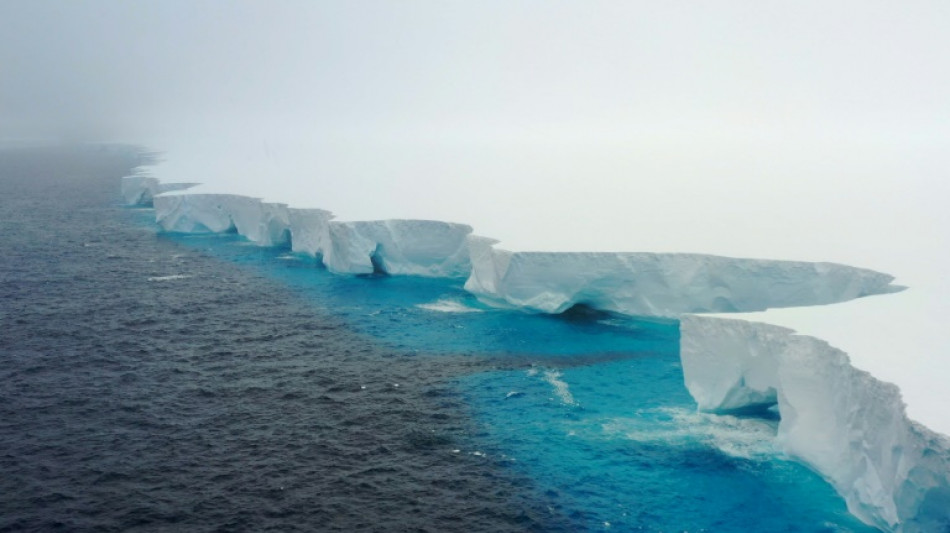
Tides could help predict when huge icebergs break loose: study / Photo: Richard Sidey - EYOS Expeditions/AFP/File

 Ed Sheeran returns to stage after Palestinian controversy

 Asian Games to open in Japan after troubled build-up

 Drone owners rush to offload devices ahead of Beijing ban

 Trump's beef policies irk Texas ranchers, testing their loyalty

 Nvidia, OpenAI CEOs to attend Xi dinner at White House

 Anthropic picks Accenture for in-house AI safety evaluation

 Balogun returns as Monaco beat Lens to continue strong Ligue 1 start

 'Pause' on overt repression in Venezuela, but reforms still needed: HRW

 Global stocks mixed as yen falls despite Bank of Japan rate hike

 Cuba hit with seventh major blackout of the year

 Murray out with concussion so Wentz will start for Vikings

 UN chief 'deeply regrets' US visa refusal to Abbas for annual meeting

 England quick Carse to face no charges over alleged nightclub assault

 Mancini brings nine newcomers into the first squad of his Italy comeback

 Czechs level Davis Cup tie against USA as South Korea eye Finals

 New France boss Zidane confirms Mbappe as captain after naming first squad

 California governor signs order to explore AI 'kill switch'

 Head leads run spree as Australia win Zimbabwe ODI series

 In-form Raphinha wants to finish career at Barcelona

 Warren Buffett steps down as Berkshire Hathaway chairman

 Carrick confident Man Utd can 'work through' tough time

 Mbappe ends Nike partnership to join Swiss brand On

 Liverpool boss Iraola puts Bournemouth love affair on hold

 'A disaster' if Man City do not win says Maresca after flawless start

 Kerry James Marshall: American 'blackness' painter celebrated in Europe

Ocean tides can trigger city-sized icebergs to break off from Antarctic ice shelves, scientists said on Thursday, offering a potential way to predict these dramatic events in the future.
It is not normally possible to forecast when icebergs break free, or calve, although the timing is important because these behemoths change the shape of ice sheets and affect global sea levels.
Yet when a chunk of ice the size of Greater London suddenly broke off the Brunt Ice Shelf in 2023 and started drifting away, glaciologist Oliver Marsh was not surprised.
Marsh told AFP he had predicted that a huge iceberg breaking off was "imminent within the next weeks to months".
The British Antarctic Survey researcher had spent years studying the huge crack that would create the 550-square-kilometre (210-square-mile) iceberg named A81.
As Marsh had anticipated, the calving occurred at the peak of spring tide, when there is the biggest difference between the ocean's high and low tide.
New research led by Marsh, published in the journal Nature Communications on Thursday, used modelling to show that the calving was triggered by the tide, along with high winds and stress on the ice.
After A81 broke off, Marsh visited the ice shelf to see how open water had replaced what had previously been "ice as far as you could see".
"It was sad to see it go, in a way," he said.
A81 is currently drifting up the eastern side of the Antarctica Peninsula towards the Weddell Sea.
It remains to be seen whether it will come close to South Georgia island, which is an important breeding ground for penguins, seals and other animals.
- 'Out of balance' -
The world's biggest iceberg, A23a, ran aground not too far from South Georgia earlier this year but is not thought to pose a threat to wildlife.
Now that A23a is exposed to the waves of the Southern Ocean, its "days are numbered", Marsh said.
He emphasised that iceberg calving is a natural process which balances out the massive amount of snow that falls on Antarctica every year.
However, "now we're out of balance", Marsh added.
Antarctica loses ice in two ways -- icebergs calving and ice sheets melting.
And ice sheets are melting at a rapidly increasing rate as oceans warm due to human-driven climate change, scientists have warned.
"We don't know whether calving rates have gone up" because they happen relatively infrequently, Marsh said.
A81 was the second of three mammoth icebergs that have broken free of the Brunt Ice Shelf since 2021.
"We are expecting a very large calving event at some point from this area" in the future, Marsh said.
But he could not give a timeframe.
"Whilst we're saying we are a step closer to being able to predict these events... it is still difficult to predict."
N.Esteves--PC



