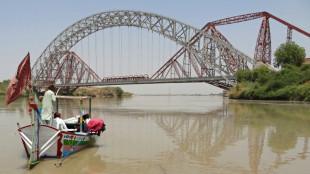
Nearly 1 in 4 globally at risk from severe flooding: study / Photo: Mamun Hossain - AFP/File

 Former Peru minister last-minute contender for UN labour agency helm

 Messi legacy will 'live forever', says Beckham
 'Literally tasting the smoke': Malaysians suffer as haze worsens

 Kyiv's defences, 'hybrid' threat from Moscow headline EU talks
 Oil extends gains, stocks mostly down as Trump issues fresh Iran warning

 ThinkMarkets Expands Weekend Trading Offering, Launches Weekend League Competition

 Tibet activists accuse China of downplaying floods
 Afghanistan war victims left 'without justice', UN says

 Iran president offers US olive branch before Putin meeting

 China-Nepal flood toll tops 1,000 as tunnel rescue offers last hope
 Japan to relax overtime regulation under workaholic PM
 Thwarted Niger mutiny exposes junta's Russia dependence

 Illegal mining ravages S.Africa's economic hub

 Nepal's wall of missing offers last hope after Himalayan flood

 US to press G20 on light-touch AI regulation

 2 die in Grand Canyon flash flood, only 1 person unaccounted for

 US Army Secretary Driscoll submits resignation: White House
 Oil extends gains, stocks drop as Trump issues fresh Iran warning

 Tsitsipas says Kyrgios's positive cocaine test 'kind of expected'

 In Japan's mountains, a different way to manage bears

 Middle East war a boon for UAE defence giant with global ambitions

 Former gang member found guilty of murdering Tupac Shakur
 Top-seeded Zverev opens US Open campaign
 US regulator, 22 states accuse Amazon of 'manipulating' ad auctions: lawsuit

 TRON Founder Justin Sun Shares Outlook on Bitcoin, Stablecoins and Global Finance at Bitcoin Asia 2026

Almost a quarter of the world's population are exposed to significant flood risks, according to new research published Tuesday, which warned those in poorer countries were more vulnerable.
Inundations from heavy rainfall and storm surges affect millions of people every year and cause billions of dollars of damage to homes, infrastructure and economies.
And the risks are rising as climate change causes more extreme precipitation and sea level rise, as exposed populations swell.
The new study, published in the journal Nature Communications, looked at global data on flood risks from the sea, rivers and rainfall, as well as population distribution and poverty estimates from the World Bank.
It found about 1.81 billion people -- or 23 percent of the people on the planet -- are directly exposed to floods of over 15 centimetres (six inches) in 1-in-100-year flooding.
"This would pose significant risks to lives and livelihoods, especially of vulnerable population groups," the study said.
Overall, nearly 90 percent of those exposed to inundations live in lower or middle income countries, according to the study.
It also concluded the number of people living in poverty and under severe flood risk is "substantially higher than previously thought".
Researchers found some $9.8 trillion of economic activity globally -- around 12 percent of the global gross domestic product in 2020 -- is located in areas exposed to severe flooding.
But they said concentrating simply on a monetary value could cause a bias of attention towards higher income countries and economic hubs.
"By accounting for the poverty levels of exposed populations, we show that low-income countries are disproportionately exposed to flood risks, while being more vulnerable to disastrous long-term impacts," said the study by Jun Rentschler of the World Bank and colleagues.
- Growing risks -
Overall, the study estimated most people exposed to flooding -- 1.24 billion -- are in South and East Asia, with China and India accounting for over a third of the global total.
Some 780 million people living on under $5.50 a day are at risk from once-in-a-hundred-year floods, it found.
The research provides "the first global estimates of the interaction between exposure to flood risk, and poverty", said Thomas McDermott, of the National University of Ireland Galway, in a linked commentary published in Nature Communications.
The authors said previous studies were often limited by geography or the type of flood risk assessed and had underestimated just how many people across the world are exposed.
"Climate change and risky urbanisation patterns are expected to further aggravate these risks in coming years," they added.
According to World Weather Attribution, a network of scientists tracing the impacts of climate change, global warming has made extreme rainfall more common and more intense across most of the world.
This has likely made flooding more severe in these areas, although scientists stress the other human factors also play a part, such as decisions about where homes and infrastructure are built.
This month, record floods in southern China displaced more than half a million people.
In Bangladesh, the Red Cross said Tuesday seven million people are still in "desperate" need of shelter and aid after some of the heaviest rains in a century swelled rivers to record levels and inundated rural villages.
M.Gameiro--PC