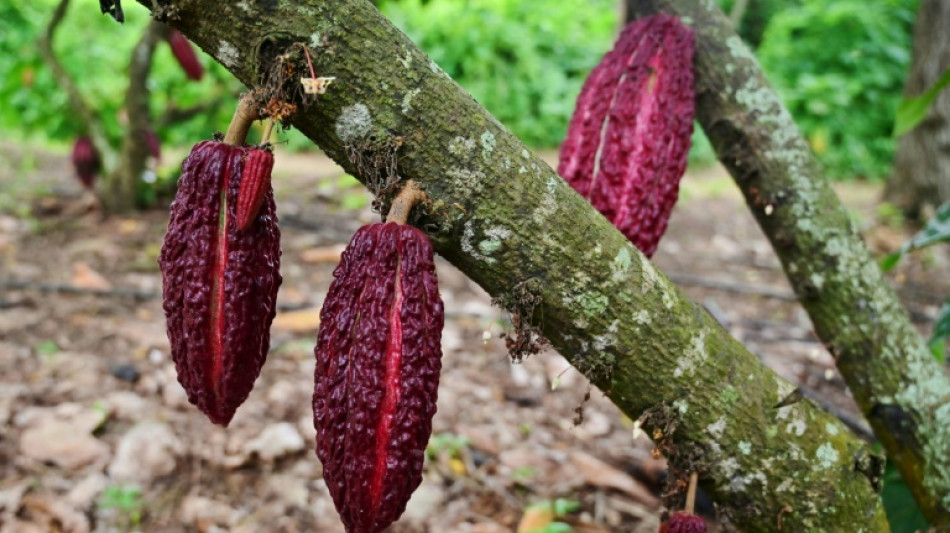
Nestle unveils method to boost cocoa yields as climate change hits / Photo: MARCOS PIN - AFP

 Ed Sheeran returns to stage after Palestinian controversy

 Asian Games to open in Japan after troubled build-up

 Drone owners rush to offload devices ahead of Beijing ban

 Trump's beef policies irk Texas ranchers, testing their loyalty

 Nvidia, OpenAI CEOs to attend Xi dinner at White House

 Anthropic picks Accenture for in-house AI safety evaluation

 Balogun returns as Monaco beat Lens to continue strong Ligue 1 start

 'Pause' on overt repression in Venezuela, but reforms still needed: HRW

 Global stocks mixed as yen falls despite Bank of Japan rate hike

 Cuba hit with seventh major blackout of the year

 Murray out with concussion so Wentz will start for Vikings

 UN chief 'deeply regrets' US visa refusal to Abbas for annual meeting

 England quick Carse to face no charges over alleged nightclub assault

 Mancini brings nine newcomers into the first squad of his Italy comeback

 Czechs level Davis Cup tie against USA as South Korea eye Finals

 New France boss Zidane confirms Mbappe as captain after naming first squad

 California governor signs order to explore AI 'kill switch'

 Head leads run spree as Australia win Zimbabwe ODI series

 In-form Raphinha wants to finish career at Barcelona

 Warren Buffett steps down as Berkshire Hathaway chairman

 Carrick confident Man Utd can 'work through' tough time

 Mbappe ends Nike partnership to join Swiss brand On

 Liverpool boss Iraola puts Bournemouth love affair on hold

 'A disaster' if Man City do not win says Maresca after flawless start

 Kerry James Marshall: American 'blackness' painter celebrated in Europe

Faced with climate change diminishing farmers' yields, Nestle announced Wednesday that it was working on a technique to produce chocolate by using up to 30 percent more of the cocoa fruit.
Chocolate is traditionally made using only cocoa beans taken from inside the pod, meaning that a large amount of the fruit -- including the pulp, placenta and pod husk -- "remains largely unused", the Swiss food giant said.
Its researchers have "developed a patented technique that leverages all parts of the fruit inside the cocoa pod", it said.
Everything inside the pod is collected as a wet mass that then ferments naturally, "unlocking the key chocolate flavour", Nestle said.
"The mass is then ground, roasted and dried into chocolate flakes which can be used to make chocolate without compromising the taste."
Nestle said the approach cut down on waste while helping farmers get more yield and value.
"With climate change increasingly affecting cocoa yields around the world, we are exploring innovative solutions that could help cocoa farmers maximise the potential of their harvests," said Louise Barrett, head of the Nestle research and development centre for confectionery in York, England.
"While this project is still at a pilot stage, we are currently exploring how to apply this innovation at a larger scale," she said.
- Heat takes toll -
Cocoa prices had been stable for around 10 years but began to soar in early 2023.
A tonne of cocoa was worth £1,900 ($2,560) on the London commodities market in January 2023, shot up to £3,800 a year later, and reached a high of over £9,000 last December.
The surge was the result of poor harvests in the leading producers Ivory Coast and Ghana, as unusually heavy rains, a cocoa pod disease outbreak and then drought took their toll.
In February, a study by the Climate Central research group found that "excessive heat can contribute to a reduction in the quantity and quality of the harvest" for cocoa growers.
The report calculated that over the last decade, climate change had added an extra three weeks of above 32C in Ivory Coast and Ghana during the main growing season from October to March -- above the levels considered optimum for cacao trees.
The surge in prices dampened demand while also pushing farmers to devote more resources to cocoa cultivation.
That allowed prices to ease in recent months, with reserves being built up for the first time in four years.
Since the beginning of 2025, prices have declined, and a tonne was worth around £5,600 on Wednesday.
A.P.Maia--PC



