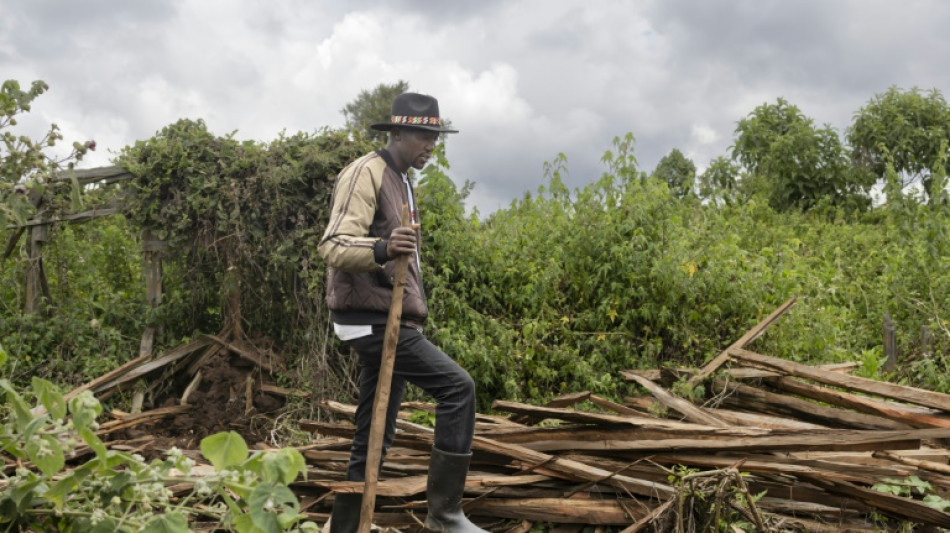
Evicted from their forests, Kenyan hunter-gatherers fight for their rights / Photo: Tony KARUMBA - AFP

 Ed Sheeran returns to stage after Palestinian controversy

 Asian Games to open in Japan after troubled build-up

 Drone owners rush to offload devices ahead of Beijing ban

 Trump's beef policies irk Texas ranchers, testing their loyalty

 Nvidia, OpenAI CEOs to attend Xi dinner at White House

 Anthropic picks Accenture for in-house AI safety evaluation

 Balogun returns as Monaco beat Lens to continue strong Ligue 1 start

 'Pause' on overt repression in Venezuela, but reforms still needed: HRW

 Global stocks mixed as yen falls despite Bank of Japan rate hike

 Cuba hit with seventh major blackout of the year

 Murray out with concussion so Wentz will start for Vikings

 UN chief 'deeply regrets' US visa refusal to Abbas for annual meeting

 England quick Carse to face no charges over alleged nightclub assault

 Mancini brings nine newcomers into the first squad of his Italy comeback

 Czechs level Davis Cup tie against USA as South Korea eye Finals

 New France boss Zidane confirms Mbappe as captain after naming first squad

 California governor signs order to explore AI 'kill switch'

 Head leads run spree as Australia win Zimbabwe ODI series

 In-form Raphinha wants to finish career at Barcelona

 Warren Buffett steps down as Berkshire Hathaway chairman

 Carrick confident Man Utd can 'work through' tough time

 Mbappe ends Nike partnership to join Swiss brand On

 Liverpool boss Iraola puts Bournemouth love affair on hold

 'A disaster' if Man City do not win says Maresca after flawless start

 Kerry James Marshall: American 'blackness' painter celebrated in Europe

Fred Ngusilo stoops to pick up a leather pouch, once used to collect honey, and a discarded shoe from the Mau forest floor, painful reminders that his Ogiek hunter-gatherer community once quietly flourished in southern Kenya, before they were evicted and their homes destroyed.
Ngusilo belongs to the Ogiek group, which is among the last hunter-gatherer communities in Africa and one of the most marginalised in Kenya.
He described how their ancestral lands were seized by the government in the name of conservation at the end of 2023, when men armed with hammers and axes suddenly appeared, violently evicting them from their homes.
"When I come here, I feel that I'm so sad. Tears are coming out of my eyes," Ngusilo said, his eyes resting on the remains of his father and grandfather's house.
Behind the 38-year-old human rights activist, bees buzz, and some of his community peacefully weave their cattle through the trees -- despite a ban on livestock, brutally enforced by Kenyan Forestry Service (KFS) rangers.
In December, a herder drowned while fleeing from the rangers, Ngusilo said.
The calm of the Mau Forest contrasts with stories of decades of persecution and dispossession recounted by its indigenous people -- all in the name of conservation.
The African Court on Human and Peoples' Rights (AfCHPR) ruled in 2017 and 2022 that the evictions were illegal, ordering Nairobi to pay reparations equivalent to more than $1 million and to recognise their ancestral lands.
But Kenya has still not complied.
- 'We are suffering greatly' -
Deprived of their livelihoods, they recount a difficult daily existence that is slowly but surely destroying their traditions and their language.
"Before, in the forest, we could survive -- eat honey, hunt, live," Ngusilo's grandmother, Janet Sumpet Ngusilo, 87, said.
"Now, out here, we are suffering greatly."
At a festival earlier this month, hundreds of community members rallied to keep the ceremonies and traditional songs alive, but also to remember what they have lost.
"I survived on meat and honey. Young people today don't know that life," said Salaton Nadumwangop, describing how he would sleep beneath the trees.
"The forest is our life," the 55-year-old Nadumwangop, dressed in traditional costume and a fur hat pinned with beads evoking bees, told AFP.
- Existential threat -
A government representative at the festival, Josphat Lodeya, promised the verdicts of the AfCHPR court would be implemented.
Lodeya, who heads the department for minorities and marginalised people, said the government was doing what it should.
"It is the same thing I have heard many times, so let us wait and see," said Daniel Kobei, head of the Ogiek People's Development Program.
But despite the assurances, which the crowd clung to hopefully, Nadumwangop said the Ogiek -- whom he described as a "small people" -- knew they lacked power.
"Even if we try to vote, they consider us worthless. So they despise us," he said.
Ngusilo believes the authorities are "trying to sell us out," saying that he would die to return home.
During a visit to his family home earlier that week, AFP reporters witnessed him receive multiple calls from what he said were KFS rangers, threatening to arrest him for being there.
KFS could not be reached by AFP for comment by publication.
More than 20 percent of the Mau has disappeared since the 1980s, according to various studies, with rights groups and elders accusing rapacious local officials.
Several community members have also alleged that carbon credit projects are behind the evictions at the end of 2023.
These allegations are difficult to prove, although several lawyers and observers consider them plausible.
For Nadumwangop, he remains worried about his people's future.
"If things continue like this, the Ogiek will disappear. We will be completely lost."
L.Henrique--PC



