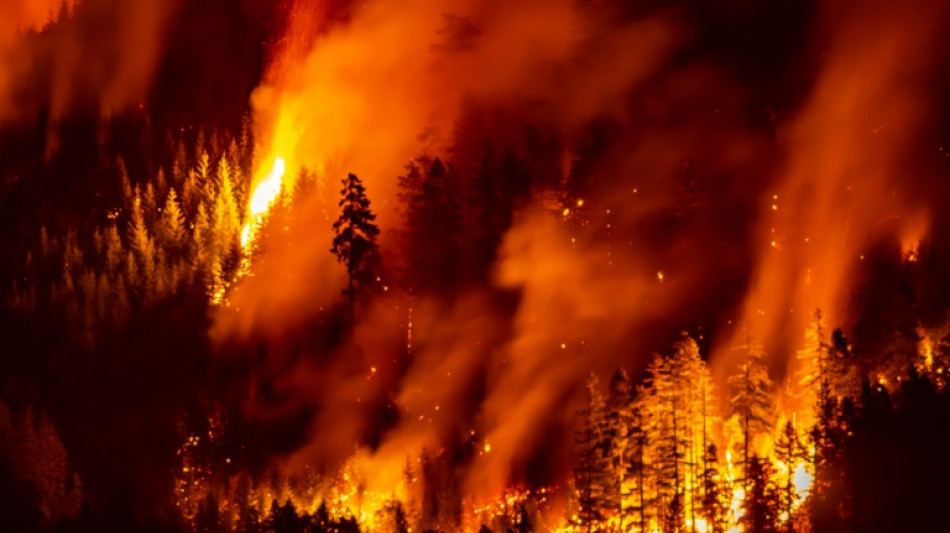
Climate-driven wildfires reversing pollution progress in N. America: study / Photo: Colby Rex O'Neill - AFP/File

 Ed Sheeran returns to stage after Palestinian controversy

 Asian Games to open in Japan after troubled build-up

 Drone owners rush to offload devices ahead of Beijing ban

 Trump's beef policies irk Texas ranchers, testing their loyalty

 Nvidia, OpenAI CEOs to attend Xi dinner at White House

 Anthropic picks Accenture for in-house AI safety evaluation

 Balogun returns as Monaco beat Lens to continue strong Ligue 1 start

 'Pause' on overt repression in Venezuela, but reforms still needed: HRW

 Global stocks mixed as yen falls despite Bank of Japan rate hike

 Cuba hit with seventh major blackout of the year

 Murray out with concussion so Wentz will start for Vikings

 UN chief 'deeply regrets' US visa refusal to Abbas for annual meeting

 England quick Carse to face no charges over alleged nightclub assault

 Mancini brings nine newcomers into the first squad of his Italy comeback

 Czechs level Davis Cup tie against USA as South Korea eye Finals

 New France boss Zidane confirms Mbappe as captain after naming first squad

 California governor signs order to explore AI 'kill switch'

 Head leads run spree as Australia win Zimbabwe ODI series

 In-form Raphinha wants to finish career at Barcelona

 Warren Buffett steps down as Berkshire Hathaway chairman

 Carrick confident Man Utd can 'work through' tough time

 Mbappe ends Nike partnership to join Swiss brand On

 Liverpool boss Iraola puts Bournemouth love affair on hold

 'A disaster' if Man City do not win says Maresca after flawless start

 Kerry James Marshall: American 'blackness' painter celebrated in Europe

Global air pollution is worsening, with the United States and Canada experiencing the sharpest increases due to record-breaking, climate-supercharged wildfires that are undoing decades of progress, a study said Thursday.
The Air Quality Life Index (AQLI) annual report uses satellite data to assess levels of particulate matter worldwide, with records dating back to 1998. It translates concentrations into years of life expectancy lost, based on peer-reviewed science.
"I just don't think this can be repeated enough: particulate matter remains the greatest external threat to human health on the planet, period," Michael Greenstone, an economics professor at the University of Chicago who co-created AQLI, told AFP.
"It's worse than tobacco smoke. It's worse than child and maternal malnutrition. It's worse than road accidents. It's worse than HIV-AIDS, worse than anything in terms of losses."
According to the report, Canada's catastrophic 2023 wildfire season drove a more than 50 percent rise in particulate levels compared to 2022, while the United States saw a 20 percent increase.
Although the data currently only extends until 2023, the trend is likely to have continued as both countries face intensifying wildfire seasons, driven by warming temperatures and drought fueled by human-caused greenhouse gas emissions.
The year 2025 already ranks as Canada's second worst wildfire season.
"The very surprising finding to me is that in parts of the world, certainly Canada, certainly the US and it looks like parts of Europe as well, air pollution is like the zombie that we thought we had killed, and now it's back," said Greenstone.
While the most polluted counties in the US have historically been found in California, that's now shifting to states downwind of Canadian wildfires including Wisconsin, Illinois, Indiana, and Ohio but also further south.
More than half of Canadians breathed air with pollution above their national standard of 8.8 micrograms per cubic meter -- a dramatic shift from less than five percent in the previous five years.
The hardest-hit regions were provinces of Northwest Territories, British Columbia, and Alberta, where particulate pollution levels rivaled those of Bolivia and Honduras, shortening lifespans by two years.
Globally, fine particulate levels -- defined as 2.5 micrometers and smaller -- were up from 23.7 micrograms per cubic meter in 2022 to 24.1 in 2023. This is nearly five times greater than the World Health Organization guideline of five.
Latin America saw its highest level since 1998, with Bolivia the worst affected country.
In South Asia -- the world's most polluted zone — pollution increased by 2.8 percent. Even China saw a small rebound of 2.8 percent after a decade of steady declines following under its "War on Pollution."
There were some bright spots: within the European Union, particulate concentrations fell by six percent, while in Central and West Africa, they dropped by eight percent.
A.Motta--PC



