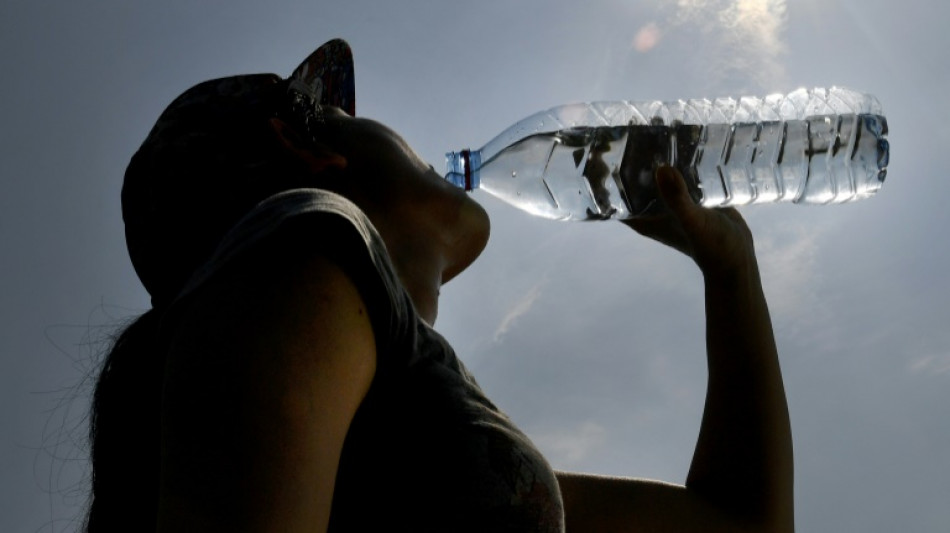
Cities face risk of water shortages in coming decades: study / Photo: Fred TANNEAU - AFP

 Drone owners rush to offload devices ahead of Beijing ban

 Trump's beef policies irk Texas ranchers, testing their loyalty

 Nvidia, OpenAI CEOs to attend Xi dinner at White House

 Anthropic picks Accenture for in-house AI safety evaluation

 Balogun returns as Monaco beat Lens to continue strong Ligue 1 start

 'Pause' on overt repression in Venezuela, but reforms still needed: HRW

 Global stocks mixed as yen falls despite Bank of Japan rate hike

 Cuba hit with seventh major blackout of the year

 Murray out with concussion so Wentz will start for Vikings

 UN chief 'deeply regrets' US visa refusal to Abbas for annual meeting

 England quick Carse to face no charges over alleged nightclub assault

 Mancini brings nine newcomers into the first squad of his Italy comeback

 Czechs level Davis Cup tie against USA as South Korea eye Finals

 New France boss Zidane confirms Mbappe as captain after naming first squad

 California governor signs order to explore AI 'kill switch'

 Head leads run spree as Australia win Zimbabwe ODI series

 In-form Raphinha wants to finish career at Barcelona

 Warren Buffett steps down as Berkshire Hathaway chairman

 Carrick confident Man Utd can 'work through' tough time

 Mbappe ends Nike partnership to join Swiss brand On

 Liverpool boss Iraola puts Bournemouth love affair on hold

 'A disaster' if Man City do not win says Maresca after flawless start

 Kerry James Marshall: American 'blackness' painter celebrated in Europe

 Spain coach De la Fuente offers 'full support' to people of Ceuta

 Russia seizes assets of Nestle, French firms over West's Ukraine support

Hotspots of water scarcity could emerge by the 2020s and 2030s across the Mediterranean, southern Africa, and North America, as climate change intensifies droughts, a new study said Tuesday.
Scientists have established that climate change is making droughts longer, stronger and more frequent, but less well understood is when and where these extreme dry conditions could trigger acute shortages of drinking water.
South Africa's Cape Town faced the threat of a "Day Zero Drought", where the taps nearly ran dry for millions of people in 2018. India's Chennai faced a similar crisis the following year.
In new peer-reviewed research in the journal Nature Communications, researchers warned that the frequency of "Day Zero" episodes could increase much sooner than previously anticipated.
To study how global warming might impact these events in future, researchers used the latest climate models to estimate when water demands would exceed supply from rainfall, rivers and reservoirs.
The simulations showed that "Day Zero" hotspots are likely to emerge in 35 percent of drought-prone regions within the next 15 years, with the Mediterranean, southern Africa, and parts of North America most affected.
By 2100, such conditions could threaten 750 million people globally -- roughly two thirds in cities and the rest in rural areas -- under a high emissions scenario, the study said.
Urban populations in the Mediterranean are most exposed, with 196 million city dwellers at risk, while rural areas in Asia and northern and southern Africa are disproportionately impacted.
Human-induced climate change and increased water consumption were both factors driving "Day Zero" events, the study said.
- Not a distant threat -
Even if global warming is held at 1.5 degrees Celsius above preindustrial levels "hundreds of millions of people will still face unprecedented water shortages", said Vecchia Ravinandrasana, one of the study's authors, in a press release.
"Our study shows that global warming causes and accelerates Day Zero Drought conditions worldwide," said Ravinandrasana from Pusan National University in South Korea, which led the research.
The world is on track to shoot past 1.5C as early as this decade. Under the Paris climate pact, nations have agreed to limit global temperature rises to well below 2C to avoid the worst impacts.
The study could not account for groundwater, the authors said, overlooking its critical role "as a vital buffer during drought" particularly in regions where it is a key water source.
Global warming is altering the water cycle, disrupting rainfall and spurring droughts in some parts of the world and devastating rainfall in others.
Cape Town narrowly avoided a "Day Zero" episode during a multi-year drought when rivers hit record lows and major reservoirs drained to near empty.
But other cities have experienced similar crises, while major capitals like Los Angeles "remain highly vulnerable", the study said.
Such events were "not just a future concern in a warming world, but also a near-term reality" and better planning was needed.
X.Matos--PC



