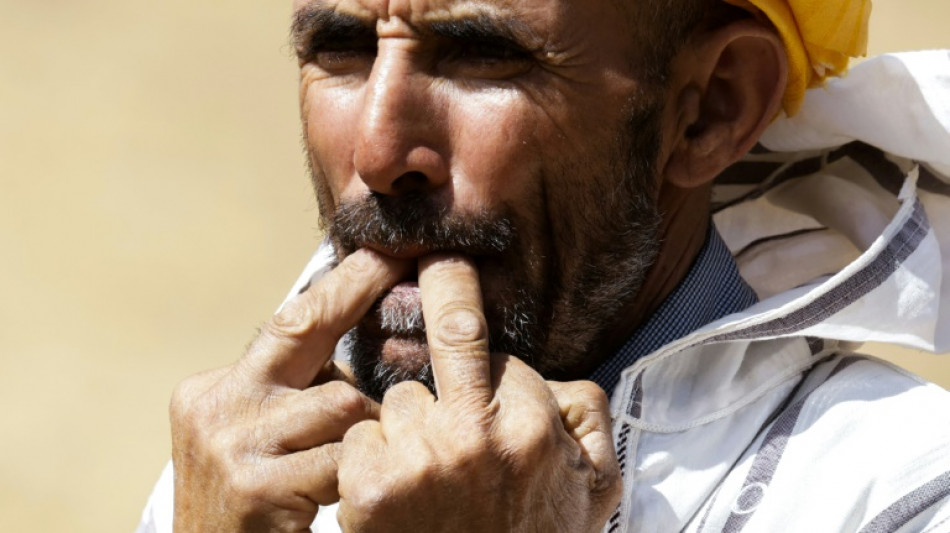
Morocco High Atlas whistle language strives for survival / Photo: Abdel Majid BZIOUAT - AFP

 Drone owners rush to offload devices ahead of Beijing ban

 Trump's beef policies irk Texas ranchers, testing their loyalty

 Nvidia, OpenAI CEOs to attend Xi dinner at White House

 Anthropic picks Accenture for in-house AI safety evaluation

 Balogun returns as Monaco beat Lens to continue strong Ligue 1 start

 'Pause' on overt repression in Venezuela, but reforms still needed: HRW

 Global stocks mixed as yen falls despite Bank of Japan rate hike

 Cuba hit with seventh major blackout of the year

 Murray out with concussion so Wentz will start for Vikings

 UN chief 'deeply regrets' US visa refusal to Abbas for annual meeting

 England quick Carse to face no charges over alleged nightclub assault

 Mancini brings nine newcomers into the first squad of his Italy comeback

 Czechs level Davis Cup tie against USA as South Korea eye Finals

 New France boss Zidane confirms Mbappe as captain after naming first squad

 California governor signs order to explore AI 'kill switch'

 Head leads run spree as Australia win Zimbabwe ODI series

 In-form Raphinha wants to finish career at Barcelona

 Warren Buffett steps down as Berkshire Hathaway chairman

 Carrick confident Man Utd can 'work through' tough time

 Mbappe ends Nike partnership to join Swiss brand On

 Liverpool boss Iraola puts Bournemouth love affair on hold

 'A disaster' if Man City do not win says Maresca after flawless start

 Kerry James Marshall: American 'blackness' painter celebrated in Europe

 Spain coach De la Fuente offers 'full support' to people of Ceuta

 Russia seizes assets of Nestle, French firms over West's Ukraine support

In Morocco's High Atlas mountains, shepherds Hammou Amraoui and his son hardly need words to speak. Across peaks, they whistle at each other in a centuries-old language, now jeopardised by rural flight.
"The whistle language is our telephone," joked Hammou, 59, the elder of a family known for the tradition in Imzerri, a hamlet in the remote commune of Tilouguit, about a two-hour drive from the nearest city.
In Tilouguit, Hammou said people learn it "like we learn to walk or to talk".
The Assinsg language replaces spoken words with sharp whistles that can carry for nearly three kilometres (two miles) in the mountains, according to researchers.
"The principle of the language is simple: the words are said in whistles and the key to understanding it is practice," said Hammou's 33-year-old son, Brahim.
"It makes it easier for us to communicate, especially when we're herding our livestock," he added.
Moroccan heritage researcher Fatima Zahra Salih described the whistle language as a cultural "treasure".
For five years, she has studied it to prepare a case for its recognition and protection by the UN's cultural agency UNESCO.
Whistle communication has been documented on nearly every continent, including the Spanish Canary Islands off Morocco's Atlantic coast.
"A little more than 90 languages have a whistled form, documented in scientific publications," said Julien Meyer, a linguist who specialises in the phenomenon.
In Morocco, it has so far only been documented in the Beni Mellal-Khenifra region of the central High Atlas mountain range, but Salih said she cannot rule out its existence elsewhere.
- Moving away -
Getting to Imzerri requires a climb along a dirt track winding through oak trees.
The village counts roughly 50 houses, none with running water or electricity.
Many families have moved away, threatening the survival of the whistle language.
"Our region is magnificent, but we live in isolation and difficult conditions," said Aicha Iken, 51, who learnt to whistle as a child while tending livestock. "Many of our neighbours have left."
Poverty in Azilal province, where Imzerri lies, has dropped in recent years, but was still double the national average in 2024, at 17 percent.
Yet some families are determined to hold onto their land -- and their whistling tradition.
Brahim Amraoui has made sure his 12-year-old son, Mohamed, was one of the few children in the hamlet who knows how to whistle.
"At first, it was very hard," said Mohamed, who dreams of becoming a pilot. "I could not understand everything, but after two years it's getting better."
His father said it was important to teach him the language, "even if he chooses a different profession".
"My goal is for the whistle language to be preserved," he added.
Since 2022, Brahim has led a small association dedicated to safeguarding the practice.
- Whistle language 'disappearing' -
It isn't just the villagers' migration to urban areas that has put the language at risk of vanishing.
"The whistle language is disappearing little by little because of environmental degradation," said Meyer.
Drought has gripped Morocco for seven straight years.
In November 2024, for the first time in their history, the Amraoui shepherds left their village to take their livestock on a nearly 350-kilometre journey east in search of pasture. They only came home seven months later.
"The move was painful, but we had no choice," Hammou recalled. "We had nothing left to feed our animals."
Salih said it was due to "climate change", which has "disrupted their pastoral way of life", where there used to be fixed seasonal pastures near their home they could travel between.
"For the first time, they had to practice nomadism," she said of the Amraouis.
The shepherd family has pinned its hopes on potential rainfall this fall, hoping they would not be forced to move again.
But while they wonder whether they will have to, Salih insists on the "urgent need to safeguard" the whistle language before more people leave it behind alongside rural life.
O.Salvador--PC



