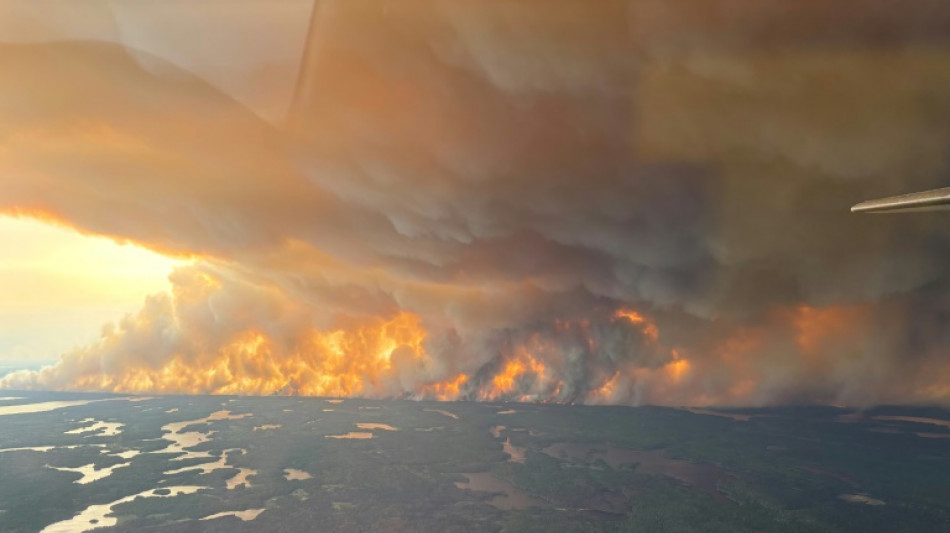
'Bigger, hotter, faster': extreme blazes drive rise in CO2 fire emissions / Photo: HANDOUT - Manitoba Government/AFP

 Drone owners rush to offload devices ahead of Beijing ban

 Trump's beef policies irk Texas ranchers, testing their loyalty

 Nvidia, OpenAI CEOs to attend Xi dinner at White House

 Anthropic picks Accenture for in-house AI safety evaluation

 Balogun returns as Monaco beat Lens to continue strong Ligue 1 start

 'Pause' on overt repression in Venezuela, but reforms still needed: HRW

 Global stocks mixed as yen falls despite Bank of Japan rate hike

 Cuba hit with seventh major blackout of the year

 Murray out with concussion so Wentz will start for Vikings

 UN chief 'deeply regrets' US visa refusal to Abbas for annual meeting

 England quick Carse to face no charges over alleged nightclub assault

 Mancini brings nine newcomers into the first squad of his Italy comeback

 Czechs level Davis Cup tie against USA as South Korea eye Finals

 New France boss Zidane confirms Mbappe as captain after naming first squad

 California governor signs order to explore AI 'kill switch'

 Head leads run spree as Australia win Zimbabwe ODI series

 In-form Raphinha wants to finish career at Barcelona

 Warren Buffett steps down as Berkshire Hathaway chairman

 Carrick confident Man Utd can 'work through' tough time

 Mbappe ends Nike partnership to join Swiss brand On

 Liverpool boss Iraola puts Bournemouth love affair on hold

 'A disaster' if Man City do not win says Maresca after flawless start

 Kerry James Marshall: American 'blackness' painter celebrated in Europe

 Spain coach De la Fuente offers 'full support' to people of Ceuta

 Russia seizes assets of Nestle, French firms over West's Ukraine support
Rampant wildfires in the Americas drove a jump in global greenhouse gas emissions from fires in the year to February, new research found Thursday, warning that climate change was fanning the flames.
Infernos that ravaged huge areas of Canada's boreal forest and swept through the dry forests and vulnerable wetlands in South America drove global fire CO2 emissions 10 percent above the 20 year average, the State of Wildfires report found.
That is despite a below-average total of areas burned across the world, the international team of researchers said.
The report found that heat, drought and human activities helped intensify blazes in particularly carbon-rich forests and ecosystems.
"It's the scale and frequency of these extreme events that I find most staggering," said co-author Matthew Jones, of the University of East Anglia in eastern England.
He said satellite monitoring has shown that fires are becoming more intense across the world, expanding in key ecosystems and burning more material than in the past.
"During these extreme wildfire years, we see more fires, bigger fires, hotter fires and faster fires and these properties all aggregate up to extreme extent and destructive impacts on people and nature," Jones told AFP.
Climate change is one key factor, helping to create the optimal hot, dry conditions for fire to spread and burn.
The report, which looked at extreme wildfires from March 2024 to February 2025, found that devastating infernos in Los Angeles and parts of South America were two to three times more likely due to climate change.
Warming also made the area burned during those events 25 to 35 times larger, the authors said.
Global temperatures in 2024 were the hottest on record, going above 1.5C relative to the pre-industrial period for the first time.
Flames engulfed millions of hectares of forests and farmland last year in Canada, western parts of the United States and the Amazon, as well as in the Pantanal, the world's largest tropical wetland, which is shared by Brazil, Bolivia and Paraguay.
Across the world, the authors said wildfires killed 100 people in Nepal, 34 in South Africa and 31 in Los Angeles during the report period, with smoke drifting across continents and causing dangerous levels of air pollution far from the heat of the flames.
Globally, the report said fires emitted over eight billion tonnes of CO2 in the 2024-2025 period -- about 10 percent above average since 2003.
It comes after the World Meteorological Organization on Wednesday warned that the increase in the amount of carbon dioxide in the atmosphere last year was the biggest ever recorded.
The WMO voiced "significant concern" that the land and oceans were becoming unable to soak up CO2, leaving the greenhouse gas in the atmosphere.
It warned that the planet could be witnessing a so-called "vicious cycle" of climate feedback -- whereby increasing greenhouse gas emissions fuel rising temperatures that help stoke wildfires that release more CO2, while warmer oceans cannot absorb as much CO2 from the air.
M.A.Vaz--PC



