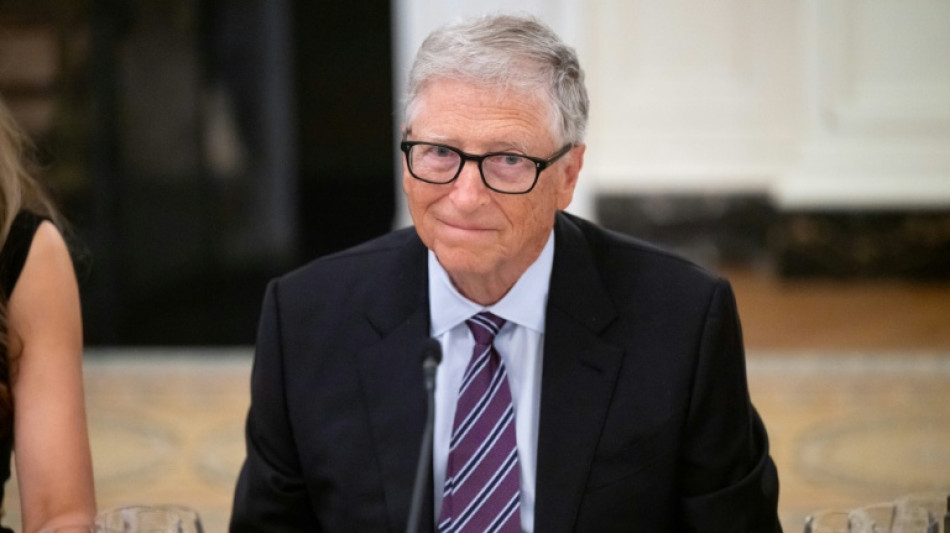
Climate change won't end civilization, says Bill Gates / Photo: SAUL LOEB - AFP/File

 Drone owners rush to offload devices ahead of Beijing ban

 Trump's beef policies irk Texas ranchers, testing their loyalty

 Nvidia, OpenAI CEOs to attend Xi dinner at White House

 Anthropic picks Accenture for in-house AI safety evaluation

 Balogun returns as Monaco beat Lens to continue strong Ligue 1 start

 'Pause' on overt repression in Venezuela, but reforms still needed: HRW

 Global stocks mixed as yen falls despite Bank of Japan rate hike

 Cuba hit with seventh major blackout of the year

 Murray out with concussion so Wentz will start for Vikings

 UN chief 'deeply regrets' US visa refusal to Abbas for annual meeting

 England quick Carse to face no charges over alleged nightclub assault

 Mancini brings nine newcomers into the first squad of his Italy comeback

 Czechs level Davis Cup tie against USA as South Korea eye Finals

 New France boss Zidane confirms Mbappe as captain after naming first squad

 California governor signs order to explore AI 'kill switch'

 Head leads run spree as Australia win Zimbabwe ODI series

 In-form Raphinha wants to finish career at Barcelona

 Warren Buffett steps down as Berkshire Hathaway chairman

 Carrick confident Man Utd can 'work through' tough time

 Mbappe ends Nike partnership to join Swiss brand On

 Liverpool boss Iraola puts Bournemouth love affair on hold

 'A disaster' if Man City do not win says Maresca after flawless start

 Kerry James Marshall: American 'blackness' painter celebrated in Europe

 Spain coach De la Fuente offers 'full support' to people of Ceuta

 Russia seizes assets of Nestle, French firms over West's Ukraine support

Climate change "will not lead to humanity's demise," billionaire philanthropist Bill Gates has said in a long memo in which he argued that tackling global disease and poverty will help prepare the planet's poorest for a warming world.
The missive was seen as a pivot by the 70-year-old Microsoft co-founder, a major backer of green technologies through his Breakthrough Energy organization, and comes days ahead of the COP30 climate summit in Brazil, whose leadership Gates praised for placing climate adaptation and human development high on the agenda.
Gates acknowledged that critics may charge him with hypocrisy because of his significant carbon footprint or argue the memo was a "sneaky way of arguing that we shouldn't take climate change seriously."
But he said that while climate change will have "serious" consequences, "people will be able to live and thrive in most places on Earth for the foreseeable future."
Gates's memo outlined his "Three tough truths about climate": climate change will not end civilization, limiting temperature is not the best measure of progress, and health and prosperity are the strongest defenses against climate destabilization.
He also pointed to significant progress in cutting emissions to date and said he was optimistic future technology innovation would pave the way for more.
While the planet is dangerously off course in meeting the Paris Agreement's goal of limiting long-term warming to 1.5 degrees Celsius, Gates argued that rather than fixating on the precise figure, the world should strengthen its resilience.
For most of the world's poor, he added, poverty and disease remain the more pressing problems, he added.
"Our chief goal should be to prevent suffering, particularly for those in the toughest conditions who live in the world's poorest countries," he said.
That means, for example, less focus on limiting extremely hot and cold days, and more on ensuring "fewer people live in poverty and poor health so that extreme weather isn't such a threat to them."
Looking ahead, Gates said a key climate strategy should be to reduce the so-called green premium -- the cost difference between clean and dirty ways of doing something -- to zero for materials such as cement, steel, and jet fuel.
He compared the memo to one he wrote at Microsoft 30 years ago urging the company to put the internet at the heart of everything it did.
Likewise, he said, the climate community needs a "strategic pivot" at COP30 and beyond.
"Prioritize the things that have the greatest impact on human welfare," he said.
Critics said Gates' essay lacked substance and posed a false choice between climate action and reducing human suffering.
"Mr. Gates has set up a false frame that pits improving lives against science-based temperature and emissions goals. In fact, the two are intrinsically connected," Rachel Cleetus of the Union of Concerned Scientists told AFP.
"The warming climate is directly undermining poverty eradication and human development goals around the world.
"Hurricane Melissa, a climate change-fueled monster storm, is just the latest example of the deadly and costly consequences of climate change for nations already struggling with complex humanitarian challenges."
Transitioning away from fossil fuels will bring health and economic benefits while disrupting the "malign influence" of Big Oil on the future of the planet, she added.
C.Cassis--PC



