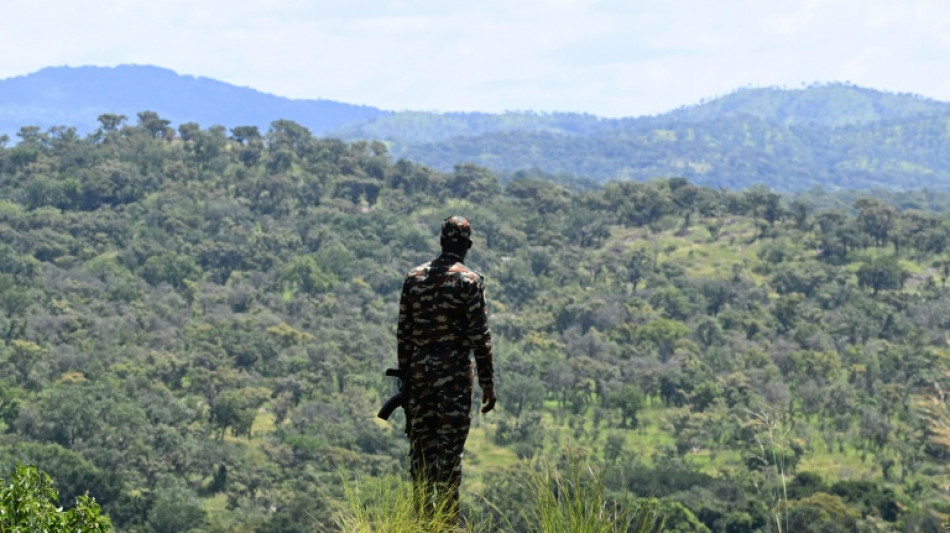
Pillaged I.Coast nature reserve on the mend after crisis decade / Photo: Issouf SANOGO - AFP

 Drone owners rush to offload devices ahead of Beijing ban

 Trump's beef policies irk Texas ranchers, testing their loyalty

 Nvidia, OpenAI CEOs to attend Xi dinner at White House

 Anthropic picks Accenture for in-house AI safety evaluation

 Balogun returns as Monaco beat Lens to continue strong Ligue 1 start

 'Pause' on overt repression in Venezuela, but reforms still needed: HRW

 Global stocks mixed as yen falls despite Bank of Japan rate hike

 Cuba hit with seventh major blackout of the year

 Murray out with concussion so Wentz will start for Vikings

 UN chief 'deeply regrets' US visa refusal to Abbas for annual meeting

 England quick Carse to face no charges over alleged nightclub assault

 Mancini brings nine newcomers into the first squad of his Italy comeback

 Czechs level Davis Cup tie against USA as South Korea eye Finals

 New France boss Zidane confirms Mbappe as captain after naming first squad

 California governor signs order to explore AI 'kill switch'

 Head leads run spree as Australia win Zimbabwe ODI series

 In-form Raphinha wants to finish career at Barcelona

 Warren Buffett steps down as Berkshire Hathaway chairman

 Carrick confident Man Utd can 'work through' tough time

 Mbappe ends Nike partnership to join Swiss brand On

 Liverpool boss Iraola puts Bournemouth love affair on hold

 'A disaster' if Man City do not win says Maresca after flawless start

 Kerry James Marshall: American 'blackness' painter celebrated in Europe

 Spain coach De la Fuente offers 'full support' to people of Ceuta

 Russia seizes assets of Nestle, French firms over West's Ukraine support

Forest ranger Daouda Bamba is in no doubt about who the apex predator is in Ivory Coast's Comoe National Park, ravaged by war and unrest between 2002 and 2011.
"The most dangerous animal here is man," the lieutenant told AFP, while at the head of a 10-strong patrol on the lookout for hostile intruders.
Founded as a big game reserve in 1926, Comoe long ranked among Africa's most beautiful natural parks.
Tourists flocked by the thousands to catch a glimpse of its elephants, lions, leopards and herds of antelope and hippopotamuses.
But that status came under threat during Comoe's lost decade, when the government abandoned the park during the west African country's two civil wars, leaving its rich fauna and flora at the mercy of looters and poachers.
Yet while Bamba's militia still has to guard against the threat of unscrupulous humans, Comoe has made strides towards recovering from its close brush with destruction in the years since.
On a rare reporting mission to the reserve in Ivory Coast's far northeast, near the border with jihadist-riven Burkina Faso, an AFP team saw antelopes frolicking, clans of barking baboons and families of warthogs with snouts to the ground across its vast and nigh-on-pristine expanse.
- 'Vultures circling' -
"We're seeing lots of animals. The park's getting better," said Bamba, one of 160 rangers working for the Ivorian Parks and Reserves Office (OIPR) in Comoe.
"Since we upped our game in 2016, the animals have been at peace. They don't run away all the time, which means they're not being hunted anymore."
However, the Kalashnikov slung over Bamba's shoulder, as well as the truncheons and tear gas grenades hanging from the rangers' belts, are hints that not all is well in paradise.
"When we catch intruders, it often leads to a brawl," the lieutenant said.
"Three major threats hang over the park," Bamba said, namely "poaching, illegal gold mining and unlawful livestock herding".
Nearby, one of his deputies tinkered with a drone, a useful tool when tasked with detecting human activity across the park's 11,500 square kilometres (4,440 square miles).
Often, however, the rangers have to resort to old-school means.
"Our day-to-day is spent on foot. We're on the lookout for smoke from a fire, tracks from bicycles or motorcycles, or vultures circling overhead," said Bamba.
In 2024, 125 people were arrested in the park, including 105 gold diggers and 18 poachers, according to the OIPR.
- 'Nearly died' -
Raynald Gilon's voice trembled as the old bushman remembered Comoe's glory days.
"We had a fabulous era here. The wildlife was magnificent," said the grizzled Belgian, who has spent half a century guarding the park.
Hyenas and red hartebeest roamed its sun-baked savannahs, while Nile crocodiles and fishing eagles alike plunged into the waters of the Comoe River, which gave the park its name.
Comoe welcomed "up to 6,000 to 7,000 tourists each season, most of them Europeans who arrived here by plane", he remembered.
At the park's northwest point, the dusty Kafolo Safari Lodge's crumbling stone entrance and abandoned blue-bottomed swimming pool serve as a reminder of that bygone age, long left to rot.
When the crisis began in 2002, the park found itself deep within territory controlled by the rebels who were fighting to overthrow then-president Laurent Gbagbo.
With the rangers forced to flee, the park was left exposed to the whims of the poachers, gold diggers and farmers.
"It was a massacre, a real ransacking," lamented Raynald Gilon.
"Everyone was taking part in the looting, including the rebels who claimed to be protecting it!"
Within a year of the war's outbreak, UNESCO added the park to its list of endangered World Heritage sites.
"The Comoe park nearly died," he said.
- 'Target of greed' -
When Ivory Coast's crisis ended in 2011, the new government worked to fix the damage done, pouring funds into equipping and training up guards tasked with flushing out the poachers.
"All of this allows us to really monitor the park and restore peace and quiet for the wildlife," said Commander Henri Tra Bi Zah, one of the park's managers.
Those efforts bore fruit. In 2017, UNESCO removed Comoe from its endangered heritage site list, in a first for an African park.
Three herds of elephants have been spotted, with a total of 200 individuals, while the chimpanzee has made a comeback.
Although the lion and the African wild dog are both believed to be locally extinct, leopards, spotted hyenas and even the caracal cat are a common sight in Comoe.
Antelopes and buffalo number by the thousands.
That said, those hoping to catch a glimpse of the park's rarer beasts have to venture deep into the savannah, often while braving thick swarms of biting tsetse flies, the AFP team observed.
While insisting that the "biggest problem" of illegal gold mining has been "contained", Commander Tra Bi Zah warned that the park "is still the target of greed because it is brimming with resources".
- Return of the tourist? -
Nearby villagers seem to be respecting the park's boundaries.
"Hand on heart we can't enter. If they catch you in there, you'll go straight to jail," said a farmer from Bambela, whose hut lies just a few metres from the edge of the savannah.
The OIPR even has hopes to revive tourism to make the park "a driving force for socioeconomic development" in the Ivorian northeast.
Those hopes, however, are complicated by the park's proximity to Burkina Faso, which is locked in conflict with fighters linked to Al-Qaeda or the Islamic State group. Western governments have advised against all travel to the region as a result.
That said, no jihadist has been arrested or even spotted recently in the park, according to security sources questioned by AFP.
A new hotel has sprung up in Kafolo to welcome humanitarian workers, civil engineers or even the odd foreigner passing through, its walls adorned with hunting trophies from the big game era of yore.
"The park is struggling to recover from the disaster... The revival is fragile," said local deputy Abdoulaye Karim Diomande.
"But the OIPR is making great strides. The future looks bright."
P.L.Madureira--PC



