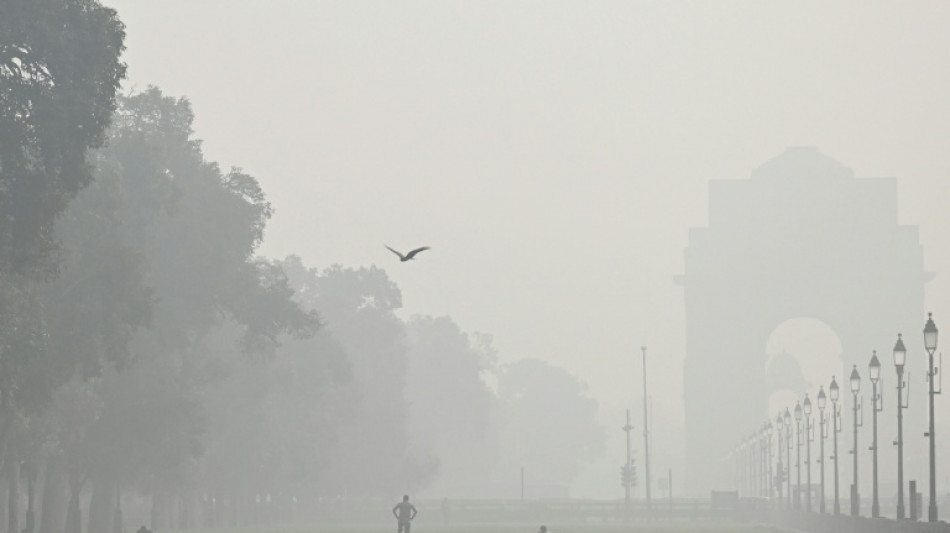
India's cloud seeding trials 'costly spectacle' / Photo: Arun SANKAR - AFP

 Drone owners rush to offload devices ahead of Beijing ban

 Trump's beef policies irk Texas ranchers, testing their loyalty

 Nvidia, OpenAI CEOs to attend Xi dinner at White House

 Anthropic picks Accenture for in-house AI safety evaluation

 Balogun returns as Monaco beat Lens to continue strong Ligue 1 start

 'Pause' on overt repression in Venezuela, but reforms still needed: HRW

 Global stocks mixed as yen falls despite Bank of Japan rate hike

 Cuba hit with seventh major blackout of the year

 Murray out with concussion so Wentz will start for Vikings

 UN chief 'deeply regrets' US visa refusal to Abbas for annual meeting

 England quick Carse to face no charges over alleged nightclub assault

 Mancini brings nine newcomers into the first squad of his Italy comeback

 Czechs level Davis Cup tie against USA as South Korea eye Finals

 New France boss Zidane confirms Mbappe as captain after naming first squad

 California governor signs order to explore AI 'kill switch'

 Head leads run spree as Australia win Zimbabwe ODI series

 In-form Raphinha wants to finish career at Barcelona

 Warren Buffett steps down as Berkshire Hathaway chairman

 Carrick confident Man Utd can 'work through' tough time

 Mbappe ends Nike partnership to join Swiss brand On

 Liverpool boss Iraola puts Bournemouth love affair on hold

 'A disaster' if Man City do not win says Maresca after flawless start

 Kerry James Marshall: American 'blackness' painter celebrated in Europe

 Spain coach De la Fuente offers 'full support' to people of Ceuta

 Russia seizes assets of Nestle, French firms over West's Ukraine support
India's efforts to combat air pollution by using cloud seeding in its sprawling capital New Delhi appear to have fallen flat, with scientists and activists questioning the effectiveness of the move.
Cloud seeding involves spraying particles such as silver iodide and salt into clouds from aircraft to trigger rain, that can wash pollutants from the air.
Delhi authorities, working with the Indian Institute of Technology (IIT) Kanpur, began trials last week using a Cessna aircraft over parts of the city.
But officials said the first trials produced very little rainfall because of thin cloud cover.
"This will never ever do the job, it's an illusion," said Bhavreen Kandhari, an environmental campaigner in Delhi. "Only when we clean up sources of air pollution can we control it."
The government has spent around $364,000 on the trials, according to local media reports.
Each winter, thick smog chokes Delhi and its 30 million residents. Cold air traps emissions from farm fires, factories and vehicles.
Despite various interventions -- such as vehicle restrictions, smog sucking towers, and mist-spraying trucks -- the air quality ranks among the worst for a capital in the world.
A day after the latest trial, levels of cancer-causing PM2.5 particles hit 323, more than 20 times the daily limits set by the World Health Organization. It will likely worsen further through the season.
A study published in The Lancet Planetary Health last year estimated that 3.8 million deaths in India between 2009 and 2019 were linked to air pollution.
There are also questions about the long-term impact of the chemicals sprayed themselves.
While the US Environmental Protection Agency notes "limited" studies suggest silver iodide does not pose an environmental or health risk, it acknowledges the impact of more widespread use is "not known".
- 'Research process' -
Environmental activists say even if cloud seeding produces rain, the benefits are short-lived.
Climate scientist Daniele Visioni at Cornell University said it was unclear how efficient it was in heavy polluted conditions.
"It can't create rain where there is no moisture in the air, but it just 'forces' some of the water to condense in one location rather than another," he told AFP.
"There is only one thing that can sensibly reduce pollution: avoiding the burning of fossil fuels."
Virendra Sachdeva, from Delhi's ruling Bharatiya Janata Party (BJP), said it was too early to dismiss the cloud seeding experiment as a "scientific failure".
"It is a part of the research process, and success is not always achieved in the first attempt," he told reporters.
However, two atmospheric scientists at IIT Delhi called the cloud seeding plan "another gimmick".
"It is a textbook case of science misapplied and ethics ignored," Shahzad Gani and Krishna Achutarao wrote in The Hindu newspaper.
Mohan George, from the Delhi-based Centre for Science and Environment, said artificial rain was not the answer.
"The levels of pollution will come back almost immediately as rain stops," the scientist told AFP.
When it does work, it will increase precipitation in one area -- while potentially decreasing it for another.
- 'Costly spectacle' -
Cloud seeding, first developed in the 1940s, has been used in various countries to induce rain, clear fog, and reduce drought, but with mixed results.
China used it during the 2008 Beijing Olympics in an attempt to control the weather.
Gani and Achutarao said Delhi's pollution causes -- unchecked emissions and seasonal crop burning -- are well known.
So too are the solutions -- cleaner fuel, better waste management and stricter enforcement of rules.
"Instead of reinforcing these priorities, parts of the scientific ecosystem -- researchers, advisors, and institutions -- are lending credibility to a costly spectacle that will do little to address the sources of the crisis," they said.
B.Godinho--PC



