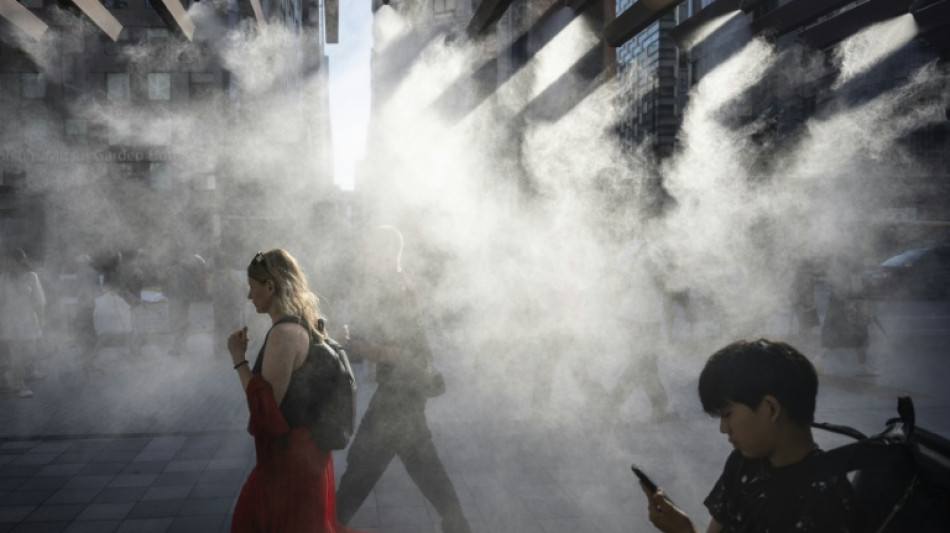
UN says 2025 to be among top three warmest years on record / Photo: Yuichi YAMAZAKI - AFP

 Drone owners rush to offload devices ahead of Beijing ban

 Trump's beef policies irk Texas ranchers, testing their loyalty

 Nvidia, OpenAI CEOs to attend Xi dinner at White House

 Anthropic picks Accenture for in-house AI safety evaluation

 Balogun returns as Monaco beat Lens to continue strong Ligue 1 start

 'Pause' on overt repression in Venezuela, but reforms still needed: HRW

 Global stocks mixed as yen falls despite Bank of Japan rate hike

 Cuba hit with seventh major blackout of the year

 Murray out with concussion so Wentz will start for Vikings

 UN chief 'deeply regrets' US visa refusal to Abbas for annual meeting

 England quick Carse to face no charges over alleged nightclub assault

 Mancini brings nine newcomers into the first squad of his Italy comeback

 Czechs level Davis Cup tie against USA as South Korea eye Finals

 New France boss Zidane confirms Mbappe as captain after naming first squad

 California governor signs order to explore AI 'kill switch'

 Head leads run spree as Australia win Zimbabwe ODI series

 In-form Raphinha wants to finish career at Barcelona

 Warren Buffett steps down as Berkshire Hathaway chairman

 Carrick confident Man Utd can 'work through' tough time

 Mbappe ends Nike partnership to join Swiss brand On

 Liverpool boss Iraola puts Bournemouth love affair on hold

 'A disaster' if Man City do not win says Maresca after flawless start

 Kerry James Marshall: American 'blackness' painter celebrated in Europe

 Spain coach De la Fuente offers 'full support' to people of Ceuta

 Russia seizes assets of Nestle, French firms over West's Ukraine support

An alarming streak of exceptional temperatures has put 2025 on course to be among the hottest years ever recorded, the United Nations said Thursday, insisting though that the trend could still be reversed.
While this year will not surpass 2024 as the hottest recorded, it will rank second or third, capping more than a decade of unprecedented heat, the UN's weather and climate agency said, capping more .
Meanwhile concentrations of greenhouse gases grew to new record highs, locking in more heat for the future, the World Meteorological Organization warned in a report released as dozens of world leaders met in the Brazilian Amazon ahead of next week's COP30 UN climate summit.
Together, the developments "mean that it will be virtually impossible to limit global warming to 1.5C in the next few years without temporarily overshooting the Paris Agreement target," WMO chief Celeste Saulo told leaders in Belem in northern Brazil.
The 2015 Paris climate accords aimed to limit global warming to well below two degrees Celsius above pre-industrial levels -- and to 1.5C if possible.
Saulo insisted in a statement that while the situation was dire, "the science is equally clear that it's still entirely possible and essential to bring temperatures back down to 1.5C by the end of the century".
- Surface heat -
UN chief Antonio Guterres called the miss temperature target a "moral failure".
Speaking at a Geneva press conference, WMO's climate science chief Chris Hewitt stressed that "we don't yet know how long we would be above 1.5 degrees".
"That very much depends on decisions that are made now... So that's one of the big challenges of COP30."
But the world remains far off track.
Already, the years between 2015 and 2025 will individually have been the warmest since observations began 176 years ago, WMO said.
And 2023, 2024 and 2025 figure at the very top of that ranking.
The WMO report said that the mean near-surface temperature -- about two metres (six feet) above the ground -- during the first eight months of this year stood at 1.42C above the pre-industrial average.
At the same time, concentrations of heat-trapping greenhouse gases in the atmosphere and ocean heat content continued to rise, up from 2024's already record levels, it found.
In its annual report on Tuesday, the UN Environment Programme also confirmed that emissions of greenhouse gases increased by 2.3 percent last year, growth driven by India followed by China, Russia and Indonesia.
- 'Urgent action' -
The WMO said the impact of temperature rises can be seen in the Arctic sea ice extent, which after the winter freeze this year was the lowest ever recorded.
The Antarctic sea ice extent meanwhile tracked well below average throughout the year, it said.
The UN agency also highlighted numerous weather and climate-related extreme events during the first eight months of 2025, from devastating flooding to brutal heat and wildfires, with "cascading impacts on lives, livelihoods and food systems".
In this context, the WMO hailed "significant advances" in early warning systems, which it stressed were "more crucial than ever".
Since 2015, it said, the number of countries reporting such systems had more than doubled, from 56 to 119.
It hailed in particular progress among the world's least developed countries and small island developing states, which showed a five-percent hike in access in the past year alone.
However, it lamented that 40 percent of the world's countries still no such early warning systems.
"Urgent action is needed to close these remaining gaps," it said.
A.P.Maia--PC



