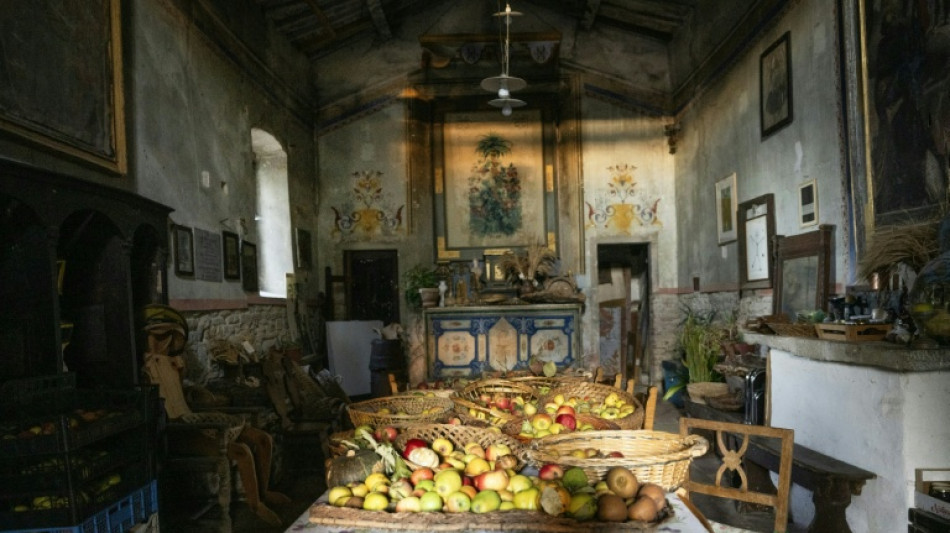
Italian fruit detective racing to save forgotten varieties / Photo: Tiziana FABI - AFP

 Drone owners rush to offload devices ahead of Beijing ban

 Trump's beef policies irk Texas ranchers, testing their loyalty

 Nvidia, OpenAI CEOs to attend Xi dinner at White House

 Anthropic picks Accenture for in-house AI safety evaluation

 Balogun returns as Monaco beat Lens to continue strong Ligue 1 start

 'Pause' on overt repression in Venezuela, but reforms still needed: HRW

 Global stocks mixed as yen falls despite Bank of Japan rate hike

 Cuba hit with seventh major blackout of the year

 Murray out with concussion so Wentz will start for Vikings

 UN chief 'deeply regrets' US visa refusal to Abbas for annual meeting

 England quick Carse to face no charges over alleged nightclub assault

 Mancini brings nine newcomers into the first squad of his Italy comeback

 Czechs level Davis Cup tie against USA as South Korea eye Finals

 New France boss Zidane confirms Mbappe as captain after naming first squad

 California governor signs order to explore AI 'kill switch'

 Head leads run spree as Australia win Zimbabwe ODI series

 In-form Raphinha wants to finish career at Barcelona

 Warren Buffett steps down as Berkshire Hathaway chairman

 Carrick confident Man Utd can 'work through' tough time

 Mbappe ends Nike partnership to join Swiss brand On

 Liverpool boss Iraola puts Bournemouth love affair on hold

 'A disaster' if Man City do not win says Maresca after flawless start

 Kerry James Marshall: American 'blackness' painter celebrated in Europe

 Spain coach De la Fuente offers 'full support' to people of Ceuta

 Russia seizes assets of Nestle, French firms over West's Ukraine support

Isabella Dalla Ragione hunts in abandoned gardens and orchards for forgotten fruits, preserving Italy's agricultural heritage and saving varieties which could help farmers withstand the vagaries of a changing climate.
The 68-year-old's collection of apples, pears, cherries, plums, peaches and almonds, grown using methods of old, are more resilient to the climate shifts and extremes seen increasingly frequently in the southern Mediterranean.
The Italian agronomist-turned-detective seeks descriptions of bygone local fruits in centuries-old diaries or farming documents, and sets out to find them.
Others she identifies by matching them to fruits in Renaissance paintings, where they often appear in depictions of the Madonna and Child.
Of the 150 or so varieties collected from Tuscany, Umbria, Emilia-Romagna and Marche and grown by her non-profit Archeologia Arborea foundation, the small, round Florentine pear is among Dalla Ragione's favourites.
"I'd found it described in documents from the 1500s, but I'd never seen it and believed it lost," she told AFP.
"Then 15 years ago, in the mountains between Umbria and Marche, I found a tree almost in the middle of the woods," thanks to an elderly local woman who told her about it by chance.
While old varieties are flavoursome, most disappeared from markets and tables after the Second World War as Italy's agricultural system modernised.
- 'Urgent' -
Italy is a large fruit producer. Its pear production ranks first in Europe and third globally, but just five modern varieties -- none of which are Italian -- account for over 80 percent of its output.
"There used to be hundreds, even thousands, of varieties because each region, each valley, each place had its own," Dalla Ragione said as she showed off wicker baskets full of fruit, stored in a little church near the orchard.
Modern markets instead demand large crops of fruits that can be harvested quickly, easily stored and last a long time.
But as global warming makes for an increasingly challenging climate, experts say a broader range of plant genetic diversity is key.
"Heirloom varieties... are able to adapt to climate change, to more severe water shortages, to extremes of cold and heat," said Mario Marino, from the climate change division of the UN's Food and Agriculture Organization.
"However, a much more severe disease arrives, one that improved varieties are normally more resistant to... and the local varieties perish, or perhaps don't produce fruit," he told AFP.
The answer lies in creating new varieties by crossing modern and old-fashioned ones, he said.
Marino, who advises Dalla Ragione's foundation, said her work was "urgent" because "preserving one's heritage means preserving the land, preserving biodiversity... and (allowing) us to use that DNA for new genetic resources".
- Oral testimonies -
Researchers can access the collection, while Dalla Ragione also recreates historical gardens which can host recovered varieties as part of an EU-funded project.
"We don't do all this research and conservation work out of nostalgia, out of romanticism," she said as she harvested pink apples from her trees in the hilly hamlet of San Lorenzo di Lerchi in Umbria.
"We do it because when we lose variety, we lose food security, we lose diversity and the system's ability to respond to various changes, and we also lose a lot in cultural terms."
Dalla Ragione has sought answers to fruit mysteries in monastery orchards, the gardens of nobility and common allotments. She has pored over local texts from the 16th and 17th centuries.
She once traced a pear to a village in southern Umbria after reading about it in the diary of a musical band director.
But one of her richest sources on how best to cultivate such varieties has been oral testimonies -- and as the last generation of farmers that grew the crops die, much local knowledge is lost.
That has made it difficult to know how to divide her time between researching and looking for a new variety, though she has learnt the hard way that the urgency "is always to save it".
"In the past if I've delayed, thinking 'I'll do it next year', I've found the plant has since gone".
M.Gameiro--PC



