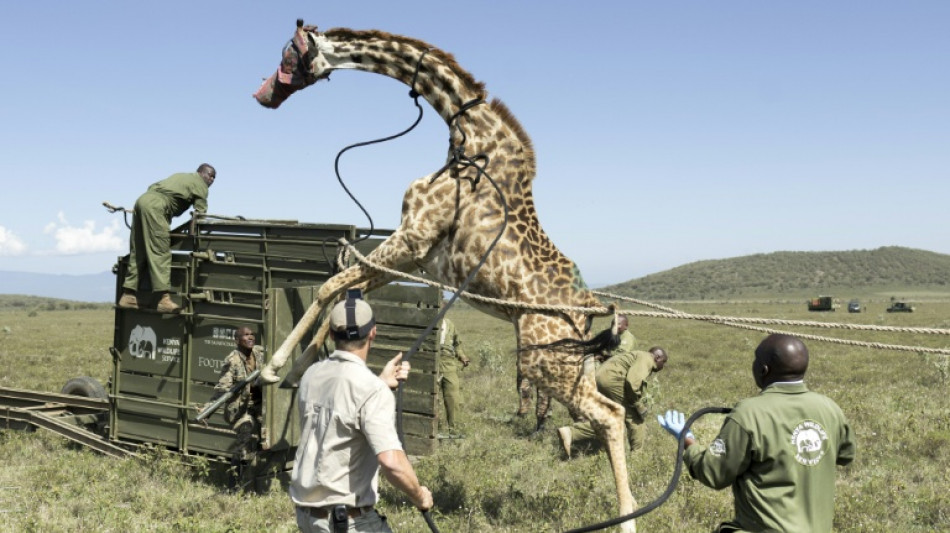
'Stranded, stressed' giraffes in Kenya relocated as habitats encroached / Photo: Tony KARUMBA - AFP

 Drone owners rush to offload devices ahead of Beijing ban

 Trump's beef policies irk Texas ranchers, testing their loyalty

 Nvidia, OpenAI CEOs to attend Xi dinner at White House

 Anthropic picks Accenture for in-house AI safety evaluation

 Balogun returns as Monaco beat Lens to continue strong Ligue 1 start

 'Pause' on overt repression in Venezuela, but reforms still needed: HRW

 Global stocks mixed as yen falls despite Bank of Japan rate hike

 Cuba hit with seventh major blackout of the year

 Murray out with concussion so Wentz will start for Vikings

 UN chief 'deeply regrets' US visa refusal to Abbas for annual meeting

 England quick Carse to face no charges over alleged nightclub assault

 Mancini brings nine newcomers into the first squad of his Italy comeback

 Czechs level Davis Cup tie against USA as South Korea eye Finals

 New France boss Zidane confirms Mbappe as captain after naming first squad

 California governor signs order to explore AI 'kill switch'

 Head leads run spree as Australia win Zimbabwe ODI series

 In-form Raphinha wants to finish career at Barcelona

 Warren Buffett steps down as Berkshire Hathaway chairman

 Carrick confident Man Utd can 'work through' tough time

 Mbappe ends Nike partnership to join Swiss brand On

 Liverpool boss Iraola puts Bournemouth love affair on hold

 'A disaster' if Man City do not win says Maresca after flawless start

 Kerry James Marshall: American 'blackness' painter celebrated in Europe

 Spain coach De la Fuente offers 'full support' to people of Ceuta

 Russia seizes assets of Nestle, French firms over West's Ukraine support

Coaxed and tugged by rangers, a blindfolded giraffe totters into the specialised vehicle that will transport it away from an increasingly hostile environment to a new home in Kenya's eastern Rift Valley.
Such relocations are a last resort when human activities or climate change threaten the survival of wildlife or peaceful coexistence with humans, say conservationists.
But the complex operations, overseen by Kenya Wildlife Service (KWS), are becoming more and more frequent in the east African country.
In recent weeks, hundreds of giraffes, zebras, and antelopes have been removed from the Kedong Ranch, on the shores of tourist hotspot Lake Naivasha.
The land had been left in its natural state, but over the years has been sold and subdivided into plots for real estate development, preventing the animals from grazing or using the natural corridor between Mount Longonot and Hells Gate.
"The animals began to suffer. They were stranded, stressed," said KWS's Patrick Wambugu, describing the construction of fences blocking the giraffes' route.
On Sunday, Wambugu's team relocated five giraffes in an operation that required dozens of people, trailers, a plow -- and even a helicopter that tracked the animals across the plains, before shooting them with tranquiliser darts.
KWS veterinarian Dominic Mijele, who was part of the operation, told AFP the giraffe is the most difficult animal to move, the risks "numerous".
The long-limbed creatures face deadly falls after being tranquilised and, despite their gentle appearance, can deliver a fierce kick to those trying to help.
They are also highly sensitive to anaesthesia and so cannot be kept sedated for long, a result of their unique build -- "the heart to the brain is quite long," Mijele explained.
As such, the rangers have to physically immobilise the creatures before they can be blindfolded and transported.
Once secured, the convoy travels the roughly 30 kilometres separating the ranch from their new home in the Oserengoni private reserve.
Once in there, a veterinarian will observe them for a week, although they usually establish their territory within two days.
"We hope that in the coming years the numbers will multiply, and they will be able to thrive in this landscape," said Mijele.
- Dilemma -
Similar operations are carried out almost every month in Kenya, said Mijele, mainly due to environmental destruction.
However, human-wildlife conflicts are also on the rise.
Kenya's population has soared from 30 million in 2000 to roughly 56.4 million in 2024, according to the World Bank.
Land privatisation is common and goes hand-in-hand with rampant speculation.
Humans often settle in areas that are also refuges for wildlife, said Evan Mkala, programme manager in eastern Kenya for the International Fund for Animal Welfare (IFAW).
The area around Lake Naivasha is being "invaded" by people, he said bluntly, leading to costly relocations when a "critical point" is reached.
This is happening with increasing frequency.
In a country with hundreds of national parks and private reserves, which generate significant tourism revenue, the challenge is to "reconcile" population growth, economic development, and wildlife conservation, said Philip Muruthi, vice president of the African Wildlife Foundation.
"Africa doesn't have to choose between wildlife conservation, nature protection, and development," he said, underscoring that the well-being of humans and animals is "inseparable".
G.Machado--PC



