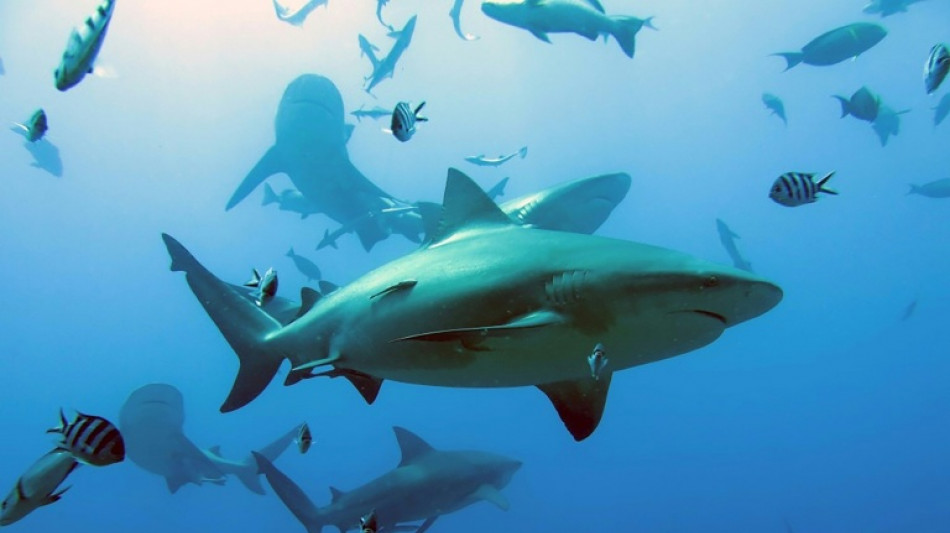
Bull shark kills woman off Australia beach / Photo: COLIN SIMPENDORFER - SIMON FRASER UNIVERSITY/JAMES COOK UNIVERSITY/AFP/File

 Drone owners rush to offload devices ahead of Beijing ban

 Trump's beef policies irk Texas ranchers, testing their loyalty

 Nvidia, OpenAI CEOs to attend Xi dinner at White House

 Anthropic picks Accenture for in-house AI safety evaluation

 Balogun returns as Monaco beat Lens to continue strong Ligue 1 start

 'Pause' on overt repression in Venezuela, but reforms still needed: HRW

 Global stocks mixed as yen falls despite Bank of Japan rate hike

 Cuba hit with seventh major blackout of the year

 Murray out with concussion so Wentz will start for Vikings

 UN chief 'deeply regrets' US visa refusal to Abbas for annual meeting

 England quick Carse to face no charges over alleged nightclub assault

 Mancini brings nine newcomers into the first squad of his Italy comeback

 Czechs level Davis Cup tie against USA as South Korea eye Finals

 New France boss Zidane confirms Mbappe as captain after naming first squad

 California governor signs order to explore AI 'kill switch'

 Head leads run spree as Australia win Zimbabwe ODI series

 In-form Raphinha wants to finish career at Barcelona

 Warren Buffett steps down as Berkshire Hathaway chairman

 Carrick confident Man Utd can 'work through' tough time

 Mbappe ends Nike partnership to join Swiss brand On

 Liverpool boss Iraola puts Bournemouth love affair on hold

 'A disaster' if Man City do not win says Maresca after flawless start

 Kerry James Marshall: American 'blackness' painter celebrated in Europe

 Spain coach De la Fuente offers 'full support' to people of Ceuta

 Russia seizes assets of Nestle, French firms over West's Ukraine support

A bull shark killed a woman swimming off a remote beach in Australia’s eastern state of New South Wales Thursday while a man was seriously injured and may have been saved by the "heroic" efforts of a passerby.
The woman died at the scene of the attack, which took place in the early hours of the morning in the remote Crowdy Bay, around 250 kilometres (155 miles) north of Sydney.
The man suffered serious leg injuries and was airlifted to hospital. Police have said his condition is stable.
"They were known to each other, and they were going for a swim and the shark attacked," New South Wales Police inspector Timothy Bayly told reporters.
A bystander potentially saved the man's life by wrapping a makeshift tourniquet around his leg, state ambulance inspector Joshua Smyth said.
"The courage from some bystanders is amazing in this situation -- to put yourself out there is very heroic," he said.
Steven Pearce, Surf Life Saving NSW chief executive, described it as "a really, really terrible incident".
"This area is so remote, there's no life guarding services up there at all," Pearce told local radio 2GB.
Authorities determined a bull shark -- one of the deadliest species of the deep-sea predatory fish -- was most "likely to have been" involved in the attack.
Assessments are usually made by examining bite marks, animal behaviour, any recent sightings or ocean conditions leading up to the incident.
Bull sharks are the only one of the cartilaginous fish that are able to move between fresh and salt water, allowing them to swim vast distances.
They can grow up to 2.3 metres (7.5 feet) and are among the species of shark most likely to bite oceangoers in Australia, alongside the great white and tiger.
- Attacks on the rise -
There have been more than 1,280 shark incidents around Australia since 1791, of which more than 250 resulted in death, according to a database of the predators' encounters with humans.
Of the total number of recorded incidents since records began, 212 involved bull sharks.
Increasingly crowded waters and rising ocean temperatures that appear to be swaying sharks' migratory patterns may be contributing to an escalation in attacks despite overfishing depleting some species, scientists say.
In September, a great white mauled a surfer to death at a popular Sydney beach.
The man, who left a wife and young daughter, lost "a number of limbs" and his surfboard was broken in two, police said.
Australia's oceans are teeming with sharks, with great whites topping the list of species that might fatally bite a human.
Though still relatively rare, fatal attacks do appear to be on the rise with 56 reported deaths in the 25 years to 2025 compared to 27 deaths in the previous quarter-century.
Undeterred, Australians flock to the sea in huge numbers -- with a 2024 survey showing nearly two-thirds of the population made a total of 650 million coastal visits in a single year.
How best to protect people from sharks is a touchy topic in Australia.
Authorities have adopted a multi-layered approach -- deploying drones, fixing acoustic trackers to sharks so they can be detected by listening buoys near popular beaches, alerting people in real time with a mobile app and stringing up old-fashioned nets.
Researchers say shark lives, too, need protecting.
Globally, about 37 percent of oceanic shark and ray species are now listed as either endangered or critically endangered by the International Union for Conservation of Nature, a database for threatened species.
G.Machado--PC



