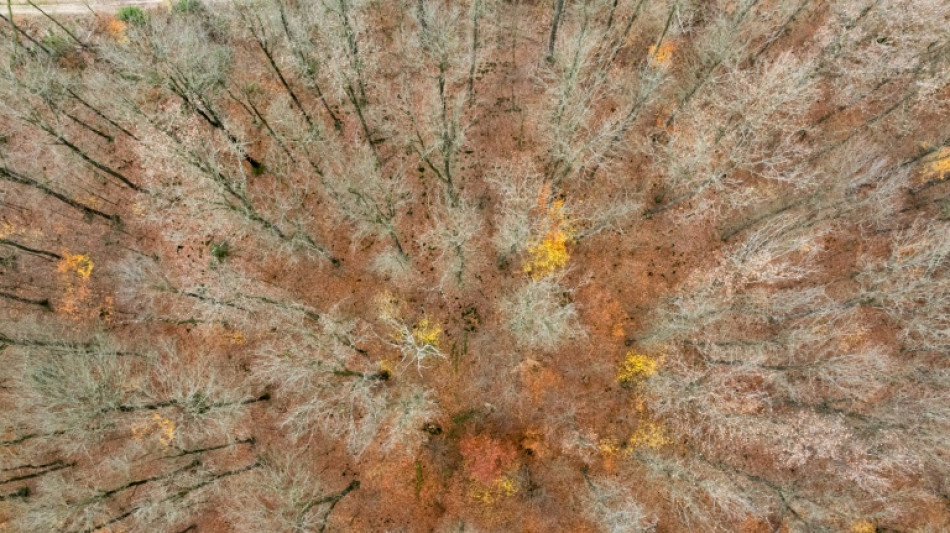
Tree branches to fleece jackets: Chemicals plant in Germany bets on biomass / Photo: JENS SCHLUETER - AFP

 Drone owners rush to offload devices ahead of Beijing ban

 Trump's beef policies irk Texas ranchers, testing their loyalty

 Nvidia, OpenAI CEOs to attend Xi dinner at White House

 Anthropic picks Accenture for in-house AI safety evaluation

 Balogun returns as Monaco beat Lens to continue strong Ligue 1 start

 'Pause' on overt repression in Venezuela, but reforms still needed: HRW

 Global stocks mixed as yen falls despite Bank of Japan rate hike

 Cuba hit with seventh major blackout of the year

 Murray out with concussion so Wentz will start for Vikings

 UN chief 'deeply regrets' US visa refusal to Abbas for annual meeting

 England quick Carse to face no charges over alleged nightclub assault

 Mancini brings nine newcomers into the first squad of his Italy comeback

 Czechs level Davis Cup tie against USA as South Korea eye Finals

 New France boss Zidane confirms Mbappe as captain after naming first squad

 California governor signs order to explore AI 'kill switch'

 Head leads run spree as Australia win Zimbabwe ODI series

 In-form Raphinha wants to finish career at Barcelona

 Warren Buffett steps down as Berkshire Hathaway chairman

 Carrick confident Man Utd can 'work through' tough time

 Mbappe ends Nike partnership to join Swiss brand On

 Liverpool boss Iraola puts Bournemouth love affair on hold

 'A disaster' if Man City do not win says Maresca after flawless start

 Kerry James Marshall: American 'blackness' painter celebrated in Europe

 Spain coach De la Fuente offers 'full support' to people of Ceuta

 Russia seizes assets of Nestle, French firms over West's Ukraine support

Staring at a pile of freshly cut beechwood, forestry manager Johannes Brodowski wonders if he is looking at the future of Germany's chemicals industry.
A local factory will use Brodowski's trees and other organic material -- instead of climate-harming fossil fuels -- to make chemical products used to manufacture items ranging from packaging to car tyres and fleece jackets.
"The innovative part of the whole thing is that a new product is getting made," he told AFP: "Namely, chemical materials that were originally made from fossil fuels and now can be made from renewable sources."
Finnish group UPM Biochemicals unveiled its 1.3-billion-euro ($1.5-billion) biorefinery in the eastern state of Saxony-Anhalt this year, taking a big risk at a difficult time for the sector.
Germany's traditional chemicals industry has been battered by high energy prices and cheap competition from Asia, with national output now at its lowest level since 1995.
Still, UPM thinks now is the right time to try and get chemical giants to break with fossil fuels and switch to renewable biomass, in this case wood which grows abundantly in the region.
"With local supply chains, we can be competitive and meet the needs of international markets," said UPM site manager Harald Dialer.
The opportunity is large: about 80 percent of German chemical products rely on imported fossil-based materials, said Paul Muennich of Agora Energiewende, an energy-transition think tank.
UPM has signed a supply contract with the forest-rich state of Saxony-Anhalt, making use of beech tree branches and twigs for chemical processes in its refinery.
As a result, beech wood production in this corner of Saxony-Anhalt could go up by 20-30 percent, Brodowski said.
He explained that the plant uses tree branches, which are less commercially viable than trunks and usually incinerated in factories.
- 'Like popcorn' -
The wood is processed at the Leuna Chemical Park, home to over 100 different firms.
Most of the factories give out the smell of rotten eggs, but inside some areas of the UPM site, a sweeter smell fills the air.
Wood chips are treated until they burst "like popcorn", turning into a slurry that is fermented in huge metal tanks, UPM spokesman Martin Ledwon said.
At the end of the process, two types of products emerge: liquids used to make clothing or bottles, and a brown powder that can replace carbon black, a powder used as a filler in tyres and other rubber products.
The UPM site should reach full capacity by 2027, with annual output of 220,000 tonnes of chemicals.
That would mark a rare bright spot in Germany's otherwise stagnant chemicals industry -- a trend thrown into stark focus in Leuna where the US group Dow is to soon close two plants.
- 'Bold decision' -
Opening the plant was a "very bold decision", Dialer said, adding that the Covid pandemic had doubled the timeline and the associated costs of the project.
UPM would like to count on help from the German state, highlighting that its project is more ecologically sustainable than oil-guzzling plants that also accelerate climate change.
But the federal government led by conservative Chancellor Friedrich Merz, which took power in May, has been less enthusiastic about environmental and climate protection than its predecessors.
When the project was launched in 2020, sustainability was "more at the centre of the debate", Dialer said.
In his view, Germany and the European Union should support European industry by imposing quotas on what he says are cheap but often environmentally damaging imports of Chinese chemicals.
Paul Muennich of Agora Energiewende also argued that government intervention with subsidies or tariffs would be "necessary to shift from fossil fuel to sustainable biomass".
E.Paulino--PC



