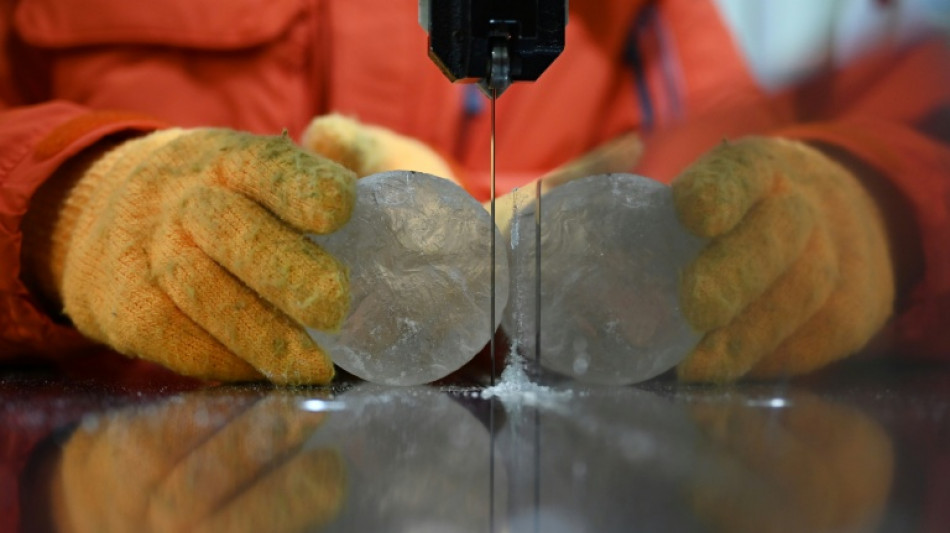
'Extremely exciting': the ice cores that could help save glaciers / Photo: GREG BAKER - AFP

 Drone owners rush to offload devices ahead of Beijing ban

 Trump's beef policies irk Texas ranchers, testing their loyalty

 Nvidia, OpenAI CEOs to attend Xi dinner at White House

 Anthropic picks Accenture for in-house AI safety evaluation

 Balogun returns as Monaco beat Lens to continue strong Ligue 1 start

 'Pause' on overt repression in Venezuela, but reforms still needed: HRW

 Global stocks mixed as yen falls despite Bank of Japan rate hike

 Cuba hit with seventh major blackout of the year

 Murray out with concussion so Wentz will start for Vikings

 UN chief 'deeply regrets' US visa refusal to Abbas for annual meeting

 England quick Carse to face no charges over alleged nightclub assault

 Mancini brings nine newcomers into the first squad of his Italy comeback

 Czechs level Davis Cup tie against USA as South Korea eye Finals

 New France boss Zidane confirms Mbappe as captain after naming first squad

 California governor signs order to explore AI 'kill switch'

 Head leads run spree as Australia win Zimbabwe ODI series

 In-form Raphinha wants to finish career at Barcelona

 Warren Buffett steps down as Berkshire Hathaway chairman

 Carrick confident Man Utd can 'work through' tough time

 Mbappe ends Nike partnership to join Swiss brand On

 Liverpool boss Iraola puts Bournemouth love affair on hold

 'A disaster' if Man City do not win says Maresca after flawless start

 Kerry James Marshall: American 'blackness' painter celebrated in Europe

 Spain coach De la Fuente offers 'full support' to people of Ceuta

 Russia seizes assets of Nestle, French firms over West's Ukraine support

Dressed in an orange puffer jacket, Japanese scientist Yoshinori Iizuka stepped into a storage freezer to retrieve an ice core he hopes will help experts protect the world's disappearing glaciers.
The fist-sized sample drilled from a mountaintop is part of an ambitious international effort to understand why glaciers in Tajikistan have resisted the rapid melting seen almost everywhere else.
"If we could learn the mechanism behind the increased volume of ice there, then we may be able to apply that to all the other glaciers around the world," potentially even helping revive them, said Iizuka, a professor at Hokkaido University.
"That may be too ambitious a statement. But I hope our study will ultimately help people," he said.
Thousands of glaciers will vanish each year in the coming decades, leaving only a fraction standing by the end of the century unless global warming is curbed, a study published in the journal Nature Climate Change showed Monday.
Earlier this year, AFP exclusively accompanied Iizuka and other scientists through harsh conditions to a site at an altitude of 5,810 metres (about 19,000 feet) on the Kon-Chukurbashi ice cap in the Pamir Mountains.
The area is the only mountainous region on the planet where glaciers have not only resisted melting, but even slightly grown, a phenomenon called the "Pamir-Karakoram anomaly".
The team drilled two ice columns approximately 105 metres (328 feet) long out of the glacier.
One is being stored in an underground sanctuary in Antarctica belonging to the Ice Memory Foundation, which supported the Tajikistan expedition along with the Swiss Polar Institute.
The other was shipped to Iizuka's facility, the Institute of Low Temperature Science at Hokkaido University in Sapporo, where the team is hunting clues on why precipitation in the region increased over the last century, and how the glacier has resisted melting.
Some link the anomaly to the area's cold climate or even increased use of agricultural water in Pakistan that creates more vapour.
But the ice cores are the first opportunity to examine the anomaly scientifically.
- 'Ancient ice' -
"Information from the past is crucial," said Iizuka.
"By understanding the causes behind the continuous build-up of snow from the past to the present, we can clarify what will happen going forward and why the ice has grown."
Since the samples arrived in November, his team has worked in freezing storage facilities to log the density, alignment of snow grains, and the structure of ice layers.
In December, when AFP visited, the scientists were kitted out like polar explorers to cut and shave ice samples in the comparatively balmy minus 20C of their lab.
The samples can tell stories about weather conditions going back decades, or even centuries.
A layer of clear ice indicates a warm period when the glacier melted and then refroze, while a low-density layer suggests packed snow, rather than ice, which can help estimate precipitation.
Brittle samples with cracks, meanwhile, indicate snowfall on half-melted layers that then refroze.
And other clues can reveal more information -- volcanic materials like sulfate ions can serve as time markers, while water isotopes can reveal temperatures.
The scientists hope that the samples contain material dating back 10,000 years or more, though much of the glacier melted during a warm spell around 6,000 years ago.
Ancient ice would help scientists answer questions such as "what kind of snow was falling in this region 10,000 years ago? What was in it?" Iizuka said.
"We can study how many and what kinds of fine particles were suspended in the atmosphere during that ice age," he added.
"I really hope there is ancient ice."
- Secrets in the ice -
For now, the work proceeds slowly and carefully, with team members like graduate student Sora Yaginuma carefully slicing samples apart.
"An ice core is an extremely valuable sample and unique," said Yaginuma.
"From that single ice core, we perform a variety of analyses, both chemical and physical."
The team hopes to publish its first findings next year and will be doing "lots of trial-and-error" work to reconstruct past climate conditions, Iizuka said.
The analysis in Hokkaido will uncover only some of what the ice has to share, and with the other samples preserved in Antarctica, there will be opportunities for more research.
For example, he said, scientists could look for clues about how mining in the region historically affected the area's air quality, temperature and precipitation.
"We can learn how the Earth's environment has changed in response to human activities," Iizuka said.
With so many secrets yet to learn, the work is "extremely exciting," he added.
S.Caetano--PC



