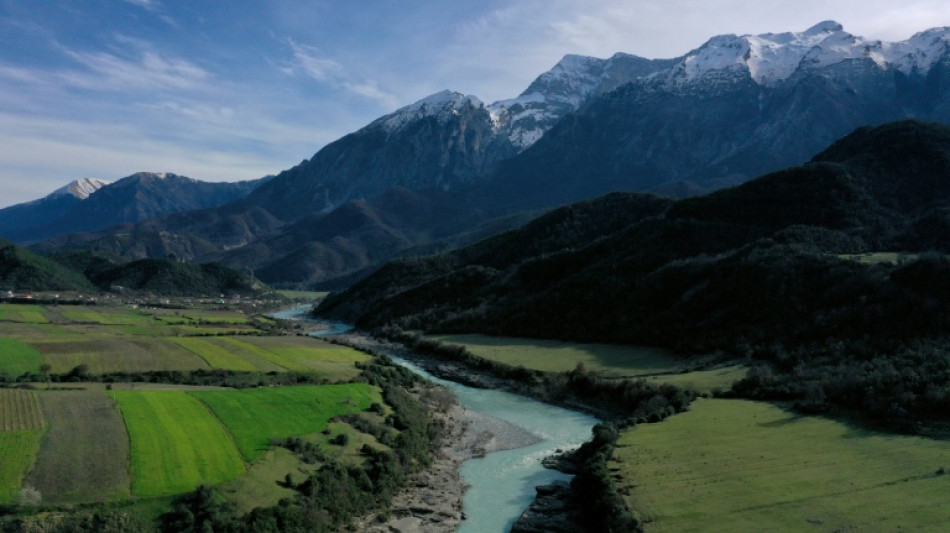
Balkan wild rivers in steady decline: study / Photo: ADNAN BECI - AFP

 Trump's beef policies irk Texas ranchers, testing their loyalty

 Nvidia, OpenAI CEOs to attend Xi dinner at White House

 Anthropic picks Accenture for in-house AI safety evaluation

 Balogun returns as Monaco beat Lens to continue strong Ligue 1 start

 'Pause' on overt repression in Venezuela, but reforms still needed: HRW

 Global stocks mixed as yen falls despite Bank of Japan rate hike

 Cuba hit with seventh major blackout of the year

 Murray out with concussion so Wentz will start for Vikings

 UN chief 'deeply regrets' US visa refusal to Abbas for annual meeting

 England quick Carse to face no charges over alleged nightclub assault

 Mancini brings nine newcomers into the first squad of his Italy comeback

 Czechs level Davis Cup tie against USA as South Korea eye Finals

 New France boss Zidane confirms Mbappe as captain after naming first squad

 California governor signs order to explore AI 'kill switch'

 Head leads run spree as Australia win Zimbabwe ODI series

 In-form Raphinha wants to finish career at Barcelona

 Warren Buffett steps down as Berkshire Hathaway chairman

 Carrick confident Man Utd can 'work through' tough time

 Mbappe ends Nike partnership to join Swiss brand On

 Liverpool boss Iraola puts Bournemouth love affair on hold

 'A disaster' if Man City do not win says Maresca after flawless start

 Kerry James Marshall: American 'blackness' painter celebrated in Europe

 Spain coach De la Fuente offers 'full support' to people of Ceuta

 Russia seizes assets of Nestle, French firms over West's Ukraine support

 England can build on World Cup 'spirit', says Tuchel

Thousands of kilometres of Balkan rivers have been damaged in recent years, a study published Wednesday found, as hydropower development, dams and sediment extraction drive a "steady erosion" of some of Europe's last pristine waterways.
The Balkans are home to some of Europe's cleanest and wildest rivers, crucial to the continent's biodiversity. But a surge in infrastructure projects increasingly threatens them, said the study published by NGOs Riverwatch and EuroNatur.
A wild river is one untouched by industry or dams. But in recent years, the entire Balkan region has seen a boom in small hydropower plants, generously subsidised, as investors seek to exploit a reliable and renewable energy source.
According to a 2024 report by the same NGOs, there are around 1,800 such plants in the Balkans, with more than 3,000 additional construction projects planned.
The new research focused on "near-natural" rivers -- waterways where flow remains intact or nearly so, with natural floodplains.
In 2012, these largely unaltered rivers accounted for 30 per cent of the region's waterways. By 2025 however, they represented only 23 per cent -- a loss of nearly 2,500 kilometres (almost 1,600 miles).
These rivers, which are essential to environmental preservation, are particularly threatened in Albania and Bosnia.
For Bosnia, the proportion of intact rivers decreased by 23 per cent between 2012 and 2025.
Albania recorded a "massive reduction" in "near-natural river sections", falling from 68 per cent in 2012 to just 40 per cent in 2025, the report said.
But it also noted that Albania's 2023 decision to designate the Vjosa -- one of Europe's last wild rivers -- as a national park had helped block dozens of planned dams there.
Across the region nearly 900 kilometres (560 miles) of rivers had been successfully preserved thanks to legal victories.
R.J.Fidalgo--PC



