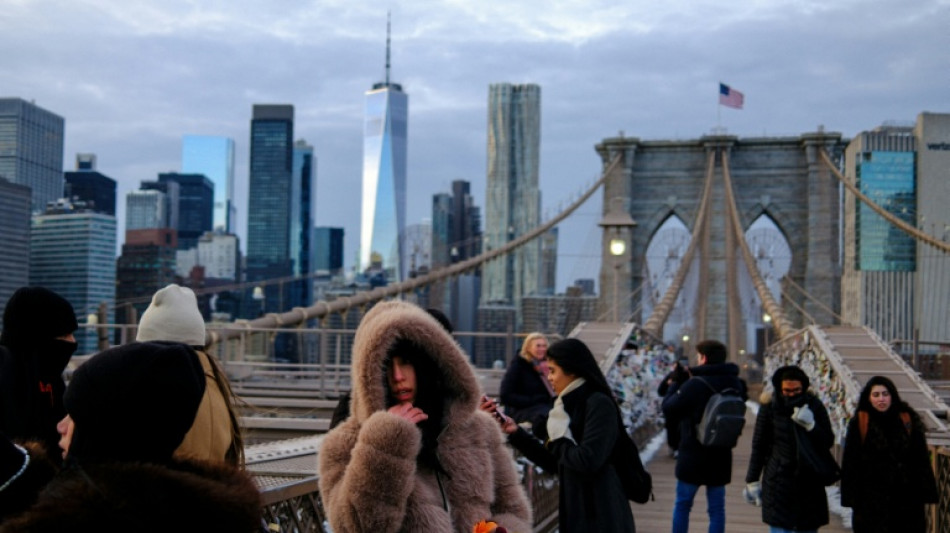
Arctic blast to wallop N. America -- is climate change to blame? / Photo: CHARLY TRIBALLEAU - AFP

 Trump's beef policies irk Texas ranchers, testing their loyalty

 Nvidia, OpenAI CEOs to attend Xi dinner at White House

 Anthropic picks Accenture for in-house AI safety evaluation

 Balogun returns as Monaco beat Lens to continue strong Ligue 1 start

 'Pause' on overt repression in Venezuela, but reforms still needed: HRW

 Global stocks mixed as yen falls despite Bank of Japan rate hike

 Cuba hit with seventh major blackout of the year

 Murray out with concussion so Wentz will start for Vikings

 UN chief 'deeply regrets' US visa refusal to Abbas for annual meeting

 England quick Carse to face no charges over alleged nightclub assault

 Mancini brings nine newcomers into the first squad of his Italy comeback

 Czechs level Davis Cup tie against USA as South Korea eye Finals

 New France boss Zidane confirms Mbappe as captain after naming first squad

 California governor signs order to explore AI 'kill switch'

 Head leads run spree as Australia win Zimbabwe ODI series

 In-form Raphinha wants to finish career at Barcelona

 Warren Buffett steps down as Berkshire Hathaway chairman

 Carrick confident Man Utd can 'work through' tough time

 Mbappe ends Nike partnership to join Swiss brand On

 Liverpool boss Iraola puts Bournemouth love affair on hold

 'A disaster' if Man City do not win says Maresca after flawless start

 Kerry James Marshall: American 'blackness' painter celebrated in Europe

 Spain coach De la Fuente offers 'full support' to people of Ceuta

 Russia seizes assets of Nestle, French firms over West's Ukraine support
 England can build on World Cup 'spirit', says Tuchel

An unusually brutal winter storm is set to pummel more than 160 million Americans from Friday, as a stretched "polar vortex" sends a devastating blast of Arctic air, bringing heavy snows and freezing rains.
Winter Storm Fern is forecast to engulf an area well over half the length of the continental United States, stretching from Texas and the Great Plains region to the mid-Atlantic and northeastern states.
Scientists say the increasing frequency of such disruptions of the polar vortex may be linked to climate change, though the debate is not yet settled and natural variability also plays a role.
– What is the polar vortex? –
The polar vortex is a large region of cold, low-pressure air that circulates counterclockwise high above the Arctic, in the stratosphere some 10 to 50 kilometers (six to 30 miles) above Earth's surface.
In a typical winter, it forms a relatively compact, circular system that helps lock in the coldest air to high northern latitudes.
"Usually the vortex spins merrily along and has little effect on our weather, but occasionally it moves or stretches southward over North America, bringing with it a jolt of cold," Jennifer Francis, a senior scientist at the Woodwell Climate Research Center, told AFP.
– What happens when it stretches? -
At times, big atmospheric waves that form closer to the ground can travel upward and knock the polar vortex out of whack.
Rather than completely breaking down -- as happens during dramatic "sudden stratospheric warming" events -- the vortex can stretch out into a more oval shape.
"Think of it like a rubber band being pulled," Judah Cohen, a climate dynamics scientist at MIT, told AFP.
"That allows the cold air to expand much further south, like we're like we're seeing this week here in the United States."
Jason Furtado, a meterologist at the University of Oklahoma whose research focuses on long-range forecasting, said these stretching events aren't as long-lasting as complete breakdowns, but are significant nonetheless, especially for North America.
-Is it linked to climate change? –
This is where the science becomes more debated.
There is broad agreement -- reflected in assessments by the UN's climate science body -- that the Arctic is warming much faster than the global average, through a process known as Arctic amplification, and human-caused climate change is behind it.
Cohen argues that this uneven warming helps amplify large atmospheric waves over Eurasia, which in turn makes the polar vortex spill more frequently over North America.
"Studies suggest these aberrations in the vortex are happening more often in a warming world, which favors more frequent winter extremes," said Francis.
Furtado said observations from the past 20 years do show an increase in such events, but he cautioned against drawing strong long-term conclusions tying them directly to human-caused climate change.
"In my opinion, it's harder to make that connection going out much further, simply because I think we just don't have enough data."
F.Santana--PC



