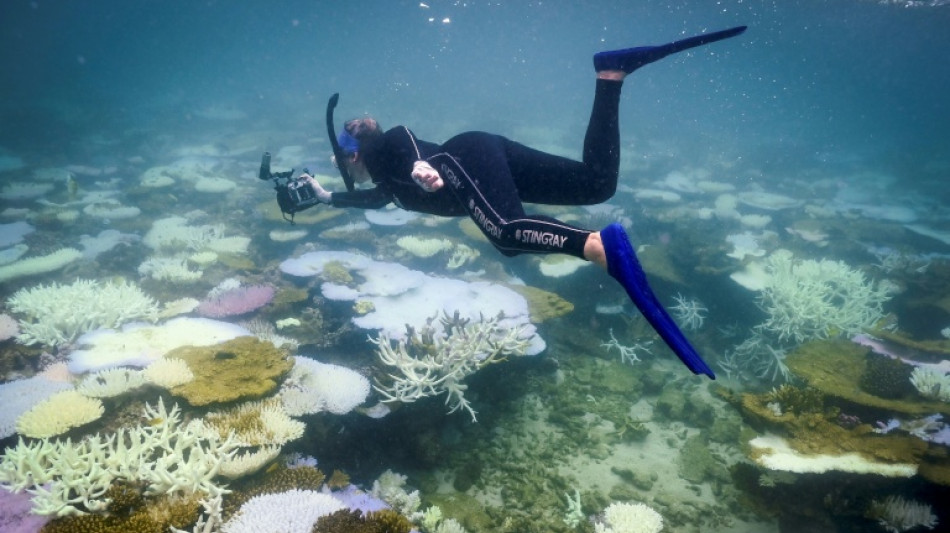
Three-year heatwave bleached half the planet's coral reefs: study / Photo: DAVID GRAY - AFP/File

 Trump's beef policies irk Texas ranchers, testing their loyalty

 Nvidia, OpenAI CEOs to attend Xi dinner at White House

 Anthropic picks Accenture for in-house AI safety evaluation

 Balogun returns as Monaco beat Lens to continue strong Ligue 1 start

 'Pause' on overt repression in Venezuela, but reforms still needed: HRW

 Global stocks mixed as yen falls despite Bank of Japan rate hike

 Cuba hit with seventh major blackout of the year

 Murray out with concussion so Wentz will start for Vikings

 UN chief 'deeply regrets' US visa refusal to Abbas for annual meeting

 England quick Carse to face no charges over alleged nightclub assault

 Mancini brings nine newcomers into the first squad of his Italy comeback

 Czechs level Davis Cup tie against USA as South Korea eye Finals

 New France boss Zidane confirms Mbappe as captain after naming first squad

 California governor signs order to explore AI 'kill switch'

 Head leads run spree as Australia win Zimbabwe ODI series

 In-form Raphinha wants to finish career at Barcelona

 Warren Buffett steps down as Berkshire Hathaway chairman

 Carrick confident Man Utd can 'work through' tough time

 Mbappe ends Nike partnership to join Swiss brand On

 Liverpool boss Iraola puts Bournemouth love affair on hold

 'A disaster' if Man City do not win says Maresca after flawless start

 Kerry James Marshall: American 'blackness' painter celebrated in Europe

 Spain coach De la Fuente offers 'full support' to people of Ceuta

 Russia seizes assets of Nestle, French firms over West's Ukraine support

 England can build on World Cup 'spirit', says Tuchel

A study published on Tuesday showed that more than half of the world's coral reefs were bleached between 2014-2017 -- a record-setting episode now being eclipsed by another series of devastating heatwaves.
The analysis concluded that 51 percent of the world's reefs endured moderate or worse bleaching while 15 percent experienced significant mortality over the three-year period known as the "Third Global Bleaching Event".
It was "by far the most severe and widespread coral bleaching event on record", said Sean Connolly, one the study's authors and a senior scientist at the Panama-based Smithsonian Tropical Research Institute.
"And yet, reefs are currently experiencing an even more severe Fourth Event, which started in early 2023," Connolly said in a statement.
When the sea overheats, corals eject the microscopic algae that provides their distinct colour and food source.
Unless ocean temperatures return to more tolerable levels, bleached corals are unable to recover and eventually die of starvation.
"Our findings demonstrate that the impacts of ocean warming on coral reefs are accelerating, with the near certainty that ongoing warming will cause large-scale, possibly irreversible, degradation of these essential ecosystems," said the study in the journal Nature Communications.
An international team of scientists analysed data from more than 15,000 in-water and aerial surveys of reefs around the world over the 2014-2017 period.
They combined the data with satellite-based heat stress measurements and used statistical models to estimate how much bleaching occurred around the world.
- No time to recover -
The two previous global bleaching events, in 1998 and 2010, had lasted one year.
"2014–17 was the first record of a global coral bleaching event lasting much beyond a single year," the study said.
"Ocean warming is increasing the frequency, extent, and severity of tropical-coral bleaching and mortality."
Australia's Great Barrier Reef, for instance, saw peak heat stress increase each year between 2014 and 2017.
"We are seeing that reefs don't have time to recover properly before the next bleaching event occurs," said Scott Heron, professor of physics at James Cook University in Australia.
A major scientific report last year warned that the world's tropical coral reefs have likely reached a "tipping point" -- a shift that could trigger massive and often permanent changes in the natural world.
The global scientific consensus is that most coral reefs would perish at warming of 1.5C above preindustrial levels -- the ambitious, long-term limit countries agreed to pursue under the 2015 Paris climate accord.
Global temperatures exceeded 1.5C on average between 2023-2025, the European Union's climate monitoring service, Copernicus, said last month.
"We are only just beginning to analyse bleaching and mortality observations from the current bleaching event," Connolly told AFP.
"However the overall level of heat stress was extraordinarily high, especially in 2023-2024, comparable to or higher than what was observed in 2014-2017, at least in some regions," he said.
He said the Pacific coastline of Panama experienced "dramatically worse heat stress than they had ever experienced before, and we observed considerable coral mortality".
X.Matos--PC



