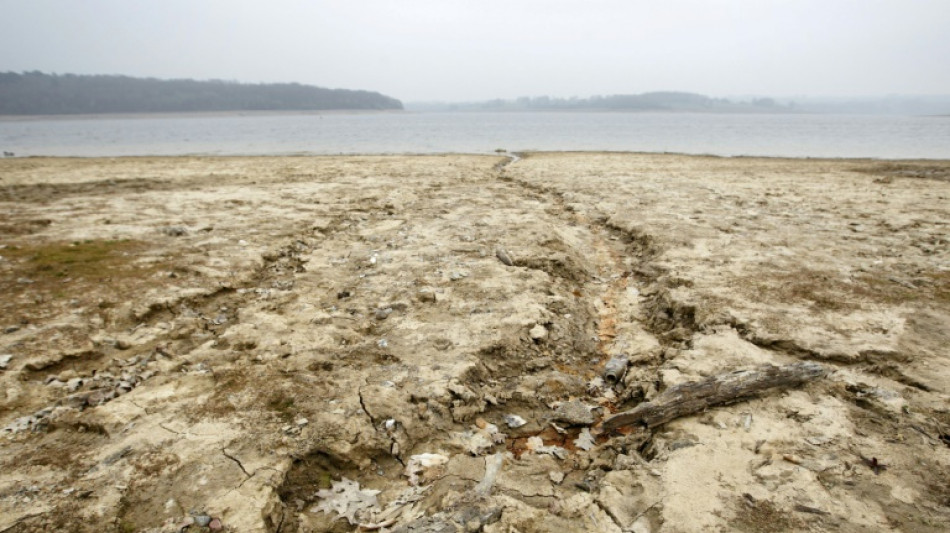
France and parts of England see driest July on record / Photo: JUSTIN TALLIS - AFP

 Trump's beef policies irk Texas ranchers, testing their loyalty

 Nvidia, OpenAI CEOs to attend Xi dinner at White House

 Anthropic picks Accenture for in-house AI safety evaluation

 Balogun returns as Monaco beat Lens to continue strong Ligue 1 start

 'Pause' on overt repression in Venezuela, but reforms still needed: HRW

 Global stocks mixed as yen falls despite Bank of Japan rate hike

 Cuba hit with seventh major blackout of the year

 Murray out with concussion so Wentz will start for Vikings

 UN chief 'deeply regrets' US visa refusal to Abbas for annual meeting

 England quick Carse to face no charges over alleged nightclub assault

 Mancini brings nine newcomers into the first squad of his Italy comeback

 Czechs level Davis Cup tie against USA as South Korea eye Finals

 New France boss Zidane confirms Mbappe as captain after naming first squad

 California governor signs order to explore AI 'kill switch'

 Head leads run spree as Australia win Zimbabwe ODI series

 In-form Raphinha wants to finish career at Barcelona

 Warren Buffett steps down as Berkshire Hathaway chairman

 Carrick confident Man Utd can 'work through' tough time

 Mbappe ends Nike partnership to join Swiss brand On

 Liverpool boss Iraola puts Bournemouth love affair on hold

 'A disaster' if Man City do not win says Maresca after flawless start

 Kerry James Marshall: American 'blackness' painter celebrated in Europe

 Spain coach De la Fuente offers 'full support' to people of Ceuta

 Russia seizes assets of Nestle, French firms over West's Ukraine support

 England can build on World Cup 'spirit', says Tuchel

France and parts of England saw their driest July on record, the countries' weather agencies said on Monday, exacerbating stretched water resources that have forced restrictions on both sides of the Channel.
In France, where an intense drought has hammered farmers and prompted widespread limits on freshwater use, there was just 9.7 millimetres (0.38 inches) of rain last month, Meteo France said.
That was 84 percent down on the average levels seen for July between 1991 and 2022, and made it the second driest month since March 1961, the agency added.
Meanwhile swathes of southern and eastern England recorded the lowest rainfall in July on record, the UK's Met Office.
The whole of England recorded an average of 23.1 mm of rain -- the lowest figure for the month since 1935 and the seventh lowest July total on record, it said.
The Met Office has been compiling records since 1836.
The low rainfall in both countries has been coupled with a summer of unprecedentedly high temperatures, which topped 40 degrees Celsius (104 degrees Fahrenheit) in England last month for the first time ever.
Climate scientists overwhelmingly agree that carbon emissions from humans burning fossil fuels are heating the planet, raising the risk and severity of droughts, heatwaves, and other extreme weather events.
Analysis by an international team of researchers released last Friday found climate change caused by human activity made the recent record-shattering UK heatwave at least 10 times more likely to occur.
- 'Vicious circle' -
Water companies on both sides of the Channel are struggling to respond to the parched conditions.
Nearly all of France's 96 mainland regions have imposed water use restrictions, also a record.
The country is bracing for its third heatwave this summer, beginning in the southeast on Monday before heading north toward Paris.
Farmers nationwide are reporting difficulties in feeding livestock because of parched grasslands, while irrigation has been banned in large areas of the northwest and southeast due to freshwater shortages.
On the eastern river Rhine, which runs along the France-Germany border, commercial boats are having to run at a third of their carrying capacity in order to avoid hitting the bottom because the water level is so low.
Environment Minister Christophe Bechu said July's rainfall represented "just 12 percent of what's needed".
"We have a heatwave that increases the need (for water) and a drought that is limiting what is available, pushing us into this vicious cycle," Bechu told BFM television during a visit to the hard-hit Isere department in the southeast.
In England, one water provider has so far announced restrictions.
Southern Water, which is responsible for supplies over a swathe of central southern England, will impose limits on its almost one million customers from later this week.
But the so-called hosepipe ban could soon be replicated by other providers, following a warning by the UK government's Environment Agency that people needed to use water "wisely".
Most of England has moved into "prolonged dry weather" status, the agency said last week.
This means it is now taking precautionary actions to mitigate impacts "as hydrological conditions deteriorate".
H.Portela--PC



