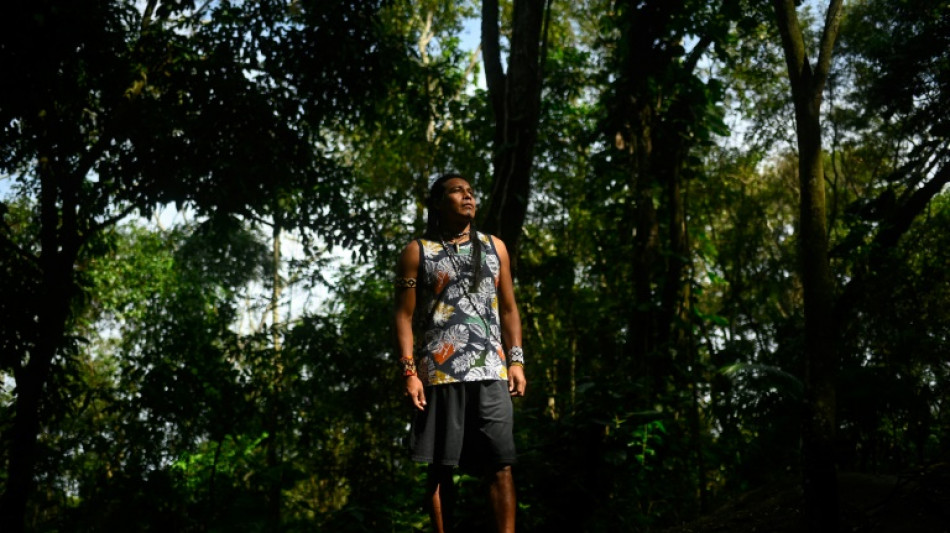
Seeking water, Brazil indigenous group finds new home / Photo: Andre BORGES - AFP

 Trump's beef policies irk Texas ranchers, testing their loyalty

 Nvidia, OpenAI CEOs to attend Xi dinner at White House

 Anthropic picks Accenture for in-house AI safety evaluation

 Balogun returns as Monaco beat Lens to continue strong Ligue 1 start

 'Pause' on overt repression in Venezuela, but reforms still needed: HRW

 Global stocks mixed as yen falls despite Bank of Japan rate hike

 Cuba hit with seventh major blackout of the year

 Murray out with concussion so Wentz will start for Vikings

 UN chief 'deeply regrets' US visa refusal to Abbas for annual meeting

 England quick Carse to face no charges over alleged nightclub assault

 Mancini brings nine newcomers into the first squad of his Italy comeback

 Czechs level Davis Cup tie against USA as South Korea eye Finals

 New France boss Zidane confirms Mbappe as captain after naming first squad

 California governor signs order to explore AI 'kill switch'

 Head leads run spree as Australia win Zimbabwe ODI series

 In-form Raphinha wants to finish career at Barcelona

 Warren Buffett steps down as Berkshire Hathaway chairman

 Carrick confident Man Utd can 'work through' tough time

 Mbappe ends Nike partnership to join Swiss brand On

 Liverpool boss Iraola puts Bournemouth love affair on hold

 'A disaster' if Man City do not win says Maresca after flawless start

 Kerry James Marshall: American 'blackness' painter celebrated in Europe

 Spain coach De la Fuente offers 'full support' to people of Ceuta

 Russia seizes assets of Nestle, French firms over West's Ukraine support

 England can build on World Cup 'spirit', says Tuchel

Clutching a machete and a cell phone, indigenous leader Vanderlei Weraxunu tours his community's future home, a swathe of tropical forest land north of Rio de Janeiro where his people will finally have water.
Weraxunu is one of around 50 members of the Mbya Guarani people who will soon establish a new home in the middle of what will be Brazil's first municipal nature reserve, where they plan to live according to their ancestral lifestyle.
The project promises to transform the lives of community members, who have been living in a settlement with no access to potable water in Marica county, in Rio de Janeiro state.
Hailing from different regions of Brazil, the community of Mbya Guarani moved there a decade ago and founded a village, Ceu Azul (Blue Sky) on a plot of land donated by a businessman.
But the land, a former coffee plantation, is too degraded to farm crops, and the village has to have water trucked in by the municipal government.
"A river ran through it 150 years ago. But then the former owner turned it into a coffee plantation and it was devastated," says the youthful, chiseled Weraxunu, sporting a beaded armband, traditional face paint and long black hair.
"They cut down the forest and that caused the river to dry up," he adds, as a black- and bronze-furred monkey playfully performs acrobatics on his arms and shoulders.
South America is home to an estimated 280,000 Guarani, divided into several subgroups including the Mbya.
They have a long history of conflicts with non-native farmers, who had often forced them from their ancestral land.
- 'Guardians of nature' -
After years of negotiations with the government, Weraxunu's community is now set to move in the coming months to a 50-hectare (125-acre) plot of public land about 35 kilometers (20 miles) away, donated by the municipality.
"We'll have more resources, we'll be able to plant (manioc and sweet potato) and gather medicinal herbs," says Weraxunu.
They also plan to bring back native crops such as Guarani maize, which they hold sacred, as well as bamboo for the handcrafts that are an important source of the community's income.
"Until now, we've had to bring in bamboo from other places" to make traditional baskets, says Maria Helena Jaxuka, a Guarani cacique, or chief.
"It will allow us to preserve nature, as well as our culture and way of life," says Weraxunu.
"The Guarani and all indigenous peoples are the guardians of nature, which gives us life."
H.Portela--PC



