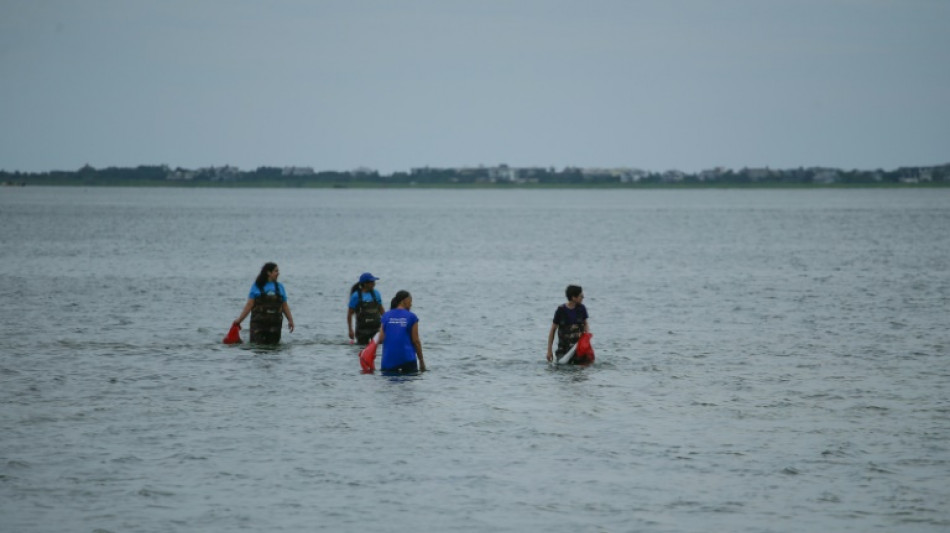
In New York, a native tribe fights to save its land from climate change / Photo: KENA BETANCUR - AFP

 African players in Europe: Mbeumo fires solo goal as United draw

 Malaysia cancels haze emergency, but warns problems remain

 Philippine sensation Eala looks forward to Asian Games 'fun'

 Jakarta airport extends closure after volcano eruption

 Lonely woman director in Venice sees industry backsliding on gender

 Tech firms rally on mixed day for Asian markets, with eyes on US inflation

 World number one An sends Asian Games warning with China hat-trick

 PSG go for three in a row as Champions League returns

 "Super-human' Alcaraz books US Open quarter-final clash with Shelton

 ECB set to hike interest rates as Iran war flares anew

 AI data centers are less thirsty now, tech giants say

 North Korea vows nuclear-armed navy as US ally drills open

 Under-fire Labuschagne named in Australia Test squad for South Africa

 Enjoying the moment: Alcaraz steps it up to reach US Open quarter-finals

 Five dead, five injured after Amazon cargo plane overshoots Miami runway

 La Rochelle half-backs lead fightback against Toulouse

 US envoys have 'more effective proposals': Ukraine official

 Defending champion Alcaraz powers into US Open quarter-finals

 Amazon cargo plane overshoots Miami runway, hits vehicles, catches fire

 Toll from Yemen clashes passes 300 as civilians flee homes

 Sabalenka books US Open quarter-final clash with Noskova

 German AfD supporters jubilant at far right's thumping win

 Zelensky warns war likely to continue into winter after US talks

 Arsenal deliver statement fightback to end Chelsea's flying start

 Leclerc accepts blame as Hamilton laments Ferrari approach

In the Hamptons, New York's playground for the rich and famous, a Native American tribe is battling with the latest threat to what's left of its traditional land: climate change.
The Shinnecock, whose name means "people of the stony shore," have lived on Long Island for 13,000 years.
Their villages stretched along the island's eastern end before land grabs by European settlers and later US authorities reduced their territory to an 800-acre (1.25 square-mile) peninsula.
That low-lying land is now shrinking due to rising sea levels and coastal erosion, and making it increasingly vulnerable to more powerful storms.
"You're looking at a situation where an entire nation of people who have been here for essentially forever are faced with a devastating reality that we may have to relocate," Tela Troge, a Shinnecock attorney, told AFP.
The Shinnecock Indian Nation is a self-governing, federally recognized tribe of approximately 1,600 members.
Roughly half live on its reservation, which juts out into Shinnecock Bay beside Southampton, where multi-million-dollar mansions sit behind electric gates.
Also next door is the hamlet of Shinnecock Hills and its famous eponymous golf club, land the tribe says was stolen from them in 1859.
Warming temperatures are causing seas to expand and rise, eating away at the reservation's coastline.
- Flooding -
Ed Terry, who makes traditional Shinnecock jewelry out of shells found on the beach, remembers the sand going out much further when he was a boy.
"You can see the erosion. Where the land was is now water. It's like the sea is coming to us," the 78-year-old told AFP, as he sculpted a mussel shell to be worn as earrings.
Some parts of the shoreline have already receded 150 feet (45 meters), according to studies cited by Shavonne Smith, the nation's environment director.
She says 57 homes may have to be relocated soon and bodies possibly disinterred from the tribe's coastal cemetery and moved elsewhere.
"If you're talking about taking a people that are so dependent on the water -- for spiritual health, recreational and sustenance -- and now moving them further inland, you're talking about a very huge, stressful, emotional, dynamic shift in who we are," Smith told AFP.
The nation estimates its sea levels will rise by up to 4.4 feet (1.3 meters) by the end of the century. Coupled with more intense storms, this would mean frequent devastating floods.
Hurricane Sandy gave a foretaste in 2012, washing away bluffs on the shore, ripping off roofs and flooding basements and the burial grounds.
"There are studies that show by the year 2040 there's a 100 percent chance the entire Shinnecock Nation region will get inundated by a storm," said Scott Mandia, a climate change professor at Suffolk County Community College.
- 'We will survive' -
In an attempt to preserve their homeland and way of life, which includes fishing and farming, the nation is taking a nature-based approach towards tackling global warming.
It has built an oyster shell reef and placed boulders to try to hold back waves, as well as planted sea and beach grass in a bid to stop sand from shifting.
Tribe members are doing their bit too.
Troge, 35, is director of Shinnecock Kelp Farmers -- a group of six Indigenous women who harvest sugar kelp and sell it as a non-chemical fertilizer.
The seaweed helps clean up water pollution, fueled by neighboring development, by absorbing carbon and nitrates that cause toxic algae blooms, which damage marine life.
Wading into the bay waist-high, farmer Donna Collins-Smith says she is inspired by previous Shinnecock generations "and what they have preserved for us."
"We are maintaining that and bringing it back from a state of near dead," the 65-year-old told AFP.
Mandia, co-author of a book about rising sea levels, laments that marginalized communities "who are least responsible for" climate change are those "who are going to feel the pain the most."
He applauds the tribe's efforts but says they are "just buying time" before their land becomes uninhabitable.
Terry, the septuagenarian jeweler, wonders where future Shinnecock will go, since tribal boundaries are fixed.
"We have no higher ground," he says.
Nevertheless, Terry adds, "We are a strong people. We will survive."
T.Vitorino--PC