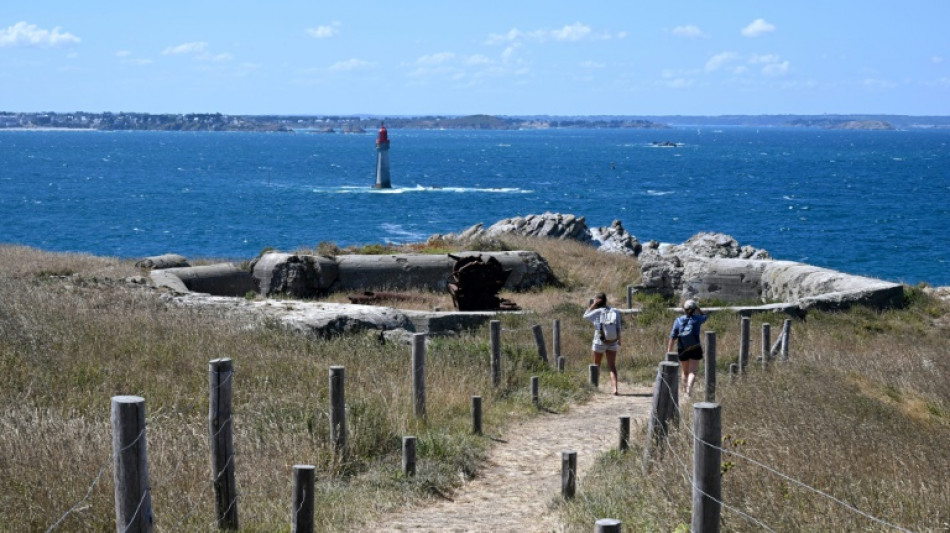
Mine-riddled French island becomes unlikely walkers' paradise / Photo: Damien MEYER - AFP

 Thousands bid farewell to Bosnian Serb war criminal in Belgrade

 EU chief announces 200-mn-euro investment package for Greenland

 Lebanon says Israel conducts wave of deadly strikes

 Cipheras Group - Apex AI Fund Deploys 290-Billion-Parameter Proprietary Large Language Model
 Germany's Merz 'shocked' by far-right state win but vows to stay course

 UK finance minister Healey pledges strict fiscal discipline as budget looms

 Mbappe embraces Ballon d'Or talk after historic World Cup exploits

 Tech firms rally, with eyes on US inflation update

 Jaguar Land Rover to cut 4,000 jobs as European car sector hits skids

 US average diesel price rises to record $5.90 a gallon: AAA

 Dukascopy Bank Unveils AI-Powered Trading, 25,000+ Stock CFDs and a New Flagship E-Banking App
 Tech firms rally but Asian markets mixed, with eyes on US inflation

 Nepal holds day of mourning as families pray missing still alive

 African players in Europe: Mbeumo fires solo goal as United draw

 Malaysia cancels haze emergency, but warns problems remain

 Philippine sensation Eala looks forward to Asian Games 'fun'
 Jakarta airport extends closure after volcano eruption

 Lonely woman director in Venice sees industry backsliding on gender

 Tech firms rally on mixed day for Asian markets, with eyes on US inflation

 World number one An sends Asian Games warning with China hat-trick
 PSG go for three in a row as Champions League returns

 "Super-human' Alcaraz books US Open quarter-final clash with Shelton

 ECB set to hike interest rates as Iran war flares anew

 AI data centers are less thirsty now, tech giants say

 North Korea vows nuclear-armed navy as US ally drills open

Every year, thousands of day-trippers make the short boat journey from France's northern coast to the island of Cezembre, marvelling at the spectacular maritime views and flourishing wildlife.
But they better tread carefully and stick to the path, as almost all the island remains perilous due to unexploded munitions from World War II.
Cezembre opened to visits only in 2018, over seven decades after the end of World War II, after extensive demining efforts allowed the opening of a marked path for visitors.
However, the area safe for visitors makes up just three percent of the island, which experts say was the most bombed area of all of World War II in terms of the number of hits per square metre.
"It's magnificent!" enthused Maryse Wilmart, a 60-year-old visitor from the southwestern town of La Rochelle, contemplating the sandy beach with turquoise waters and looking out to the ramparts of the port city of Saint-Malo beyond.
"But when you see all that behind us... Can you even imagine what happened here?" she asked, pointing to the barbed wire and signs warning "Danger! Ground not cleared beyond the fences!"
- 'Like Stalingrad' -
A visitor needs to go back 80 years to understand what happened on this usually uninhabited rocky outcrop.
In 1942, the occupying Nazi German army seized the strategically important island and installed bunkers and artillery pieces.
On August 17, 1944, Saint-Malo was liberated by the Americans but the Nazi commander of Cezembre, leading some 400 men, refused to surrender.
There then followed a devastating bombardment from the air by the Allies.
"It is said that per square metre it sustained the greatest number of bombardments of all the theatres of operation of World War II," said Philippe Delacotte, author of the book "The Secrets of the Island of Cezembre".
"There were between 4,000 and 5,000 bombs dropped", some of which contained napalm, he said.
On September 2, 1944, the white flag was finally raised and some 350 exhausted men surrendered.
"Some survivors claimed it was like Stalingrad," Delacotte said. The island was completely devastated, to the extent that its altitude even dropped because of the bombs.
After the war, the island became the property of the French ministry of defence and access was totally closed, with the first demining efforts starting in the 1950s.
It was handed over to a public coastal conservation body, the Conservatoire du Littoral, in 2017.
- 'Recolonised and revegetated' -
The path of about 800 metres (875 yards) lets visitors wander between rusty cannons and bunkers, with breathtaking views towards Cap Frehel and the Pointe de la Varde.
Since the opening of the path, "there has been no accident" even if "there are always people who want to go beyond the authorised section," said Jean-Christophe Renais, a coast guard.
Over time, colonies of seabirds have reappeared, including seagulls, cormorants, razorbills and guillemots.
"Biodiversity is doing wonderfully, everything has been recolonised and revegetated, birds have taken back possession of the site," said Gwenal Hervouet, who manages the site for Conservatoire du Littoral.
"It's just a joy."
Because of the focus on restoring wildlife, the trail was partially closed in April "to maximise the chances of success and the flight of peregrine falcon chicks," said local conservation activist Manon Simonneau.
Some walkers say they hope the trail will be lengthened to allow a complete tour of the island, but according to the Conservatoire there is little chance of this -- the cost of further demining would be astronomical, so it is now birds and nature that are the masters of Cezembre.
J.Oliveira--PC