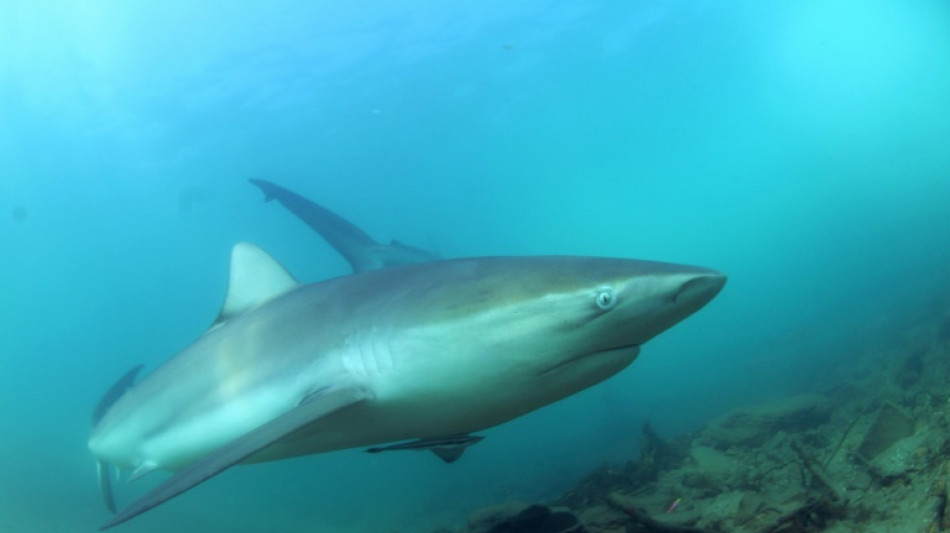
Endangered sharks, rays caught in protected Med areas: study / Photo: Ran Golan - Out of The Blu/AFP/File

 Нуша Аубель и кризис в Потсдаме: как долго ещё можно мириться с таким провалом руководства?

 England quick Archer in 'good place' after injuries

 Robots protest rampant AI in Poland

 Rare woman director in Venice sees industry backsliding on gender

 France, SKorea warn at film summit of AI risks to creativity

 Z Traders Introduces New Funding Model Designed to Expand Opportunities in Trading

 Lebanon says 12 killed in strikes as Israel vows to 'remove threats'

 Volkswagen plant to be converted for Israeli defence group

 Israeli rubble-clearing in Gaza could erase 'atrocity crimes' evidence: UN expert

 Scorching summer pushes French wine harvest to new historic low

 Pietersen joins England coaching team ahead of World Cup

 Germany's triumphant far-right AfD aims fire at Merz

 Fury claims Joshua bout is off, calls for Usyk trilogy

 British family bids to row back against suicide taboo

 China's teenage 223cm basketball player 'just a little girl'

 Tokyo's Shinjuku to ban more than half of vacation rentals

 Australian Rules limits contact training to reduce concussion

 Germany's Merz under pressure from far-right election triumph

 Nepal tunnel rescues face 'unprecedented' challenge
 Mourinho's Real Madrid European revival bid starts with Inter reunion

 Solomons PM survives attempt to oust government

 Ohtani 'unlikely' to pitch again this season, says Dodgers manager

 Driver thanks 'superhero' rival for saving him from flaming race car

 Can dogs sniff cancer? AI joins the hunt in India

 Shelton steams into US Open quarter-final clash with Alcaraz

Endangered sharks, rays and skates in the Mediterranean are more frequently caught in protected than in unprotected areas, according to research published Tuesday highlighting the need for better conservation for critically threatened species.
The three types of elasmobranch are among the species most threatened by overfishing.
While often landed as by-catch -- or caught in nets of boats seeking to land other species -- demand for their fins and meat has driven an estimated 71-percent decline in ocean sharks and rays since 1970.
Although they are among the oldest marine species on Earth, their slow growth rate and late maturity mean one third of elasmobranchs are categorised by the International Union for the Conservation of Nature (IUCN) as at risk of extinction.
While dozens of nations have banned large-scale fishing of endangered shark, ray and skate species, true global catch figures are likely to be hugely underestimated as 90 percent of the world's fishing fleet is made up of small-scale boats.
Researchers in Italy wanted to get a better idea of how species fare in the Mediterranean's partially protected areas, which allow some fishing with restrictions.
They used photo-sampling and image analysis to compile a database covering more than 1,200 small-scale fishing operations across 11 locations in France, Italy, Spain, Croatia, Slovenia and Greece.
- Protected areas -
The team then used statistical models to demonstrate that catches of threatened species were higher in partially protected areas than in areas with no protection at all.
"People assume that it is large-scale trawlers that are impacting biodiversity, which is true and there's a lot of evidence for this," said co-author Antonio Di Franco, from the Sicily Marine Centre.
"There is less research on small-scale fishing's impact and our research shows that there is this potential."
The team found that catches they analysed in partially protected areas landed 24 species of shark, skate and ray -- more than a third of which are endangered.
This is likely in part due to the species' preference for coastal waters, where most small-scale fisheries prefer to operate.
"We don't know the activity of small-scale fisheries in general, we don't know how many nets they actually fish or where they fish," said Di Franco.
Overall, in the partially protected areas studied, 517 elasmobranchs were caught compared with 358 in non-protected areas.
In terms of mass, the weight of shark, ray or skate species caught in partially protected areas was roughly double that in non-protected areas.
More than 100 countries have committed to increase the amount of protected oceans worldwide to 30 percent by 2030.
Di Franco said there were a number of steps countries could take to help threatened species, including fitting smaller fishing boats with GPS trackers and ensuring that protected areas were joined up, allowing the species to more easily change living regions.
"Protected areas are a great potential benefit to biodiversity but the point is to look at management," he told AFP.
"But often countries don't have the capacity to properly manage stocks."
R.Veloso--PC