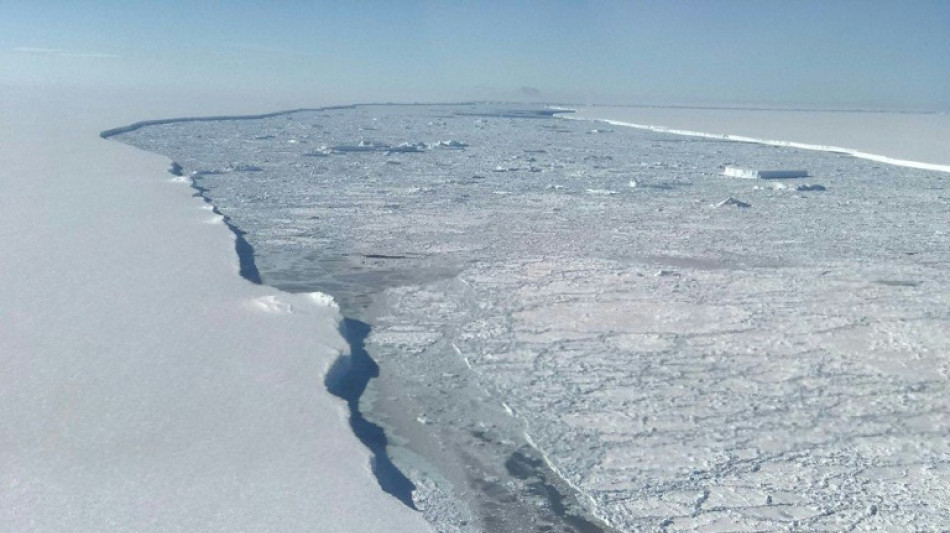
World's biggest ice sheet could cause massive sea rise without action: study / Photo: HO - NASA/AFP/File

 Trump's beef policies irk Texas ranchers, testing their loyalty

 Nvidia, OpenAI CEOs to attend Xi dinner at White House

 Anthropic picks Accenture for in-house AI safety evaluation

 Balogun returns as Monaco beat Lens to continue strong Ligue 1 start

 'Pause' on overt repression in Venezuela, but reforms still needed: HRW

 Global stocks mixed as yen falls despite Bank of Japan rate hike

 Cuba hit with seventh major blackout of the year

 Murray out with concussion so Wentz will start for Vikings

 UN chief 'deeply regrets' US visa refusal to Abbas for annual meeting

 England quick Carse to face no charges over alleged nightclub assault

 Mancini brings nine newcomers into the first squad of his Italy comeback

 Czechs level Davis Cup tie against USA as South Korea eye Finals

 New France boss Zidane confirms Mbappe as captain after naming first squad

 California governor signs order to explore AI 'kill switch'

 Head leads run spree as Australia win Zimbabwe ODI series

 In-form Raphinha wants to finish career at Barcelona

 Warren Buffett steps down as Berkshire Hathaway chairman

 Carrick confident Man Utd can 'work through' tough time

 Mbappe ends Nike partnership to join Swiss brand On

 Liverpool boss Iraola puts Bournemouth love affair on hold

 'A disaster' if Man City do not win says Maresca after flawless start

 Kerry James Marshall: American 'blackness' painter celebrated in Europe

 Spain coach De la Fuente offers 'full support' to people of Ceuta

 Russia seizes assets of Nestle, French firms over West's Ukraine support

 England can build on World Cup 'spirit', says Tuchel

The world's biggest ice sheet could cause "several metres" of sea-level rise over centuries if the global temperature rises more than 2°C, according to a British study published Wednesday.
Researchers at Durham University concluded that if global greenhouse emissions remain high, the melting East Antarctica Ice Sheet (EAIS) could cause nearly half a metre of sea-level rise by 2100. Their analysis was published in the scientific journal Nature.
If emissions remain high beyond that, the EAIS could contribute around one to three metres to global sea levels by 2300, and two to five metres by 2500, they said.
However, if emissions were dramatically reduced, EAIS could contribute around two centimetres of sea level rise by 2100, according to the assessment.
This would represent far less than the ice loss expected from Greenland and West Antarctica.
"A key conclusion from our analysis is that the fate of the East Antarctic Ice Sheet remains very much in our hands," said lead author Chris Stokes, from Durham University's Department of Geography.
"This ice sheet is by far the largest on the planet, containing the equivalent of 52 metres of sea level and it's really important that we do not awaken this sleeping giant.
"Restricting global temperature increases to below the 2°C limit set by the Paris Climate Agreement should mean that we avoid the worst-case scenarios, or perhaps even halt the melting of the East Antarctic Ice Sheet, and therefore limit its impact on global sea level rise," he added.
- Computer simulations -
The study did note that the worst scenarios projected were "very unlikely".
World leaders agreed at the 2015 UN Climate Change Conference in Paris to limit global warming to well below 2°C and pursue efforts to limit the rise to 1.5°C.
The research team, which included scientists from the UK, Australia, France and the US, analysed how the ice sheet responded to past warm periods when making their predictions.
They ran computer simulations to model the effects of different greenhouse gas emission levels and temperatures on the ice sheet by the years 2100, 2300 and 2500.
They found evidence to suggest that three million years ago, when temperatures were around 2-4°C higher than present, part of the EAIS "collapsed and contributed several metres to sea-level rise".
"Even as recently as 400,000 years ago -- not that long ago on geological timescales -- there is evidence that a part of the EAIS retreated 700 km inland in response to only 1-2°C of global warming," they added.
Nerilie Abram, a co-author of the study from the Australian National University in Canberra, warned the sheet "isn't as stable and protected as we once thought."
A.Seabra--PC



