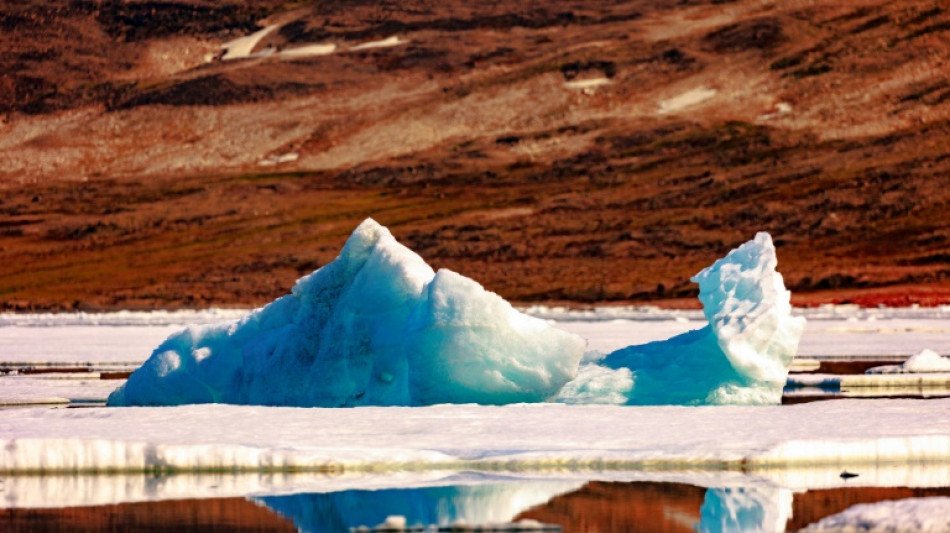
Arctic warming four times faster than rest of Earth: study / Photo: Kerem YUCEL - AFP/File

 Trump's beef policies irk Texas ranchers, testing their loyalty

 Nvidia, OpenAI CEOs to attend Xi dinner at White House

 Anthropic picks Accenture for in-house AI safety evaluation

 Balogun returns as Monaco beat Lens to continue strong Ligue 1 start

 'Pause' on overt repression in Venezuela, but reforms still needed: HRW

 Global stocks mixed as yen falls despite Bank of Japan rate hike

 Cuba hit with seventh major blackout of the year

 Murray out with concussion so Wentz will start for Vikings

 UN chief 'deeply regrets' US visa refusal to Abbas for annual meeting

 England quick Carse to face no charges over alleged nightclub assault

 Mancini brings nine newcomers into the first squad of his Italy comeback

 Czechs level Davis Cup tie against USA as South Korea eye Finals

 New France boss Zidane confirms Mbappe as captain after naming first squad

 California governor signs order to explore AI 'kill switch'

 Head leads run spree as Australia win Zimbabwe ODI series

 In-form Raphinha wants to finish career at Barcelona

 Warren Buffett steps down as Berkshire Hathaway chairman

 Carrick confident Man Utd can 'work through' tough time

 Mbappe ends Nike partnership to join Swiss brand On

 Liverpool boss Iraola puts Bournemouth love affair on hold

 'A disaster' if Man City do not win says Maresca after flawless start

 Kerry James Marshall: American 'blackness' painter celebrated in Europe

 Spain coach De la Fuente offers 'full support' to people of Ceuta

 Russia seizes assets of Nestle, French firms over West's Ukraine support

 England can build on World Cup 'spirit', says Tuchel

The Arctic has warmed nearly four times faster than the rest of the planet over the last 40 years, according to research published Thursday that suggests climate models are underestimating the rate of polar heating.
The United Nations' climate science panel said in a special report in 2019 that the Arctic was warming "by more than double the global average" due to a process known as Arctic amplification.
This occurs when sea ice and snow, which naturally reflect the Sun's heat, melt into sea water, which absorbs it instead.
While there is a long-held consensus among scientists that the Arctic is warming quickly, estimates vary according to the timeframe studied and the definition of what constitutes the geographic area of the Arctic.
A team of researchers based in Norway and Finland analysed four sets of temperature data gathered by satellite studies since 1979 -- the year when satellite data became available -- over the entire Arctic circle.
They found that on average the data showed the Arctic had warmed 0.75C per decade, nearly four times quicker than the rest of the planet.
"The take in the literature is that the Arctic is warming about twice as fast as the globe, so for me it was a bit surprising that ours was so much higher than the usual number," Antti Lipponen, co-author from the Finnish Meteorological Institute, told AFP.
The study, published in the journal Communications Earth & Environment, found significant regional variations in warming rate within the Arctic circle.
For example, the Eurasian sector of the Arctic Ocean, near the Svalbard and Novaya Zemlya archipelagos, has warmed as much as 1.25C per decade -- seven times faster than the rest of the world.
The team found that even state-of-the-art climate models predicted Arctic warming to be approximately one third lower than what the observed data showed.
They said that this discrepancy may be due to previous modelled estimates being rendered out of date by continued Arctic modelling.
"Maybe the next step would be to take a look at the models and I would be really interested in seeing why the models do not reproduce what we see in observations and what impact that is having on future climate projections," said Lipponen.
As well as profoundly impacting local communities and wildlife that rely on sea ice to hunt, intense warming in the Arctic will have worldwide repercussions.
The Greenland ice sheet, which recent studies warn may be approaching a melting "tipping point", contains enough frozen water to lift Earth's oceans some six metres.
"Climate change is caused by humans. As the Arctic warms up its glaciers will melt and this will globally affect sea levels," said Lipponen.
"Something is happening in the Arctic and it will affect us all."
R.J.Fidalgo--PC



