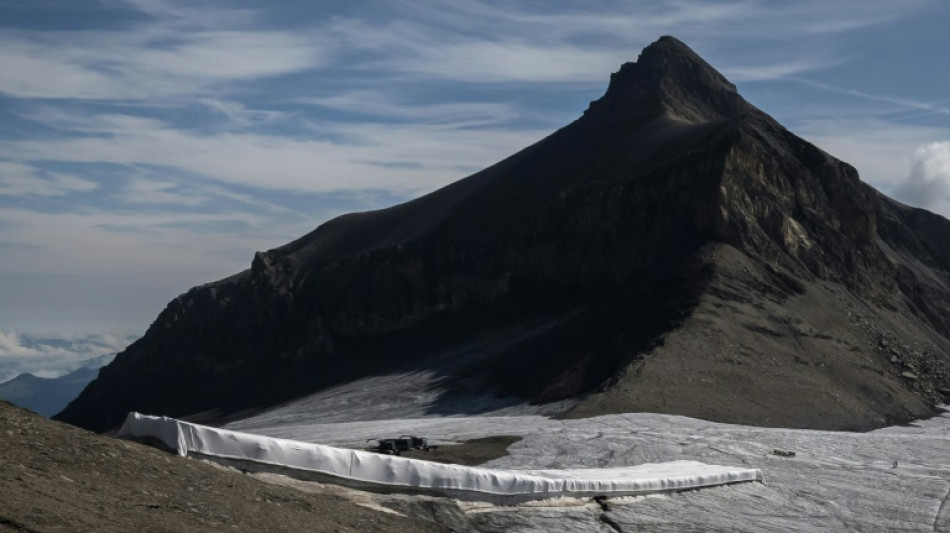
Swiss mountain pass ice to melt completely within weeks / Photo: Fabrice COFFRINI - AFP

 Trump's beef policies irk Texas ranchers, testing their loyalty

 Nvidia, OpenAI CEOs to attend Xi dinner at White House

 Anthropic picks Accenture for in-house AI safety evaluation

 Balogun returns as Monaco beat Lens to continue strong Ligue 1 start

 'Pause' on overt repression in Venezuela, but reforms still needed: HRW

 Global stocks mixed as yen falls despite Bank of Japan rate hike

 Cuba hit with seventh major blackout of the year

 Murray out with concussion so Wentz will start for Vikings

 UN chief 'deeply regrets' US visa refusal to Abbas for annual meeting

 England quick Carse to face no charges over alleged nightclub assault

 Mancini brings nine newcomers into the first squad of his Italy comeback

 Czechs level Davis Cup tie against USA as South Korea eye Finals

 New France boss Zidane confirms Mbappe as captain after naming first squad

 California governor signs order to explore AI 'kill switch'

 Head leads run spree as Australia win Zimbabwe ODI series

 In-form Raphinha wants to finish career at Barcelona

 Warren Buffett steps down as Berkshire Hathaway chairman

 Carrick confident Man Utd can 'work through' tough time

 Mbappe ends Nike partnership to join Swiss brand On

 Liverpool boss Iraola puts Bournemouth love affair on hold

 'A disaster' if Man City do not win says Maresca after flawless start

 Kerry James Marshall: American 'blackness' painter celebrated in Europe

 Spain coach De la Fuente offers 'full support' to people of Ceuta

 Russia seizes assets of Nestle, French firms over West's Ukraine support
 England can build on World Cup 'spirit', says Tuchel

The thick layer of ice that has covered a Swiss mountain pass for centuries will have melted away completely within a few weeks, a ski resort said Thursday.
Following a dry winter, the summer heatwaves hitting Europe have been catastrophic for the Alpine glaciers, which have been melting at an accelerated rate.
The pass between the Scex Rouge and Tsanfleuron glaciers has been iced over since at least the Roman era.
But as both glaciers have retreated, the bare rock of the ridge between the two is beginning to emerge -- and will be completely ice-free before the summer is out.
"The pass will be entirely in the open air in a few weeks," the Glacier 3000 ski resort said in a statement.
While the ice measured around 15 metres (50 feet) thick in 2012, the ground underneath "will have completely resurfaced by the end of September".
- Land unseen in centuries -
The ridge is at an altitude of 2,800 metres in the Glacier 3000 ski domain and effectively marks the border between the Vaud and Wallis cantons in western Switzerland.
Skiers could glide over the top from one glacier to the other. But now a strip of rock between them has emerged, with just the last remaining bit of ice left.
"No-one has set foot here for over 2,000 years; that's very moving," said Glacier 3000 chief executive Bernhard Tschannen.
The Scex Rouge glacier is likely to turn into a lake within the next 10 to 15 years. It should be about 10 metres deep with a volume of 250,000 cubic metres (8.8 million cubic feet).
The ski resort is working out how to adapt to the new reality if people cannot ski between the two glaciers.
"We are planning to renew the facilities in this area in the coming years, and one idea would be to shift the route of the current chairlift to allow more direct access to the Tsanfleuron glacier," said Tschannen.
Covers have been put on sections of the Tsanfleuron glacier by the pass to protect them from the Sun's melting rays.
Glaciologist Mauro Fischer, a researcher at Bern University, said the loss of thickness of the glaciers in the region will be on average three times higher this year compared to the last 10 summers.
- Bodies emerge from ice -
The melting of the glaciers makes them more unstable, which makes them less viable for winter sports and hiking, but it also means that things buried in the ice for years -- even decades -- can re-emerge.
In the past two weeks, two human skeletons were found on glaciers in Wallis.
Work is underway to try to identify the remains. According to the Swiss news agency ATS, the Wallis police have a list of some 300 people who have gone missing since 1925.
In July 2017, the Tsanfleuron glacier turned up the bodies of a couple who disappeared in 1942.
The bones of three brothers who died in 1926 were found on the Aletsch glacier in June 2012.
And last week the wreckage of a plane that crashed in the Alps in 1968 was discovered on the Aletsch glacier.
The bodies of the three people on board were recovered at the time but the wreckage was not.
F.Carias--PC



