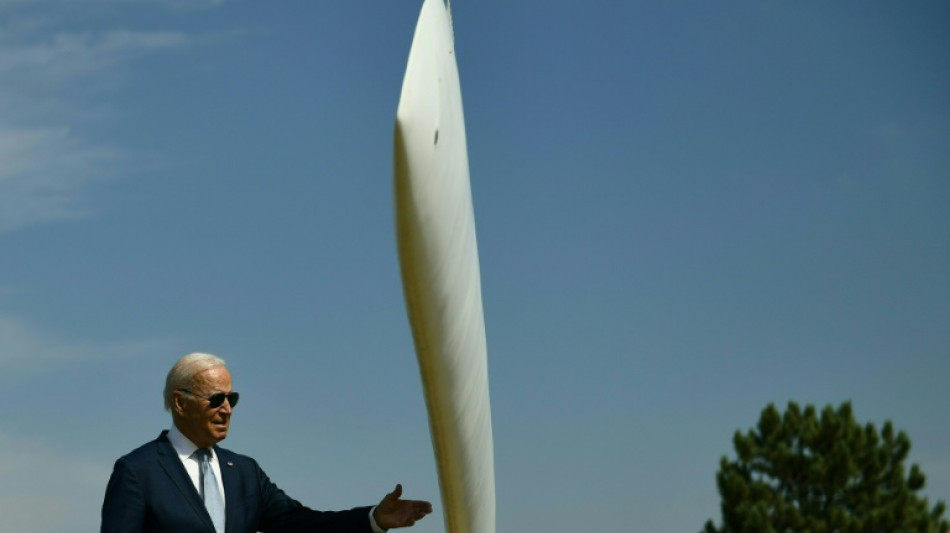
What's in Biden's big climate and health plan? / Photo: Brendan Smialowski - AFP/File

 Trump's beef policies irk Texas ranchers, testing their loyalty

 Nvidia, OpenAI CEOs to attend Xi dinner at White House

 Anthropic picks Accenture for in-house AI safety evaluation

 Balogun returns as Monaco beat Lens to continue strong Ligue 1 start

 'Pause' on overt repression in Venezuela, but reforms still needed: HRW

 Global stocks mixed as yen falls despite Bank of Japan rate hike

 Cuba hit with seventh major blackout of the year

 Murray out with concussion so Wentz will start for Vikings

 UN chief 'deeply regrets' US visa refusal to Abbas for annual meeting

 England quick Carse to face no charges over alleged nightclub assault

 Mancini brings nine newcomers into the first squad of his Italy comeback

 Czechs level Davis Cup tie against USA as South Korea eye Finals

 New France boss Zidane confirms Mbappe as captain after naming first squad

 California governor signs order to explore AI 'kill switch'

 Head leads run spree as Australia win Zimbabwe ODI series

 In-form Raphinha wants to finish career at Barcelona

 Warren Buffett steps down as Berkshire Hathaway chairman

 Carrick confident Man Utd can 'work through' tough time

 Mbappe ends Nike partnership to join Swiss brand On

 Liverpool boss Iraola puts Bournemouth love affair on hold

 'A disaster' if Man City do not win says Maresca after flawless start

 Kerry James Marshall: American 'blackness' painter celebrated in Europe

 Spain coach De la Fuente offers 'full support' to people of Ceuta

 Russia seizes assets of Nestle, French firms over West's Ukraine support

 England can build on World Cup 'spirit', says Tuchel

Hundreds of billions of dollars for clean energy projects, cheaper prescription drugs and new corporate taxes are a few of the key items in US President Joe Biden's massive investment plan, which Congress has now passed.
Here's a closer look at the signature elements of the package, which represents a big political win for the Democratic president heading into November's crucial midterm elections.
Biden said he will sign it into law next week.
- $370 billion for clean energy, climate -
The legislation marks the biggest investment in US history in the fight against climate change.
Rather than attempting to punish the biggest polluters in corporate America, the bill put forward by Biden's party instead offers a series of financial incentives aimed at steering the world's biggest economy away from fossil fuels.
Tax credits will be given to producers and consumers of wind, solar and nuclear power.
It allots up to $7,500 in tax credits to every American who buys an electric vehicle. Anyone installing solar panels on their roof will see 30 percent of the cost subsidized.
Around $60 billion will be allocated for clean energy manufacturing, from wind turbines to the processing of minerals needed for electric car batteries.
The same amount will go towards programs to help drive investment in underprivileged communities, notably through grants for home renovation to improve energy efficiency and access to less polluting modes of transportation.
Huge investments will go into making forests less susceptible to wildfires and protect coastal areas from erosion caused by devastating hurricanes.
The bill aims to help the United States reduce its carbon emissions by 40 percent by 2030, as compared with 2005 levels.
- $64 billion for health care -
The second major aspect of the legislation is to help reduce the huge disparities in access to health care across the United States, notably by reining in skyrocketing prescription drug prices.
Under the new plan, Medicare -- the nation's health insurance plan for those aged 65 and older, or with modest incomes -- will be permitted to negotiate prices of certain medications directly with Big Pharma for the first time, likely yielding far better deals.
The plan requires pharmaceutical companies to offer rebates on certain drugs if the prices rise faster than soaring US inflation.
It also extends benefits under Barack Obama's signature Affordable Care Act -- known colloquially as Obamacare -- until 2025.
- Minimum corporate tax of 15% -
Alongside these huge investments, the so-called "Inflation Reduction Act" seeks to pare down the federal deficit through the adoption of a minimum corporate tax of 15 percent for all companies with profits exceeding one billion dollars.
The new tax aims to prevent certain huge firms from using tax havens to pay far less than what they theoretically owe.
According to estimates, the measure could generate more than $258 billion in tax revenue for US government coffers over the next 10 years.
A.Magalhes--PC



