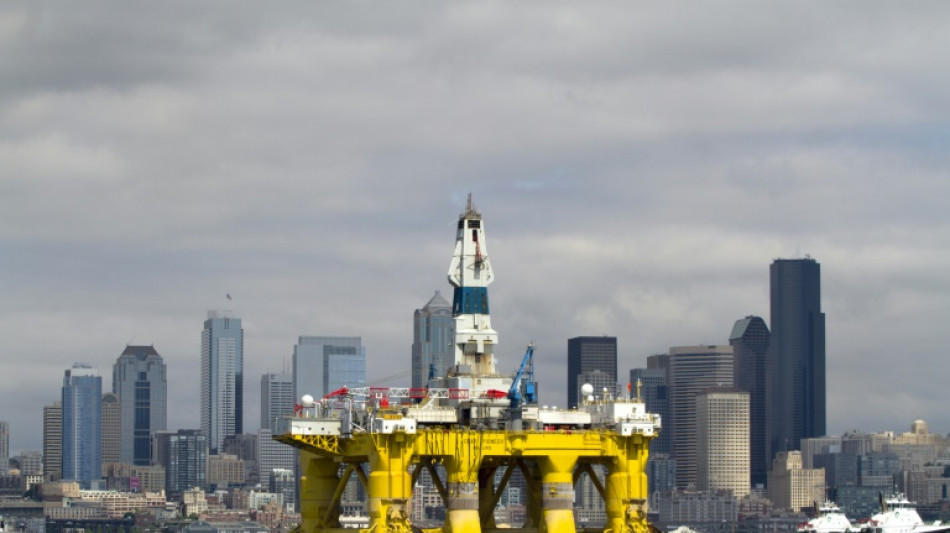
Oil majors' climate visions 'inconsistent' with Paris targets / Photo: Karen Ducey - GETTY IMAGES NORTH AMERICA/AFP/File

 Trump's beef policies irk Texas ranchers, testing their loyalty

 Nvidia, OpenAI CEOs to attend Xi dinner at White House

 Anthropic picks Accenture for in-house AI safety evaluation

 Balogun returns as Monaco beat Lens to continue strong Ligue 1 start

 'Pause' on overt repression in Venezuela, but reforms still needed: HRW

 Global stocks mixed as yen falls despite Bank of Japan rate hike

 Cuba hit with seventh major blackout of the year

 Murray out with concussion so Wentz will start for Vikings

 UN chief 'deeply regrets' US visa refusal to Abbas for annual meeting

 England quick Carse to face no charges over alleged nightclub assault

 Mancini brings nine newcomers into the first squad of his Italy comeback

 Czechs level Davis Cup tie against USA as South Korea eye Finals

 New France boss Zidane confirms Mbappe as captain after naming first squad

 California governor signs order to explore AI 'kill switch'

 Head leads run spree as Australia win Zimbabwe ODI series

 In-form Raphinha wants to finish career at Barcelona

 Warren Buffett steps down as Berkshire Hathaway chairman

 Carrick confident Man Utd can 'work through' tough time

 Mbappe ends Nike partnership to join Swiss brand On

 Liverpool boss Iraola puts Bournemouth love affair on hold

 'A disaster' if Man City do not win says Maresca after flawless start

 Kerry James Marshall: American 'blackness' painter celebrated in Europe

 Spain coach De la Fuente offers 'full support' to people of Ceuta

 Russia seizes assets of Nestle, French firms over West's Ukraine support

 England can build on World Cup 'spirit', says Tuchel

Global decarbonisation scenarios envisioned by oil and gas majors are incompatible with the Paris climate deal temperature goals aimed at averting devastating heating, according to research published Tuesday.
The landmark 2015 accord saw nations commit to limit planetary heating to "well below" two degrees Celsius (3.6 Farenheit) above pre-industrial levels and to work towards a safer 1.5-C warming cap.
Writing in the journal Nature Communications, an international team of experts analysed six emissions scenarios from three European energy giants -- Equinor, BP and Shell -- as well as those produced by the International Energy Agency.
They then compared the analysed pathways to scenarios outlined in a special report from the Intergovernmental Panel on Climate Change on 1.5C of warming.
The team used these to evaluate peak and end-of-century temperatures under each scenario, noting that average global temperatures may decline by 2100 in some scenarios after peaking.
They also assessed the underlying energy system changes that drive emissions and could lead to a given scenario meeting -- or failing to meet -- the Paris temperature goals.
"Most of the scenarios we evaluated would be classified as inconsistent with the Paris Agreement as they fail to limit warming to 'well below 2C', let alone 1.5C, and would exceed the 1.5C warming limit by a significant margin," said Robert Brecha of the Climate Analytics think tank and co-lead author of the study.
"Energy system transformation is critical to reaching the Paris Agreement warming limit, and decision makers need sound and transparent scientific assessments. This paper adds to that transparency."
- 'Catastrophic impacts' -
The analysis found that Shell's Sky scenario would lead to warming of 1.81C by 2069 -- a far cry from 1.5C.
A Shell spokeswoman told AFP that the Sky pathway was just one of several envisaged by the company.
The team responsible for modelling scenarios "makes assessments based on plausible assumptions and quantifications, which are not intended to be predictions of likely future events or outcomes, let alone our energy transition plan", she added.
Equinor's Rebalance scenario would see warming peak at 1.73C above pre-industrial levels by 2060, according to the study.
BP's Rapid scenario would see peak warming of 1.73C by 2058, while its Net Zero scenario would see median warming peak at 1.65C, the analysis found.
Equinor declined to comment, while BP did not respond to a comment request.
Only the IEA's Net Zero 2050 pathway is fully aligned with the Paris agreement's 1.5C goal, the authors concluded.
"Fossil fuel companies claim that we can continue to burn oil and gas while keeping to the 1.5C warming limit, and they cite their own scenarios as justification," said Bill Hare, CEO and Senior Scientist at Climate Analytics.
"But our research shows that their pathways would bust the Paris Agreement. Even temporarily exceeding the 1.5C warming would lead to catastrophic impacts and severely weaken our ability to adapt to climate change."
C.Cassis--PC



