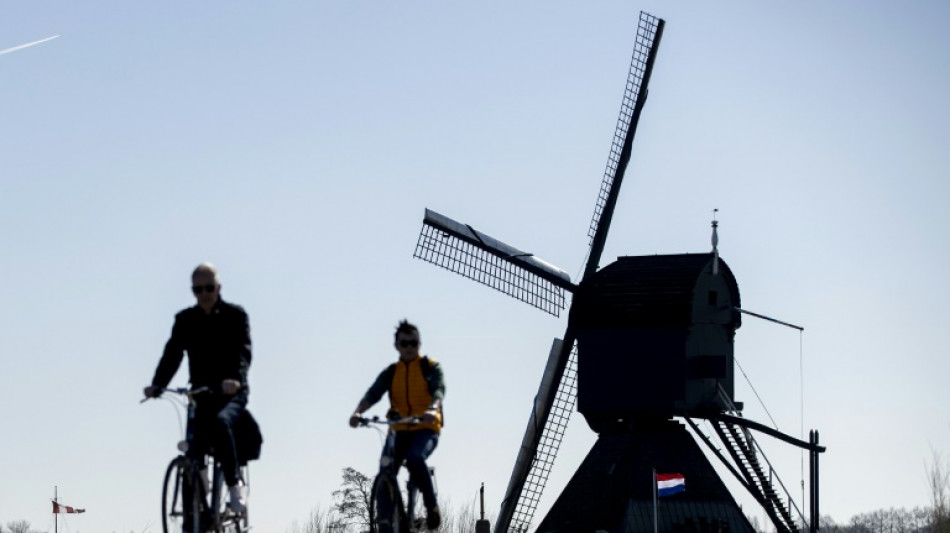
World could save 700 mn tonnes of CO2 if people cycled more, study shows / Photo: Sem van der Wal - ANP/AFP/File

 'Hopeless, stuck, afraid': US deportees in limbo in Cameroon

 Mount Fuji ends hiking season with landslide, two rescues

 Seahawks beat Patriots again in NFL opener

 Asian Games begin with Qatar basketball win, nine days before opening ceremony

 Stocks sink as oil rally fans inflation and rate hike fears

 Argentine industry reels from Milei's free-market revolution

 Women quit South Korea's grind for diving tradition

 Bayeux Tapestry 'mania' sweeps UK as sold-out exhibition opens
 August hottest month ever recorded globally: EU monitor

 Duplantis leads creme de la creme at 'game-changing' Ultimate Championship

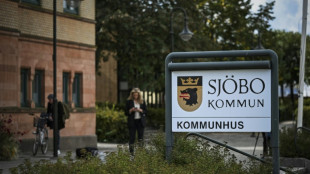 Sjobo, cradle of Sweden's now-mainstream anti-migrant sentiment
 Israeli-made film about Gaza civilian deaths to debut in Venice

 Stars ready for busy Toronto International Film Festival

 Rubio defends anti-drug boat strikes, warns of cartel 'cancer'

 Rybakina books US Open semi against Gauff, secures No.1 ranking

 Pegula aiming to thwart Sabalenka three-peat in US Open semis

 'Not normal' US Open scheduling under-fire after late-night finishes

 Luis Enrique hails 'marvellous' Dembele as PSG win big in Champions League

 Liverpool's Iraola 'lucky' after first taste of Champions League

 Resurgent Zheng takes positives from storming US Open run

 Odegaard gives Arsenal winning Champions League start at Napoli

 Bond yields jump despite $6 bn US government intervention

 Mac Allister caps Liverpool comeback to beat Atletico Madrid

 Ferran Torres hits hat-trick as PSG wallop Slovan in Champions League

 New CEO unveils Apple's first foldable iPhone

The world would save nearly 700 million tonnes of carbon pollution each year -- more than Canada's annual emissions -- if every person adopted the Dutch way of life and cycled on a daily basis, new research showed Thursday.
The transport sector currently accounts for a quarter of all fuel-related greenhouse gas emissions, which are warming the planet.
Half of those emissions are from passenger cars, and worldwide transport demand is predicted to triple by mid-century.
As they seek to decarbonise transport, governments and industry have turned towards electric vehicles, with 6.75 million units sold in 2021 alone.
Vehicle sales are tracked and published each year. However, it has been difficult to calculate the production and ownership of a much older, low-carbon technology: the bicycle.
An international team of researchers has now compiled the first global dataset of bicycle ownership and use by country dating back to the early 1960s, using statistical modelling to fill in any information gaps.
They found that between 1962-2015 global production of bikes outstripped that of cars, with China accounting for nearly two-thirds of the more than 123 million bikes manufactured in 2015.
Writing in the journal Communications Earth and Environment, the team showed that bicycle ownership was generally higher in upper-income and upper-middle-income countries -- but then so was the percentage of journeys undertaken by car.
This meant that high bicycle ownership does not necessarily lead to high bicycle use.
Among the 60 countries included in the dataset, the share of bicycle use for journeys was only five percent. Some countries, simply lack bicycle stocks, while others with high bike ownership, such as the United States, tended to view cycling as more of a leisure activity than a mode of transport.
- 'Going Dutch' -
The team calculated that if everyone emulated the Danish commute of cycling an average of 1.6 kilometres (1 mile) each day, the world could save some 414 million tonnes of CO2 a year -- equivalent to Britain's annual emissions.
"Going Dutch" and cycling 2.6 kilometres daily like people do in The Netherlands would save 686 million tonnes, and bring with it associated health benefits due to more exercise and improved air quality.
"A worldwide pro-bicycle policy and infrastructure development enabled modal shift like the Netherlands and Denmark can lead to significant untapped climate and health benefits," the authors wrote.
They said this dual benefit demanded better bicycle data collection, and said there was "an urgent need to promote sustainable bicycle use via supporting policy, planning, and infrastructure development."
The study's lead author, Gang Liu, a professor at the University of Southern Denmark's Department of Green Technology, said the research showed that bicycles had an important future role in lowering global transport's carbon footprint.
"Addressing such gigantic challenges requires not only technology-side strategies, such as lightweight design or electrification," he told AFP.
"But also needs demand-side strategies, such as alternative mobility patterns -- sharing mobility, on-demand mobility, and ride sharing -- and transport mode change, such as reducing short-distance car use by cycling."
Ferreira--PC