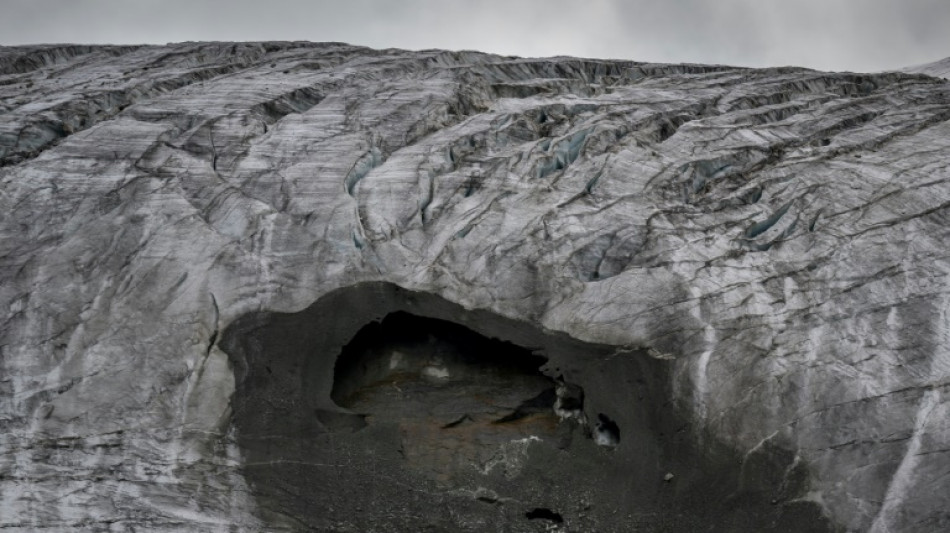
Swiss glaciers shrink in half since 1931: study / Photo: Fabrice COFFRINI - AFP

 'Bragging rights' up for grabs at game-changing Ultimate Championship, says Coe

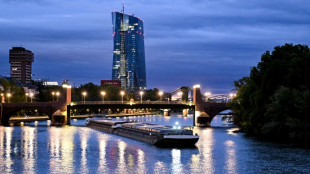
 ECB hikes borrowing costs to combat Mideast energy shock

 England turn screw in 3rd Test against Pakistan

 France will not support Infantino in FIFA election: federation chief

 In their words: Israeli forces describe AI-backed Gaza killing in new film

 Yemen's Houthis seize key city on Red Sea: military source

 Oil prices extend gains as markets await ECB rate outlook
 Wars pose a test as India hosts BRICS summit with China, Russia, Iran leaders

 Messi to buy second Spanish lower league club

 Pochettino calls for Chelsea to lose 2016-17 Premier League title
 North Korea leader's daughter believed to have younger sibling: Seoul

 Wars pose a test as India hosts BRICS summit with Russia, Iran leaders

 Zamanat Targets GCC’s $250 Billion SME Financing Gap With Up to $100 Million Tokenized Private Credit Fund

 Stocks drop as oil spike fans inflation and interest rate fears

 Portugal harvests grapes at night to beat the heat
 Philippine ferry fire kills 5, dozens missing

 Oil prices flare as Iran tightens grip on Hormuz
 Japan gymnasts under injury cloud for home Asian Games
 India trailblazer won't 'let go' of chance for Asian weightlifting glory

 Zverev cruises past van de Zandschulp into US Open semis
 Myanmar tin mega-mine restarts operations: think tank

 Online and undercover: saving trafficked wildlife in Thailand

 Antonelli faces new challenge after stirring triumph in Monza

 Korda leads US bid to win first away Solheim Cup since 2015
 Eurozone rate-setters to hike borrowing costs as energy prices jump

Swiss glaciers have shed half their volume since 1931, Swiss researchers said Monday, following the first reconstruction of the country's ice loss in the 20th century.
Rapid glacier melt in the Alps and elsewhere, which scientists say is driven by climate change, has been increasingly closely monitored since the early 2000s. However, until now there has been little insight into how glaciers changed prior to that during the 20th century, with only a handful of individual glaciers tracked over time, and with different models for estimating their volume.
But Swiss researchers from the ETH Zurich technical university and the Swiss Federal Institute for Forest, Snow and Landscape Research WSL say they had now reconstructed the topography of all Swiss glaciers in 1931, making it possible to show how they have evolved.
"Based on these reconstructions and comparisons with data from the 2000s, the researchers conclude that the glacier volume halved between 1931 and 2016," they said in a statement.
Their study, published in the scientific journal The Cryosphere, used material from the TerrA image archive, which covers about 86 percent of Switzerland's glacierised area, analysing around 21,700 photographs taken between 1916 and 1947.
- Dramatic change -
For their reconstruction, the glaciologists used so-called stereophotogrammetry -- a technique used to determine the nature, shape and position of any object on the basis of image pairs.
"If we know the surface topography of a glacier at two different points in time, we can calculate the difference in ice volume," lead study author Erik Schytt Mannerfelt said in the statement.
The researchers presented side-by-side picture pairs showing the same spot nearly a century apart, indicating the dramatic change that has taken place.
The Fiescher Glacier, for instance, resembled a massive sea of ice in 1928, but in 2021, a few tiny specs of white were all that remained on the lush green mountainside.
Since the images used for the reconstruction were taken in different years, the study used the mean year 1931 as a reference and reconstructed the surface topography of all glaciers for that year, the statement said.
In their statement, the researchers stressed that glaciers did not continuously recede over the past century, pointing out that there was even sporadic mass glacier growth in the 1920s and 1980s.
But while there may have been growth over short-term periods, Daniel Farinotti, a glaciology professor at ETH Zurich and WSL and co-author of the study, said it was "important to keep the big picture in mind."
"Our comparison between the years 1931 and 2016 clearly shows that there was significant glacial retreat during this period," he said in the statement.
And the total glacier volume is decreasing at an ever faster rate.
While Swiss glaciers lost half their volume in the 85 years leading up to 2016, the Swiss glacier monitoring network, GLAMOS indicates that they lost a further 12 percent in the following six years alone.
Farinotti said the evidence was clear: "Glacier retreat is accelerating."
J.Oliveira--PC