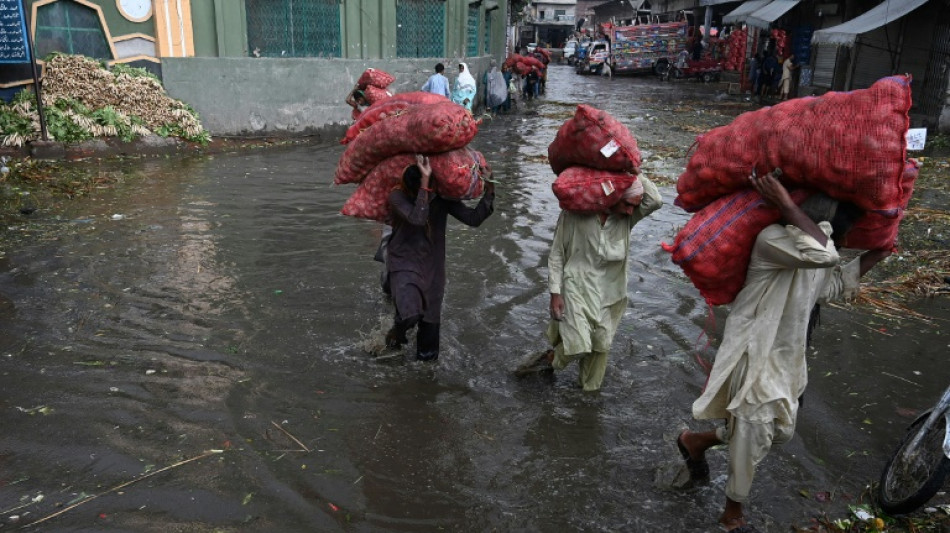
'Third' of Pakistan under water as flood aid efforts gather pace / Photo: Arif ALI - AFP

 Trump's beef policies irk Texas ranchers, testing their loyalty

 Nvidia, OpenAI CEOs to attend Xi dinner at White House

 Anthropic picks Accenture for in-house AI safety evaluation

 Balogun returns as Monaco beat Lens to continue strong Ligue 1 start

 'Pause' on overt repression in Venezuela, but reforms still needed: HRW

 Global stocks mixed as yen falls despite Bank of Japan rate hike

 Cuba hit with seventh major blackout of the year

 Murray out with concussion so Wentz will start for Vikings

 UN chief 'deeply regrets' US visa refusal to Abbas for annual meeting

 England quick Carse to face no charges over alleged nightclub assault

 Mancini brings nine newcomers into the first squad of his Italy comeback

 Czechs level Davis Cup tie against USA as South Korea eye Finals

 New France boss Zidane confirms Mbappe as captain after naming first squad

 California governor signs order to explore AI 'kill switch'

 Head leads run spree as Australia win Zimbabwe ODI series

 In-form Raphinha wants to finish career at Barcelona

 Warren Buffett steps down as Berkshire Hathaway chairman

 Carrick confident Man Utd can 'work through' tough time

 Mbappe ends Nike partnership to join Swiss brand On

 Liverpool boss Iraola puts Bournemouth love affair on hold

 'A disaster' if Man City do not win says Maresca after flawless start

 Kerry James Marshall: American 'blackness' painter celebrated in Europe

 Spain coach De la Fuente offers 'full support' to people of Ceuta

 Russia seizes assets of Nestle, French firms over West's Ukraine support

 England can build on World Cup 'spirit', says Tuchel

Aid efforts ramped up across flooded Pakistan on Tuesday to help tens of millions of people affected by relentless monsoon rains that have submerged a third of the country and claimed more than 1,100 lives.
The rains that began in June have unleashed the worst flooding in more than a decade, washing away swathes of vital crops and damaging or destroying more than a million homes.
Authorities and charities are struggling to accelerate aid delivery to more than 33 million people affected, a challenging task in areas cut off because roads and bridges have been washed away.
In the south and west, dry land is limited, with displaced people crammed on to elevated highways and railroad tracks to escape the flooded plains.
"We don't even have space to cook food. We need help," Rimsha Bibi, a schoolgirl in Dera Ghazi Khan in central Pakistan, told AFP.
Pakistan receives heavy -- often destructive -- rains during its annual monsoon season, which are crucial for agriculture and water supplies.
But such intense downpours have not been seen for three decades.
Pakistani officials have blamed climate change, which is increasing the frequency and intensity of extreme weather around the world.
"To see the devastation on the ground is really mind-boggling," Pakistan's climate change minister Sherry Rehman told AFP.
"When we send in water pumps, they say 'Where do we pump the water?' It's all one big ocean, there's no dry land to pump the water out."
She said "literally a third" of the country was under water, comparing scenes from the disaster to a dystopian movie.
The Indus River, which runs along the length of the South Asian nation, is threatening to burst its banks as torrents of water rush downstream from its tributaries in the north.
The meteorological office says the country as a whole had been deluged with twice the usual monsoon rainfall, but Balochistan and Sindh provinces had seen more than four times the average of the last three decades.
- 'Pakistan is drowning' -
The disaster could not have come at a worse time for Pakistan, where the economy is in free fall.
The government has declared an emergency and appealed for international help.
Aid flights have arrived in recent days from Turkey and the UAE, while other nations including Canada, Australia and Japan have also pledged assistance.
The United Nations has announced it will launch a formal $160 million appeal on Tuesday to fund emergency aid.
Pakistan was already desperate for international support and the floods have compounded the challenge.
Prices of basic goods -- particularly onions, tomatoes and chickpeas -- are soaring as vendors bemoan a lack of supplies from the flooded breadbasket provinces of Sindh and Punjab.
Finance Minister Miftah Ismail has told local media that the disaster could cost upwards of $10 billion, and on Monday said "Pakistan is drowning".
There was some relief on Monday when the International Monetary Fund approved the revival of a loan programme for Pakistan, releasing an initial $1.1 billion.
Makeshift relief camps have sprung up all over Pakistan -- in schools, on motorways and in military bases.
In the northwestern town of Nowshera, a technical college was turned into a shelter for up to 2,500 flood victims.
They sweltered in the summer heat with sporadic food aid and little access to water.
"I never thought that one day we will have to live like this," said 60-year-old Malang Jan.
"We have lost our heaven and are now forced to live a miserable life."
P.Serra--PC



