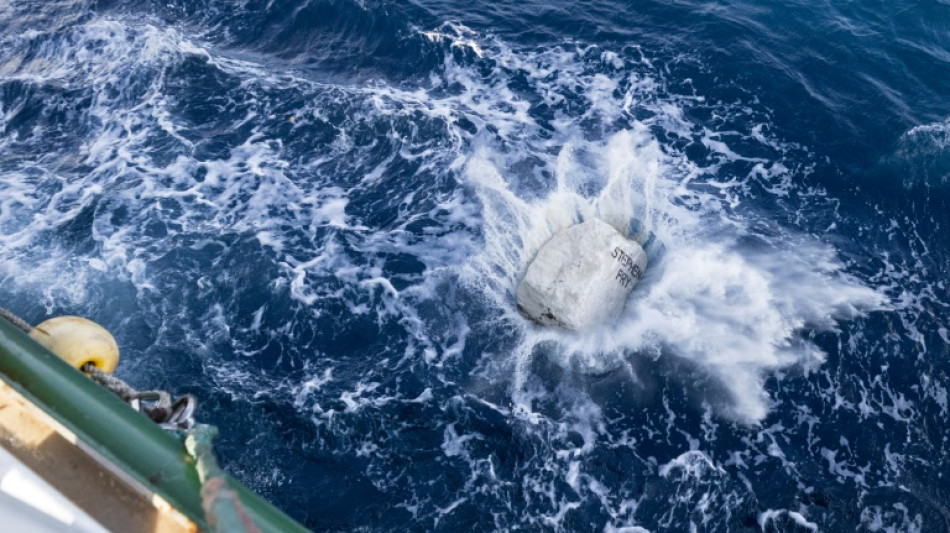
Greenpeace drops boulders on UK seabed to curb bottom-trawling fishing / Photo: Quentin TYBERGHIEN - AFP

 Trump's beef policies irk Texas ranchers, testing their loyalty

 Nvidia, OpenAI CEOs to attend Xi dinner at White House

 Anthropic picks Accenture for in-house AI safety evaluation

 Balogun returns as Monaco beat Lens to continue strong Ligue 1 start

 'Pause' on overt repression in Venezuela, but reforms still needed: HRW

 Global stocks mixed as yen falls despite Bank of Japan rate hike

 Cuba hit with seventh major blackout of the year

 Murray out with concussion so Wentz will start for Vikings

 UN chief 'deeply regrets' US visa refusal to Abbas for annual meeting

 England quick Carse to face no charges over alleged nightclub assault

 Mancini brings nine newcomers into the first squad of his Italy comeback

 Czechs level Davis Cup tie against USA as South Korea eye Finals

 New France boss Zidane confirms Mbappe as captain after naming first squad

 California governor signs order to explore AI 'kill switch'

 Head leads run spree as Australia win Zimbabwe ODI series

 In-form Raphinha wants to finish career at Barcelona

 Warren Buffett steps down as Berkshire Hathaway chairman

 Carrick confident Man Utd can 'work through' tough time

 Mbappe ends Nike partnership to join Swiss brand On

 Liverpool boss Iraola puts Bournemouth love affair on hold

 'A disaster' if Man City do not win says Maresca after flawless start

 Kerry James Marshall: American 'blackness' painter celebrated in Europe

 Spain coach De la Fuente offers 'full support' to people of Ceuta

 Russia seizes assets of Nestle, French firms over West's Ukraine support

 England can build on World Cup 'spirit', says Tuchel

Greenpeace UK said Friday it had dropped 18 large boulders on the seabed in a marine conservation zone off the coast of southwest England to prevent "destructive" industrial fishing.
The environmental campaigners sailed to the western part of the Channel between the UK and France, loaded with the boulders of Portland limestone, each weighing between 500 and 1,400 kilograms (1,100 and 3,100 pounds).
The giant rocks were dropped on Thursday from its Arctic Sunrise research vessel in an area of the South West Deeps (East) Conservation Zone, which lies some 190 kilometres (120 miles) off Land's End, the most westerly point of mainland England.
"We are placing large limestone boulders on the seabed to create a protective underwater barrier which will put the area off limits to destructive fishing," Anna Diski, UK oceans campaigner, told AFP on board.
The action would make it "impossible for them to drag the heavy fishing gear along the seabed, destroying the habitat and disturbing the carbon", she added.
Artists created a giant ammonite sculpture -- inspired by the fossil often found in Portland limestone -- out of one of the boulders, which was also placed on the seabed.
The names of the action's celebrity backers and supportive politicians were also inscribed on the rocks.
"Right now, there's an industrial fishing frenzy happening in UK waters, and what's our government doing about it?" asked Greenpeace UK's head of oceans, Will McCallum.
"Greenpeace UK has created this underwater boulder barrier as a last resort to protect the oceans. We'd much rather the government just did their job."
McCallum said it was "outrageous" that bottom-trawlers are allowed to operate on the seabed in protected areas.
"They destroy huge swathes of the marine ecosystem and make a mockery of our so-called 'protection'," he added.
- 'Get serious!' -
The action comes after the latest round of UN talks to try to secure protection for marine life in international waters broke up without agreement.
Greenpeace said the 4,600-square-kilometre (1,776-square-mile) South West Deeps is "one of the most heavily fished so-called Marine Protected Areas in the UK".
It cited figures from the Global Fishing Watch monitoring agency that said that 110 vessels -- more than half of them from France -- fished for 18,928 hours in area in the 18 months to July.
Of that, industrial vessels with bottom-towed fishing gear spent 3,376 hours fishing in the zone.
Bottom-trawling is only banned in four out of the UK's 76 offshore Marine Protected Areas, and the government is consulting over the possible bans in a further 13.
"The problem is that the majority of the UK's MPAs don't have any actual protection at all," said Jasmine Watkiss, one of those on board the Arctic Sunrise.
"The government needs to get serious about ocean protection before it's too late.
"The next prime minister should ban industrial fishing in all of the UK's Marine Protected Areas by tweaking commercial fishing licences," she added.
Neil Whitney, a fisherman from East Sussex in southern England, said bottom-trawling was "like ploughing a combine harvester through a national park".
"They're able to take out entire ecosystems, and if they cause a fishery to collapse, they just move on to the next one," he added.
"Industrial fishing, like fly-shooters (vessels which tow lead-weighted ropes along the seabed) and supertrawlers (trawlers over 100 metres long), are killing our marine environment, and small-scale UK fishermen like me are losing out big time."
He said it was "absurd" that bottom-trawling was legal in MPAs. "MPAs are supposed to be the areas where fish stocks can recover, so that we fish for generations to come.
"It's a case of common sense."
video-jwp/phz/lth
M.Carneiro--PC



