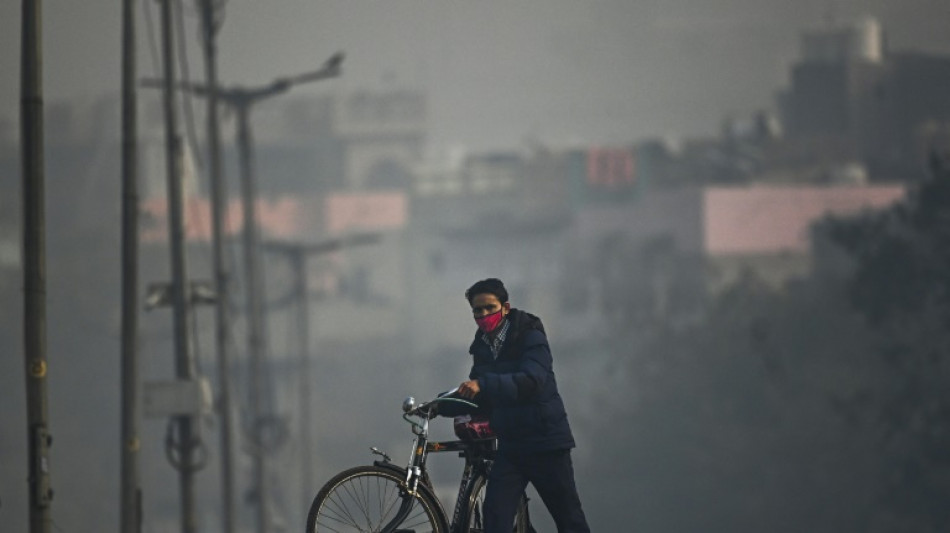
Heatwaves and wildfires to worsen air pollution: UN / Photo: Jewel SAMAD - AFP

 Trump's beef policies irk Texas ranchers, testing their loyalty

 Nvidia, OpenAI CEOs to attend Xi dinner at White House

 Anthropic picks Accenture for in-house AI safety evaluation

 Balogun returns as Monaco beat Lens to continue strong Ligue 1 start

 'Pause' on overt repression in Venezuela, but reforms still needed: HRW

 Global stocks mixed as yen falls despite Bank of Japan rate hike

 Cuba hit with seventh major blackout of the year

 Murray out with concussion so Wentz will start for Vikings

 UN chief 'deeply regrets' US visa refusal to Abbas for annual meeting

 England quick Carse to face no charges over alleged nightclub assault

 Mancini brings nine newcomers into the first squad of his Italy comeback

 Czechs level Davis Cup tie against USA as South Korea eye Finals

 New France boss Zidane confirms Mbappe as captain after naming first squad

 California governor signs order to explore AI 'kill switch'

 Head leads run spree as Australia win Zimbabwe ODI series

 In-form Raphinha wants to finish career at Barcelona

 Warren Buffett steps down as Berkshire Hathaway chairman

 Carrick confident Man Utd can 'work through' tough time

 Mbappe ends Nike partnership to join Swiss brand On

 Liverpool boss Iraola puts Bournemouth love affair on hold

 'A disaster' if Man City do not win says Maresca after flawless start

 Kerry James Marshall: American 'blackness' painter celebrated in Europe

 Spain coach De la Fuente offers 'full support' to people of Ceuta

 Russia seizes assets of Nestle, French firms over West's Ukraine support
 England can build on World Cup 'spirit', says Tuchel

More frequent and intense heatwaves and wildfires driven by climate change are expected to worsen the quality of the air we breathe, harming human health and ecosystems, the UN warned Wednesday.
A new report from the UN's World Meteorological Organization (WMO) cautioned that the interaction between pollution and climate change would impact hundreds of millions of people over the coming century, and urged action to rein in the harm.
The WMO's annual Air Quality and Climate Bulletin examined the impacts of large wildfires across Siberia and western North America in 2021, finding that they produced widespread increases in health hazards, with concentrations in eastern Siberia reaching "levels not observed before".
Tiny particles with a diameter of less than 2.5 micrometres (PM2.5) are considered particularly harmful since they can penetrate deep into the lungs or cardiovascular system.
"As the globe warms, wildfires and associated air pollution are expected to increase, even under a low emissions scenario," WMO chief Petteri Taalas said in a statement.
"In addition to human health impacts, this will also affect ecosystems as air pollutants settle from the atmosphere to Earth's surface."
- 'Foretaste of the future' -
At the global scale, there has been a reduction over the past two decades in the total burned area, as a result of decreasing numbers of fires in savannas and grasslands.
But WMO said that some regions like western North America, the Amazon and Australia were seeing far more fires.
Even beyond wildfires, a hotter climate can drive up pollution and worsen air quality.
Taalas pointed out that severe heatwaves in Europe and China this year, coupled with stable high atmospheric conditions, sunlight and low wind speeds, had been "conducive to high pollution levels," warning that "this is a foretaste of the future."
"We expect a further increase in the frequency, intensity and duration of heatwaves, which could lead to even worse air quality," he said.
This phenomenon is known as the "climate penalty", which refers to how climate change amplifies ground-level ozone production, which negatively impacts air quality.
In the stratosphere, ozone provides important protection from cancer-causing ultraviolet rays, but closer to the ground it is very hazardous for human health.
If emission levels remain high, this climate penalty is expected to account for "a fifth of all surface ozone concentration increase," WMO scientific officer Lorenzo Labrador told reporters.
He warned that most of that increase will happen over Asia, "and there you have about one quarter of the entire world population."
The WMO called for action, stressing that "a worldwide carbon neutrality emissions scenario would limit the future occurrence of extreme ozone air pollution episodes."
The report points out that air quality and climate are interconnected, since chemicals that worsen air quality are normally co-emitted with greenhouse gases.
"Changes in one inevitably cause changes in the other," it said.
L.Torres--PC



