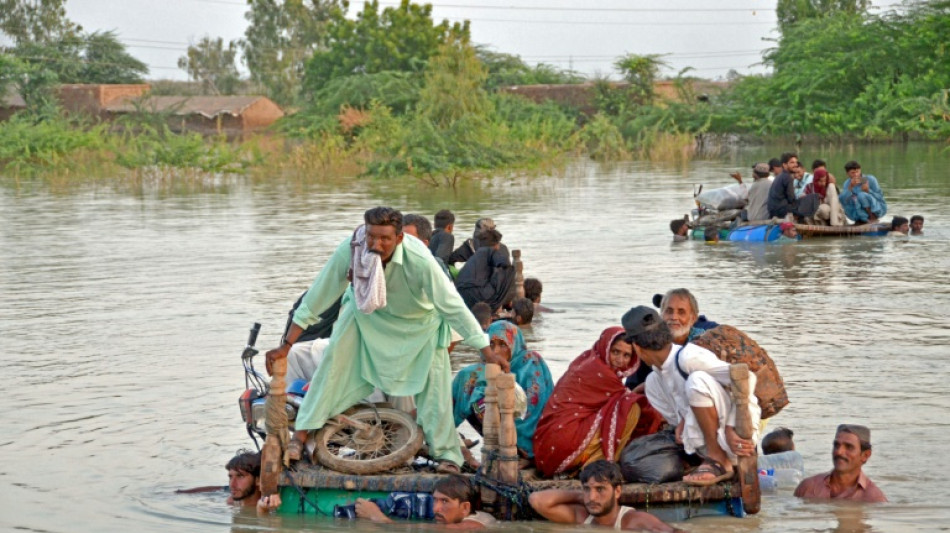
UN chief slams climate change 'insanity' on Pakistan flood visit / Photo: Fida HUSSAIN - AFP

 Drone owners rush to offload devices ahead of Beijing ban

 Trump's beef policies irk Texas ranchers, testing their loyalty

 Nvidia, OpenAI CEOs to attend Xi dinner at White House

 Anthropic picks Accenture for in-house AI safety evaluation

 Balogun returns as Monaco beat Lens to continue strong Ligue 1 start

 'Pause' on overt repression in Venezuela, but reforms still needed: HRW

 Global stocks mixed as yen falls despite Bank of Japan rate hike

 Cuba hit with seventh major blackout of the year

 Murray out with concussion so Wentz will start for Vikings

 UN chief 'deeply regrets' US visa refusal to Abbas for annual meeting

 England quick Carse to face no charges over alleged nightclub assault

 Mancini brings nine newcomers into the first squad of his Italy comeback

 Czechs level Davis Cup tie against USA as South Korea eye Finals

 New France boss Zidane confirms Mbappe as captain after naming first squad

 California governor signs order to explore AI 'kill switch'

 Head leads run spree as Australia win Zimbabwe ODI series

 In-form Raphinha wants to finish career at Barcelona

 Warren Buffett steps down as Berkshire Hathaway chairman

 Carrick confident Man Utd can 'work through' tough time

 Mbappe ends Nike partnership to join Swiss brand On

 Liverpool boss Iraola puts Bournemouth love affair on hold

 'A disaster' if Man City do not win says Maresca after flawless start

 Kerry James Marshall: American 'blackness' painter celebrated in Europe

 Spain coach De la Fuente offers 'full support' to people of Ceuta

 Russia seizes assets of Nestle, French firms over West's Ukraine support

United Nations Secretary General Antonio Guterres called the lack of global attention to climate change "insanity" Friday as he visited Pakistan to mobilise help for millions of people affected by devastating monsoon floods.
Nearly 1,400 people have died in flooding that covers a third of the country -- an area the size of the United Kingdom -- wiping out crops and destroying homes, businesses, roads and bridges.
Pakistan says it will cost at least $10 billion to rebuild and repair -- an impossible sum for the deeply indebted nation -- but the priority is food and shelter for 33 million people affected.
Guterres said he hoped his visit would galvanise international help, noting Pakistan had always shown generosity towards others, hosting millions of refugees for decades from neighbouring Afghanistan at enormous cost.
Pakistan receives heavy -- often destructive -- rains during its annual monsoon season, which are crucial for agriculture and water supplies.
But downpours as intense as this year's have not been seen for decades, and Pakistan officials blame climate change, which is increasing the frequency and intensity of extreme weather around the world.
"This is insanity, this is collective suicide," Guterres told a press conference in the capital, lamenting the lack of attention the world gave to climate change -- particularly the industrialised nations that scientists blame.
Pakistan is responsible for less than one percent of global greenhouse gas emissions, but is eighth on a list compiled by the NGO Germanwatch of countries most vulnerable to extreme weather caused by climate change.
Guterres plans to tour flood-hit parts of the south on Saturday, and also visit Mohenjo-daro, a centuries-old UNESCO-designated world heritage site threatened by the deluge.
- Tents and tarpaulins needed -
"If he comes and sees us, Allah will bless him," Rozina Solangi, a 30-year-old housewife from a flooded village near Sukkur, told AFP Friday.
"All the children, men and women are roasting in this scorching heat. We have nothing to eat, there is no roof on our heads. So he must do something for us poor."
A flood relief plan compiled by the Pakistan government and UN calls for an immediate $160 million in international funding, and aid is already arriving.
On Thursday, a US Air Force C-17 landed -- the first American military plane in Pakistan for years -- bringing desperately needed tents and tarpaulins for temporary shelter.
While Washington is a key supplier of military hardware to Islamabad, relations have been fractious as a result of conflicting interests in neighbouring Afghanistan -- especially since the Taliban returned to power in August last year.
The meteorological office says Pakistan received five times more rain than normal in 2022. Padidan, a small town in Sindh province, has been drenched by more than 1.8 metres (71 inches) since the monsoon began in June.
The effect of the rains has been twofold -- flash floods in rivers in the mountainous north that washed away roads, bridges and buildings in minutes, and a slow accumulation of water in the southern plains that has submerged hundreds of thousands of square kilometres of land.
In Jaffarabad district of Balochistan on Thursday, villagers were fleeing their homes on makeshift rafts made from upturned wooden "charpoy" beds.
With people and livestock cramped together, the camps are ripe for outbreaks of disease, with many cases of mosquito-borne dengue reported, as well as scabies.
T.Batista--PC



