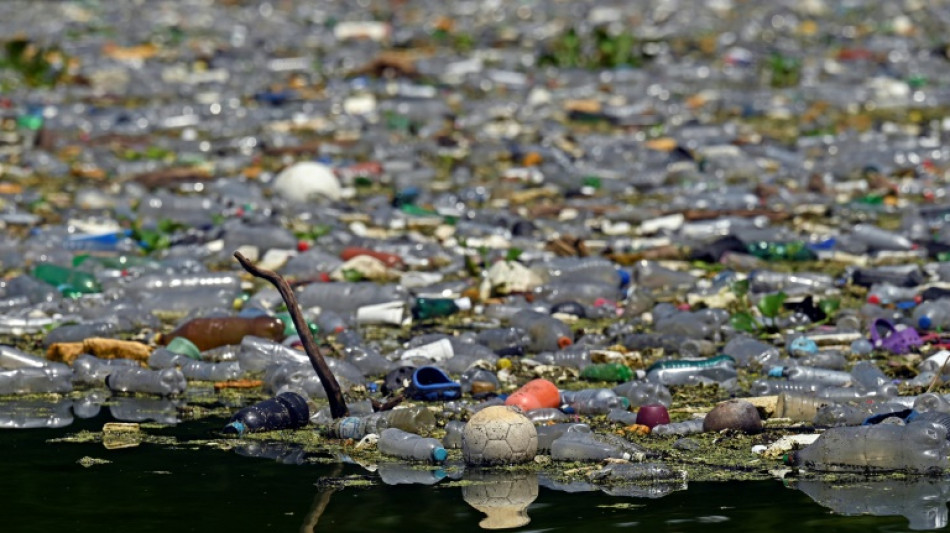
Plastic garbage covers Central American rivers, lakes and beaches / Photo: MARVIN RECINOS, MARVIN RECINOS - AFP

 Drone owners rush to offload devices ahead of Beijing ban

 Trump's beef policies irk Texas ranchers, testing their loyalty

 Nvidia, OpenAI CEOs to attend Xi dinner at White House

 Anthropic picks Accenture for in-house AI safety evaluation

 Balogun returns as Monaco beat Lens to continue strong Ligue 1 start

 'Pause' on overt repression in Venezuela, but reforms still needed: HRW

 Global stocks mixed as yen falls despite Bank of Japan rate hike

 Cuba hit with seventh major blackout of the year

 Murray out with concussion so Wentz will start for Vikings

 UN chief 'deeply regrets' US visa refusal to Abbas for annual meeting

 England quick Carse to face no charges over alleged nightclub assault

 Mancini brings nine newcomers into the first squad of his Italy comeback

 Czechs level Davis Cup tie against USA as South Korea eye Finals

 New France boss Zidane confirms Mbappe as captain after naming first squad

 California governor signs order to explore AI 'kill switch'

 Head leads run spree as Australia win Zimbabwe ODI series

 In-form Raphinha wants to finish career at Barcelona

 Warren Buffett steps down as Berkshire Hathaway chairman

 Carrick confident Man Utd can 'work through' tough time

 Mbappe ends Nike partnership to join Swiss brand On

 Liverpool boss Iraola puts Bournemouth love affair on hold

 'A disaster' if Man City do not win says Maresca after flawless start

 Kerry James Marshall: American 'blackness' painter celebrated in Europe

 Spain coach De la Fuente offers 'full support' to people of Ceuta

 Russia seizes assets of Nestle, French firms over West's Ukraine support

A blanket of multi-colored plastic waste flowing in from tributaries covers Lake Suchitlan in El Salvador.
It is a sorry scene that has also become an all too common sight on the Caribbean beaches of Honduras, where thousands of tons of rubbish arrive from neighboring Guatemala.
Fizzy drink bottles, medication packets, tattered flipflops: all sorts of plastic rubbish can be found floating on 13,500-hectare (52 square mile) Lake Suchitlan, which serves as a reservoir for a power plant and is considered by UNESCO to be a wetland of international importance.
Local fishermen say the pollution forces tilapia and cichlid fish deeper into the artificial lake -- the largest body of freshwater in the country -- where they cannot be reached with fishing nets.
"It has been more than two months since we've been able to fish," angler Luis Penate, 25, told AFP.
To make ends meet he has started ferrying around tourists in a boat owned by another fisherman.
Ducks clear paths through the rubbish, little tortoises climb on top of floating bottles to sunbathe and skinny horses wade into the lake to drink the contaminated water.
This contamination is unprecedented, says Jacinto Tobar, the mayor of Potonico, a small village 100 kilometers north of San Salvador in Chalatenango department.
"The fauna and flora are suffering a lot" and there are ever fewer tourists, he said.
The fishermen must also compete with 1.5 million black cormorants that inhabit the lake, according to Tobar, who says they have become a type of plague since arriving as migratory birds and then staying put.
With a population of 2,500, Potonico is the most affected of 15 riverside villages.
The state body that administers the reservoir employs dozens of workers to clean the lake by hand.
Some locals also help out with the task, which Tobar says will take three to four months to complete.
"What can we hope for in the future if we don't look after our environment, if we soil our streets, rivers, lakes, forests and beaches," said President Nayib Bukele earlier this week at the launch of a "Zero Rubbish" campaign.
Environment minister Fernando Lopez said the country generates 4,200 tons of waste a day, of which 1,200 tons end up in rivers, beaches and streets.
- 'Unable to stop it' -
One of the worst affected areas of the Central American Caribbean coast is the beaches of the Omoa region in Honduras.
It is a beautiful coastline with abundant vegetation and palm trees, some 200 kilometers (120 miles) north of Tegucigalpa.
But in some places the sand is almost entirely covered with plastic waste of all sorts, including syringes.
"This rubbish comes from the Motagua river on the Guatemalan side, they weren't able to stop it," said Candido Flores, 76, a local resident.
"As the river rises, it returns again."
It has created islands of floating waste that have been denounced by local authorities and activists, and has even caused tensions between the two countries.
Every year, some 20,000 tons of plastic waste comes through the Las Vacas river, a tributary of the Motagua, according to The Ocean Cleanup, a Dutch NGO.
Most of that comes from a landfill in the Guatemalan capital.
Environmental activists say the problem must be tackled at its source.
"We must attack where the main flow of rubbish comes from," said Eduardo Arguera, 29, an architecture student at the University of El Salvador, who has launched several clean up campaigns.
To contain plastic waste and prevent it from reaching rivers and lakes, he suggests fencing it in at strategic points.
Ricardo Navarro, president of the Center of Appropriate Technology, says only 30 percent of the waste floats; the rest sinks to the bottom of the bodies of water.
Meaning what is visible, quite literally, is just the tip of the iceberg.
The United Nations Environment Programme says 11 million metric tons of plastic enters the world's oceans every year, and warns that number could triple in the next 20 years.
A.Silveira--PC



