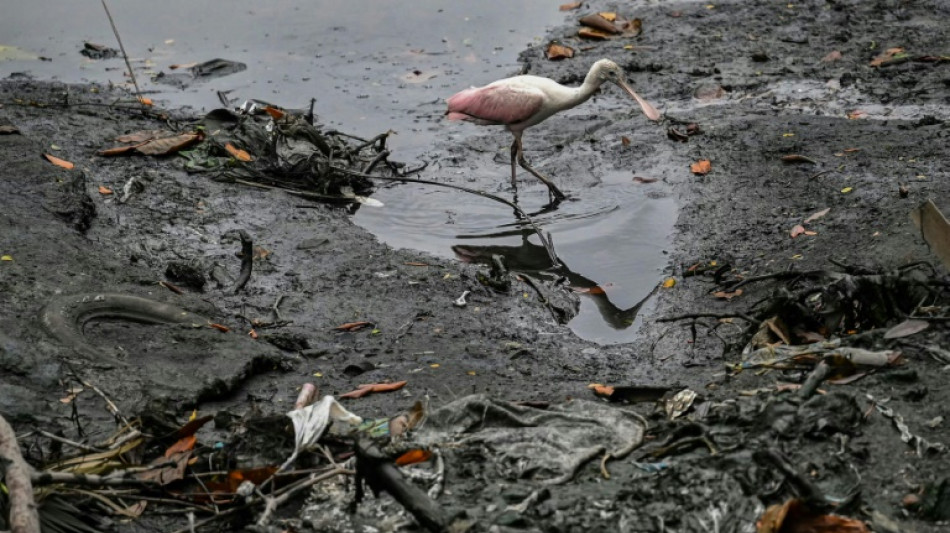
Ecuador launches floating islands to save stinky Guayaquil estuary / Photo: Marcos PIN - AFP

 Drone owners rush to offload devices ahead of Beijing ban

 Trump's beef policies irk Texas ranchers, testing their loyalty

 Nvidia, OpenAI CEOs to attend Xi dinner at White House

 Anthropic picks Accenture for in-house AI safety evaluation

 Balogun returns as Monaco beat Lens to continue strong Ligue 1 start

 'Pause' on overt repression in Venezuela, but reforms still needed: HRW

 Global stocks mixed as yen falls despite Bank of Japan rate hike

 Cuba hit with seventh major blackout of the year

 Murray out with concussion so Wentz will start for Vikings

 UN chief 'deeply regrets' US visa refusal to Abbas for annual meeting

 England quick Carse to face no charges over alleged nightclub assault

 Mancini brings nine newcomers into the first squad of his Italy comeback

 Czechs level Davis Cup tie against USA as South Korea eye Finals

 New France boss Zidane confirms Mbappe as captain after naming first squad

 California governor signs order to explore AI 'kill switch'

 Head leads run spree as Australia win Zimbabwe ODI series

 In-form Raphinha wants to finish career at Barcelona

 Warren Buffett steps down as Berkshire Hathaway chairman

 Carrick confident Man Utd can 'work through' tough time

 Mbappe ends Nike partnership to join Swiss brand On

 Liverpool boss Iraola puts Bournemouth love affair on hold

 'A disaster' if Man City do not win says Maresca after flawless start

 Kerry James Marshall: American 'blackness' painter celebrated in Europe

 Spain coach De la Fuente offers 'full support' to people of Ceuta

 Russia seizes assets of Nestle, French firms over West's Ukraine support

On the banks of the dark and murky waters of the Guayaquil estuary, volunteers trudge through mud as they slide wooden platforms.
Onboard are crucial seedlings that could save the 70-kilometer (44 mile)-long polluted artery outside Ecuador's main port city.
Environmental engineer Angela Cevallos is leading efforts to save the estuary with these "floating islands," which are embedded with red mangrove seedlings.
The plant is known for its long roots which can absorb pollutants while helping establish an aquatic ecosystem, allowing other plants and animals to thrive.
"These islands are the transportation mode and the propagules (seedlings) do the work," said Cevallos, who leads the project run by Holy Spirit University, her alma mater.
For decades, tons of rubbish, excrement and heavy metals have been dumped into the water around Guayaquil -- home to 2.8 million people.
But despite several previous conservation efforts and millions of dollars of investment, the estuary continues to be threatened by pollution.
"Guayaquil has grown at the feet of this estuary and we cannot let it die," said architect Patricio Rosero, who designed the biodegradable wooden platforms.
Volunteers carry the two-meter long platforms on their backs one by one to the water's edge.
Ten platforms are tied together using rope made from banana skins.
Wearing a long-sleeve shirt and white boots, Cevallos, 23, wades into the green mud to slowly push the platforms into place.
Each "island" is stuffed with 23 red mangrove seedlings, which within four months should form thin trunks.
"The mangrove is a noble habitat, it can be regenerated and absorb pollutants," said Cevallos.
"I will come back to test the water to see if there is less pollution."
- 1,000 times the authorized contamination -
Half a century ago, fishermen would catch snook and corvina in the estuary, while children would frolic in its natural pools.
"My father took my three siblings and myself to Puerto Liza and there he taught us to swim. The water was crystal clear and fresh," reminisced 75-year-old Lucenia Haro, a retired school teacher.
But then large scale building began, sparked by politicians seeking to win new voters.
Entire neighborhoods were built at breakneck speed, but without a connected sewage system.
Even today, the pipes that transport sewage empty directly into the estuary, where 300,000 people live along the coast, many in extreme poverty.
Between May 2019 and July 2022, almost 35,000 tons of rubbish were collected from the estuary, according to figures from the Guayaquil mayoral office.
The largest source of pollution is sewage.
"Secret connections have been closed and redirected to the sewage system," said Maria Fernanda Rumbea, head of the local environment body.
According to Cevallos's analysis, in the area where the floating islands have been placed, there is 1,000 times the authorized amount of coliform bacteria, which lives in feces and can contaminate water.
- Conservation efforts -
It is not the first time such platforms have been sent into the estuary.
In 2014, the environment ministry installed some metal platforms but they failed due to a lack of maintenance.
Earlier this year, the Higher Polytechnic School of the Coast launched an initiative to reforest the estuary with marine algae.
"We want to know whether the algae can improve the mangroves' germination rate," said Edwin Jimenez, a researcher at the university.
The Guayaquil municipality is implementing its own conservation project as well, starting with the construction of its sewage treatment plant, according to Rumbea.
When the night falls and the tide goes out, the smell is nauseating.
And yet the estuary and its vegetation continue to resist the contamination. It remains the only drainage system for rain water, thus preventing potentially catastrophic flooding during the country's rainy season.
"If it wasn't for the estuary and its smelly trees, dozens of homes and buildings would have disappeared some time ago," said Jimenez.
Nogueira--PC



