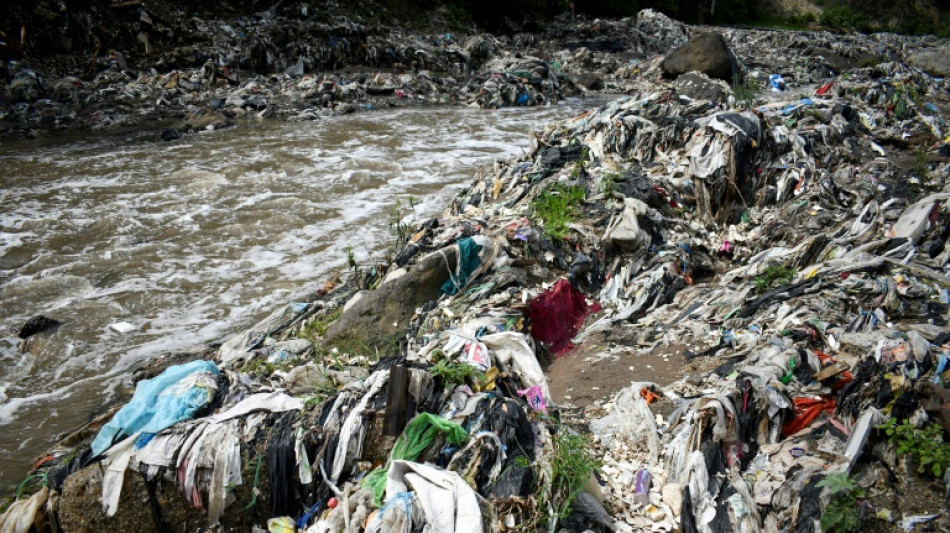
Plastic gobbling enzymes in worm spit may help ease pollution / Photo: Johan ORDONEZ - AFP/File

 Drone owners rush to offload devices ahead of Beijing ban

 Trump's beef policies irk Texas ranchers, testing their loyalty

 Nvidia, OpenAI CEOs to attend Xi dinner at White House

 Anthropic picks Accenture for in-house AI safety evaluation

 Balogun returns as Monaco beat Lens to continue strong Ligue 1 start

 'Pause' on overt repression in Venezuela, but reforms still needed: HRW

 Global stocks mixed as yen falls despite Bank of Japan rate hike

 Cuba hit with seventh major blackout of the year

 Murray out with concussion so Wentz will start for Vikings

 UN chief 'deeply regrets' US visa refusal to Abbas for annual meeting

 England quick Carse to face no charges over alleged nightclub assault

 Mancini brings nine newcomers into the first squad of his Italy comeback

 Czechs level Davis Cup tie against USA as South Korea eye Finals

 New France boss Zidane confirms Mbappe as captain after naming first squad

 California governor signs order to explore AI 'kill switch'

 Head leads run spree as Australia win Zimbabwe ODI series

 In-form Raphinha wants to finish career at Barcelona

 Warren Buffett steps down as Berkshire Hathaway chairman

 Carrick confident Man Utd can 'work through' tough time

 Mbappe ends Nike partnership to join Swiss brand On

 Liverpool boss Iraola puts Bournemouth love affair on hold

 'A disaster' if Man City do not win says Maresca after flawless start

 Kerry James Marshall: American 'blackness' painter celebrated in Europe

 Spain coach De la Fuente offers 'full support' to people of Ceuta

 Russia seizes assets of Nestle, French firms over West's Ukraine support

Enzymes found in the saliva of wax worms can degrade one of the most common forms of plastic waste, according to research published Tuesday that could open up new ways of dealing with plastic pollution.
Humans produce some 400 million tonnes of plastic waste each year despite international drives to reduce single-use plastics and to increase recycling.
Around a third is polyethylene, a tough plastic thanks to its structure, which traditionally requires heating or radiation before it starts to break down.
There have been several studies showing that microorganisms can release enzymes that start the degradation process on polyethylene, but the process has until now taken months each time.
But those contained in the saliva the wax worm moth (Galleria mellonella) can act in only a few hours, Tuesday's research showed.
Researcher Federica Bertocchini, an avid beekeeper, said she originally stumbled on the idea that this small caterpillar had unusual powers when storing honeycombs a few years ago.
"At the end of the season, usually beekeepers put some empty beehives in a storage room, to put them back in the field in the spring," she told AFP.
"One year I did that, and I found my stored honeycombs plagued with wax worms. In fact, that is their habitat."
Bertocchini cleaned the honeycombs and put the worms in a plastic bag.
When she returned a short time later she found the bag "riddled with holes".
- Poured over plastics -
"That raised the question: is it the result of munching or there is a chemical modification? We checked that, doing proper lab experiments, and we found that the polyethylene had been oxidised," she told AFP.
In her latest research Bertocchini, from Madrid's Margarita Salas Centre for Biological Studies (CIB) and her colleagues analysed proteins in the wax worm saliva and identified two enzymes that could break polyethylene down into small polymers in only a few hours at room temperature.
Writing in the journal Nature Communications they explained how they used another worm's saliva as a control experiment, which produced no degradation compared with the wax worm.
Bertocchini said her team were still trying to figure out precisely how the worms degraded the plastic.
While the study authors stressed that much more research was needed before Tuesday's findings could be implemented at any meaningful scale, there were a number of possible applications.
"We can imagine a scenario where these enzymes are used in an aqueous solution, and litres of this solution is poured over piles of collected plastic in a waste management facility," said Bertocchini, who said her team were still trying to figure out precisely how the worms degraded the plastic.
"We can also imagine small amounts that can reach more remote locations, like villages or small islands, where waste facilities are not available."
She said that further down the line the solution could be used in individual houses, where each family could degrade their own plastic waste.
O.Gaspar--PC



